
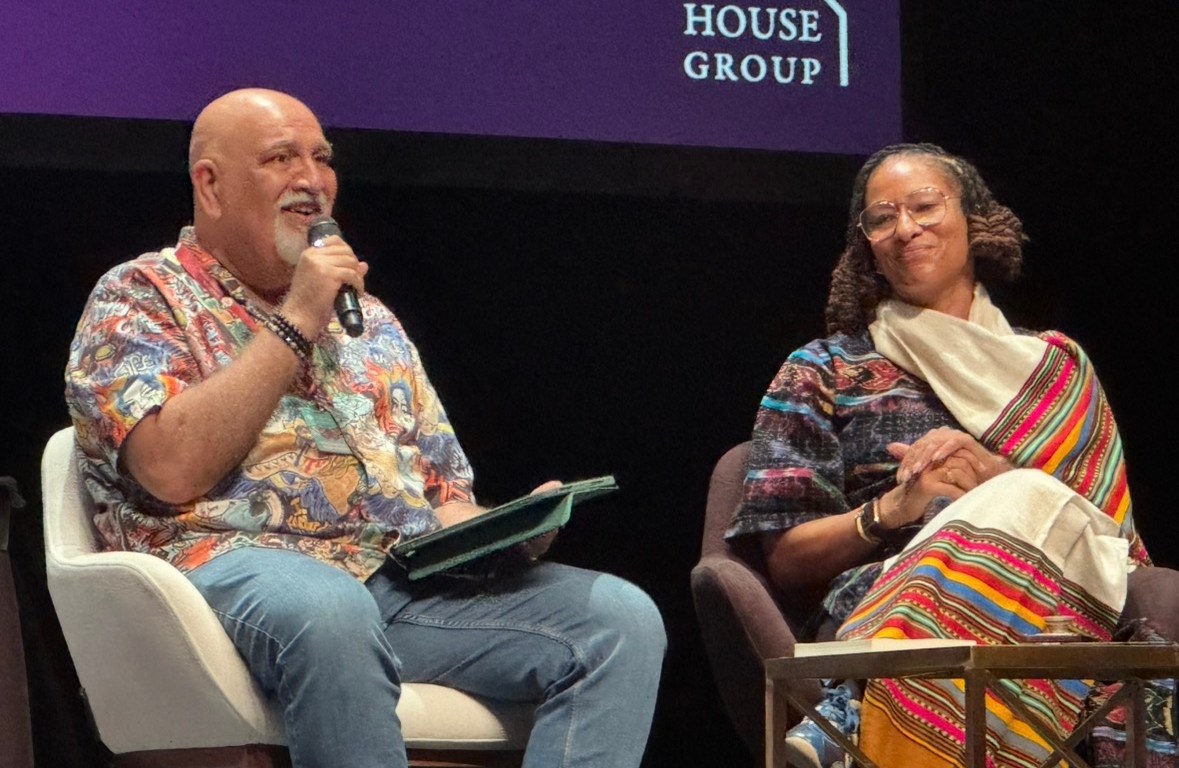
At her Singapore Writers Festival keynote, the Princeton sociologist challenged the mythology of technological progress, arguing that a more just future will depend not on smarter machines, but on our willingness to question power, reclaim imagination and act together.
What if the future we are being promised is not, in fact, a future we would want to live in? It is a question that runs through Ruha Benjamin’s work, and one she brought forcefully to the final day of the 2026 Singapore Writers Festival in her keynote, CTRL + ALT + RETHINK. The renowned sociologist, Princeton professor and founding director of the Ida B. Wells Just Data Lab invited her audience to look beyond the familiar fantasies and fears surrounding artificial intelligence, and examine the assumptions, interests and inequalities concealed beneath the language of technological progress.
Her argument was not that technology is inherently good or bad, nor that the future is already determined by machines. It was that we have been encouraged to misunderstand where technological power resides, and, in doing so, to surrender our own capacity to shape what comes next. “AI is not doing anything alone,” she insisted. “The people and companies behind the screen are.”
It was a deceptively simple proposition, but one with far-reaching implications. If technology is not an independent force moving history forward, then its consequences are neither inevitable nor beyond human intervention. The question becomes not simply what artificial intelligence can do, but who is building it, whose interests it serves, whose lives it affects and who gets to decide what progress should mean. For Benjamin, the most important question is therefore also the most fundamental: Who owns the future?
Benjamin began by placing the discussion within a longer history of Black intellectual and activist thought. She invoked the sociologist and historian W.E.B. Du Bois, the anti-lynching journalist Ida B. Wells-Barnett and Martin Luther King Jr., whose warnings about the relationship between technology, profit and human dignity remain strikingly relevant. More than 60 years ago, King spoke at Stanford University about what he called the “giant triplets” of racism, extreme materialism and militarism. He warned that when machines and computers, profit motives and property rights are considered more important than people, these forces cannot be overcome.
The setting was significant. Stanford sits in what has become the heart of Silicon Valley, a place now synonymous with technological ambition and the promise of a transformed future. Benjamin suggested that King’s warning should be heard as a challenge to the values underpinning that ambition. The Black intellectual tradition, she argued, offers more than a record of resistance. It provides ways of questioning what society has come to regard as normal, and of imagining alternatives to systems that present themselves as natural or inevitable.
One of her guiding references was writer Toni Cade Bambara’s observation that “not all speed is movement”. Benjamin applied the idea to the relentless technological race to create bigger, faster and more sophisticated systems. In the pursuit of speed, she suggested, we often fail to ask essential questions. Which communities have been consulted? Whose knowledge has been overlooked? What social conditions are being reproduced? And who bears the cost of innovation? “Any conversation about technology can’t start with the technology,” she said. “It has to start with the society and its inputs.”
She illustrated the point with the controversy surrounding the use of algorithms to predict students’ examination grades in the United Kingdom during the Covid-19 pandemic. When students were unable to sit their A-level examinations, the government turned to an algorithm to estimate their results. The system produced lower predictions for many students from working-class and more diverse schools than for their wealthier counterparts. One protest sign captured the injustice in a single sentence: “Our grades should not equal our postcode.”
For Benjamin, the problem was not that an algorithm had somehow invented inequality. It had reflected and reproduced inequalities already embedded in society, including the uneven geography of opportunity, school resources and social class. The technology had not escaped the prejudices of the world in which it was built. It had inherited them.
Benjamin’s critique extended beyond the systems themselves to the language used to describe them. She argued that society needs to unlearn several deeply established assumptions, beginning with the idea of intelligence. In an era fascinated by artificial intelligence, intelligence is increasingly understood as speed, calculation, cleverness and the ability to process enormous quantities of information. But Benjamin questioned what is lost when intelligence is separated from empathy, ethics and an understanding of other people.
She pointed to the eugenic history of IQ testing and the hierarchies through which societies have judged whose minds are considered valuable, whose abilities are recognised and whose lives are treated as disposable. The same scrutiny, she argued, should be applied to the word innovation. It is often used as though technological advancement were automatically synonymous with social progress. History tells a more troubling story.
Scientific and technological achievements have repeatedly been built through the exploitation of marginalised people: from the brutal gynaecological experiments performed on enslaved Black women to the extraction of minerals such as cobalt from communities in the Democratic Republic of the Congo. “So-called innovation has too often required exploitation,” she said. “So inequity isn’t an accidental byproduct of progress. It’s been one of its key ingredients.”
This is why Benjamin is sceptical of narratives that portray technology as a self-propelling force, destined either to save humanity or destroy it. Both the dystopian vision of machines taking over the world and the utopian promise that automated systems will solve our problems place technology in the driver’s seat. aThey differ in their predictions, but share the same underlying assumption: that technology acts upon us, while the human beings making decisions behind it disappear from view.
Pull back the screen, Benjamin suggested, and a different picture emerges: a small concentration of powerful people imposing their vision on the rest of society. And then she gave this group a pointed name: the “artificial intelligentsia”.
The term was characteristic of her approach, intellectually serious, but alive to the absurdities of the moment. It also underscored her central argument: the apparent autonomy of AI can serve the interests of those developing and deploying it. If we believe that machines are independently making decisions, we may be less inclined to hold their human creators accountable.
Benjamin urged the audience to become what she called “bullshit detectors”, borrowing from philosopher Harry Frankfurt’s account of speech intended to persuade without regard for truth. In an age of automated systems, she argued, we should be particularly alert to claims that statistical calculation is equivalent to insight, or that computational sophistication necessarily amounts to a deep understanding of the world. “Computational depth without social and historical depth really ain’t that deep,” she said.
It was one of the keynote’s most pointed lines. A system may process vast quantities of data and still be profoundly ignorant of the people and circumstances it is supposed to serve. The harms associated with predictive policing, discriminatory hiring algorithms and automated decisions about access to healthcare are not simply technical failures. They reflect the shallow social understanding of those who design systems for complex human realities.
Benjamin’s argument was grounded not only in scholarship but also in personal experience. During the question-and-answer session, she spoke about moving with her family to the Marshall Islands when she was 15. The islands had been the site of extensive American nuclear testing in the 1940s and 1950s, with more than 60 tests conducted across the atolls. She travelled to communities where people continued to experience the consequences of radiation exposure, including children born with health effects. At the same time, her entertainment came from boxes of her father’s Star Trek tapes. She became a devoted fan, absorbing its vision of a more hopeful, expansive future while living among the consequences of a very real historical catastrophe.
The contrast became even more vivid when she travelled between two neighbouring islands. One, associated with a US military base, appeared almost idyllic, with manicured lawns and golf courses. The other, Ebeye, where much of the displaced population lived, was severely overcrowded and under-resourced. Here were two realities existing side by side: one resembling a futuristic utopia, the other bearing the costs of the system that sustained it. “These aren’t parallel universes,” she observed. “One requires the other.”
The experience helped shape her understanding of the relationship between technology, power and inequality. What is presented as progress for one group may depend on the dispossession or suffering of another. A vision of the future cannot be considered just if its comforts are secured by making other people bear its costs.
It was a perspective she brought to her discussion of contemporary AI, from the often invisible labour of data workers and content moderators to the environmental demands of data centres and the extraction of materials required for digital infrastructure.
She also drew attention to the use of automated systems in policing, healthcare, employment and immigration enforcement, as well as the deployment of so-called smart weapons in warfare. These examples, she argued, should prevent us from treating AI as an abstract technological development detached from its political and material consequences. Her purpose, she stressed, was not to leave the audience in despair, but to make clear why different visions of the future are necessary.
The alternative begins, in Benjamin’s view, with rethinking power itself. She questioned the conventional understanding of power as domination, hierarchy and the ability to control others. It is a narrow conception, she suggested, that encourages people to desire power over others rather than power with them. The distinction opens up a different vocabulary: horizontal relationships, mutual support, solidarity and collective action.“What about love?” she asked. “As the most powerful technology there is.”
Benjamin suggested that love is itself a threat to systems built around competition and domination. It is often diminished, sentimentalised, commercialised or dismissed as something soft and private, rather than recognised as a force with political and social consequences. Her argument was not simply that people should be kinder. It was that our understanding of human nature has been shaped by a particular cultural story: that people are fundamentally selfish, competitive and driven by scarcity.
That story, she said, requires us to ignore the countless examples of people showing up for one another, offering mutual aid and making sacrifices for the common good. If we accept the belief that selfishness is inevitable, we risk making it a self-fulfilling prophecy. Imagination, then, becomes more than the ability to dream up something new. It is the capacity to challenge the stories that determine what we believe is possible.
Benjamin described imagination as a form of “cultural coding”: the scripts through which we understand the world and our place within it. Those scripts shape everything from our expectations of technology to our ideas about education, economics and human relationships. To change the future, we must first change the assumptions through which we see it.
One of the keynote’s most memorable moments came when Benjamin invited the audience to take part in a simple exercise. She divided the room into two sides. One was asked to shout out ambitious, seemingly extravagant visions of the future. The other was instructed to respond with the weary scepticism of a bored teenager, treating each proposal as unrealistic.
The suggestions ranged from space travel and colonising Mars to free public transport, decolonising the Earth and cancelling student debt. The contrast was revealing. “Boldness is rationed,” Benjamin observed, “while realism is mass produced.”
The exercise exposed what she sees as a profound imbalance in contemporary ideas of progress. Technological futurists are encouraged to imagine extraordinary advances in space travel, artificial intelligence and digital infrastructure. Yet when it comes to transforming social conditions – providing housing, healthcare, education and a decent life for everyone – ambition suddenly becomes constrained by what is supposedly realistic.
The imagination of those who hold power is allowed to roam freely when it comes to technological and commercial possibilities. It becomes remarkably cautious when asked to imagine a more equitable society.
Benjamin argued that we need to cultivate both critical and creative insight: the ability to identify the harms embedded in existing systems, while also imagining alternatives. It is not enough to name the world we cannot live with. We must also be able to describe the world we cannot live without.
She offered several examples of what this might look like in practice. One was the White Collar Crime Early Warning System, developed by technologist and artist Sam Lavigne. Rather than using predictive technology to map so-called street crime, the project reverses the direction of surveillance. It uses images of corporate executives to create a heat map identifying areas where financial crimes are likely to occur, drawing attention to forms of wrongdoing that are often treated very differently from offences associated with poorer communities.
The project was an example of how familiar technological methods can be repurposed to expose inequalities rather than reinforce them. Another example was the Phoenix of Gaza XR initiative, developed by Palestinian technologists, scholars and storytellers. Using 360-degree imagery captured before and after the recent devastation, the project allows people to move through virtual representations of Gaza and encounter its homes, neighbourhoods, cultural spaces and everyday life.
Benjamin described the images of children playing, a teenager reciting poetry and elderly women gathered in a sewing circle. The project preserves more than physical structures: it documents the cultural and human life of a place, while imagining a future beyond the destruction that has threatened to erase it. Technology, in this instance, becomes a means of remembering and rebuilding rather than targeting and destroying.
Taken together, these projects demonstrated the kind of future Benjamin wants people to consider: one in which technological imagination is joined to social responsibility, and critique is accompanied by the practical work of creating alternatives.
Education was another central concern, and one that emerged with particular force in the keynote. Benjamin spoke as both a professor and a mother of two sons in their mid-twenties, close in age to many of her students. She feels a profound responsibility towards the generations who will inherit the world being shaped today.
Her obligation, she explained, is not simply to prepare young people to function within existing systems, becoming “skilled cogs in a machine designed to serve the interests of a small sliver of humanity”. It is to encourage them to question those systems and imagine how they might be transformed.
She cited a study of divergent thinking – the ability to see beyond an immediate problem and conceive multiple possible solutions – which followed children over time. The research, she said, suggested a striking decline in measured creative capacity as children grew older. The broader point was not that creativity can be reduced to a single test, but that the structures of education can steadily narrow the very capacities they should nurture.
Benjamin questioned the assumption that excellent education must involve greater rigidity, standardisation and pressure. She argued instead for taking play seriously as a form of learning, one that supports collaboration, communication, experimentation and the ability to navigate conflict.
In the Q&A, she recalled being taken out of class once a week as a child to attend a gifted-and-talented programme. In her fourth-grade understanding, she was simply being allowed to play. It was only later that she recognised the value of that experience.
She pointed to Finland as one example of a different educational philosophy, with a greater emphasis on play and less reliance on standardised testing. She also recommended her book Imagination: A Manifesto, which explores how imagination can be cultivated as a shared resource, and the free online Imagination Playbook, developed with a scholar of play.
The resource offers exercises designed to bring people out of their seats and into more active, embodied forms of learning. As Benjamin put it, “We don’t think from the neck up.” Learning, she suggested, should involve our bodies, our relationships and our capacity to interact with one another, not simply our engagement with screens and systems.
An audience member raised an important tension in Benjamin’s position: how does one argue for a more just society while working at Princeton, one of the most elite universities in the United States? Benjamin welcomed the question. She had attended a historically Black college as an undergraduate and a public university for graduate school, but argued that there is no simple position outside the system. Even public universities increasingly depend on private funding and corporate partnerships.
Her reason for joining Princeton, she explained, was not the prestige of the institution but the opportunity to work in Black Studies. Within the larger university, she and her colleagues have sought to build a space that directs institutional resources towards wider communities.
The Ida B. Wells Just Data Lab, which she founded, is one example. It works with community organisations and uses the resources available through Princeton to support projects concerned with data and justice. The important question, she said, is not simply where one is positioned, but who one is in service to. “I’m not in service to the university,” she explained. “My peer review are the communities that I collaborate with, not other academics.”
It was a useful qualification to her argument. Working within an institution does not necessarily mean accepting its priorities, just as working in the technology industry does not automatically mean endorsing everything the industry does. She pointed to organising among technology workers who are challenging harmful practices from within their own companies, and encouraged young people considering a career in the industry to read Ruined by Design before entering the workplace.
She also resisted the idea that individual ethical choices, while worthwhile, could solve structural problems. Choosing different apps or reducing one’s reliance on large technology companies may matter, but it cannot replace collective action to hold powerful organisations accountable.
Drawing an analogy with the climate crisis, she noted that individual efforts to consume more ethically cannot compensate for the actions of major polluters. The same principle applies to technology. Her emphasis was on organising: supporting campaigns, working across borders and joining collective efforts to challenge harmful systems. She mentioned initiatives against environmentally damaging data centres and the Resist AI resource list as possible starting points.
The task is not to perfect one’s personal relationship with technology while leaving its larger structures untouched. It is to work with others to change those structures.
Perhaps the most affecting exchange came when an audience member asked how Benjamin sustained her hope in the face of the problems she described. How did she manage the emotional weight of studying these systems without becoming overwhelmed by dread?
Her answer returned to teaching and to the importance of action. Working with young people, she said, forces her to think beyond criticism. She had been trained to analyse what was wrong, but teaching requires her to consider what might be done differently.
For those who are not educators, she offered another recommendation: get out of your head and into action. “Hope is not something that you feel,” she said. “It’s something that you practice through engaging.”
She also described a personal practice of historical imagination. When the present feels immovable, she mentally travels back to earlier periods when oppressive systems seemed equally permanent: the height of colonialism, slavery and other forms of domination.
She thinks of her ancestors and of the people who, in those circumstances, still found the courage to resist. They may not have known whether they would see the end of the system in their lifetimes. But they acted because they refused to accept that it was natural or permanent.
Benjamin channels what she called their stubborn insistence that things could be different. The task is not necessarily to witness the complete transformation of society within one’s own lifetime, but to contribute to the conditions that will make it possible for future generations. This, she suggested, is also why we must think beyond simply dismantling existing institutions. If a system is already collapsing, there must be people prepared to imagine what should replace it. It is not enough to stand in the rubble and declare the old structures broken. We need to know what we want to build next.
Benjamin ended with a question that brought the keynote’s many strands together: “What kind of ancestor do you want to be?”
When future generations look back on the early decades of the 21st century, what will they find? A society distracted, divided and apathetic in the face of injustice and ecological collapse? Or evidence that people recognised their interdependence and did everything they could to ensure that those who came after them would not merely survive, but flourish?
It was a fitting conclusion to a talk that had begun with the need to rethink technology and arrived at something much larger: a reconsideration of what it means to be human, to live together and to take responsibility for the future.
The question also offers a way of understanding Benjamin’s intellectual project. Her work does not stop at exposing the biases and injustices embedded in systems of technology. It asks what forms of knowledge, solidarity and imagination might help us create something better.
During the Q&A, she was also asked about the use of generative AI in the images accompanying her work. She revealed that the original cover of Imagination: A Manifesto had been created using generative AI without her knowledge. After artists challenged the use of an image built from work they had not consented to have appropriated, she asked her publisher to change it. She described the wider practice of taking artists’ work without consent or compensation as “the largest heist in human history”.
The episode brought her argument into sharp focus. Even the most well-intentioned projects can reproduce the very practices they seek to challenge. Rethinking requires more than declaring the right principles; it requires a willingness to examine one’s own decisions, acknowledge mistakes and change course.
Ultimately, Benjamin’s keynote was not an appeal to abandon technology, nor a nostalgic call to return to a simpler past. It was a demand to reclaim the power to decide what technology is for, and to whom it should answer. Her challenge was directed as much at writers, educators and artists as at engineers and policymakers. Stories shape the limits of what societies can imagine. If the future is left to those who can conceive of extraordinary technological possibilities but cannot imagine a more equitable world, then our collective horizons will remain narrow.
The task is to widen them: to question what has been presented as inevitable, to recover the histories that dominant narratives leave out, and to practise imagining a world organised around mutual care rather than domination.
The future, Benjamin reminded her audience, is not simply something that happens to us. It is something we make.
Singapore Writers Festival 2026: Hidden In Plain Sight ran from 13th to 22nd November 2026. More information available here.

