
Singapore Repertory Theatre elevates Jonatahn Spector’s raucous comedy about people who don’t know how to listen to new heights.
Duration: 135 minutes including a 15 minute intermission
Opening with the familiar, deceptively warm lyrics to “The More We Get Together”, Eureka Day proves to be anything but, as the comedy gives way to something considerably less harmonious. In Singapore Repertory Theatre’s production of Jonathan Spector’s Eureka Day, directed by Daniel Jenkins, a group of parents and school-board members set out to do what they believe is best for their community. The trouble is that they cannot quite agree on what that means.
Set in a progressive elementary school in Berkeley, California, the play follows five members of its executive committee as they navigate a growing public-health crisis. Their school prides itself on inclusivity, openness and consensus, with every decision supposedly reached through discussion and mutual understanding. But when a mumps outbreak forces the committee to confront its vaccination policy, those ideals are put under pressure. What begins as an attempt to find common ground gradually exposes the competing convictions, insecurities and personal interests beneath the school’s carefully cultivated image of harmony.
Spector’s writing is particularly sharp in its understanding of how seemingly reasonable people can become unreasonable when their beliefs are challenged. The play is not simply about vaccination, nor does it ask the audience to treat established medical facts as matters of opinion. Rather, it examines the ways people argue, the assumptions they bring into a conversation and the ease with which the desire to be inclusive can turn into a reluctance to confront difficult truths. It is a timely subject, made all the more striking by the fact that the play was commissioned and first staged in 2018, before the Covid-19 pandemic gave such debates an even more immediate resonance.

Jenkins approaches the material with a keen eye for detail, allowing the characters’ personalities to emerge not only through dialogue but through their physical behaviour. The committee meetings are full of small, telling gestures: a glance held a moment too long, a pause before someone speaks, or the quiet discomfort of a person who would rather not challenge the room. These details give the production texture and help distinguish the characters in a play that is, by necessity, heavily dialogue-driven.
The cast handles the rapid exchanges with impressive clarity and comic precision. Shane Mardjuki’s Eli has the assured manner of someone accustomed to believing he knows best. His confidence can be persuasive, but there is an underlying self-absorption that becomes increasingly apparent. Coco Wang Ling’s Meiko, meanwhile, is more reserved. Often occupied with her knitting during meetings, she initially seems content to keep her thoughts to herself. Yet Wang Ling makes the character’s restraint quietly compelling; the moments when Meiko finally allows her frustrations to surface carry considerable force precisely because she has held back for so long.
Julie Wee gives Suzanne a formidable presence. Status-conscious and articulate, Suzanne is someone who knows how to occupy a room and is rarely short of an opinion. Wee avoids reducing her to a simple antagonist, however, revealing the anxieties and vulnerabilities beneath her certainty. Her performance is especially effective when the play briefly moves away from the committee’s increasingly combative exchanges and allows Suzanne to be seen in a more personal light.

Munah Bagharib’s Carina provides an important counterpoint. As the newest member of the committee, she is eager to contribute but initially cautious about disrupting an established group dynamic. Bagharib captures the tension between wanting to belong and wanting to be heard, making Carina’s gradual willingness to speak up one of the production’s more satisfying developments. Benjamin Chow’s Don, the committee’s facilitator, is equally well observed. He tries to maintain order through rituals of calm and carefully managed discussion, but his desire to keep everyone happy often leaves him reluctant to make the decisions the situation demands.
Together, the performers create a convincing ensemble. Their chemistry is evident in the way conversations overlap, alliances shift and tensions register in their faces even when they remain silent. The comedy is not dependent on exaggerated performances or broad caricature. Instead, it comes from recognition: the familiar experience of sitting through a meeting in which everyone claims to be listening, while waiting impatiently for their own turn to speak.
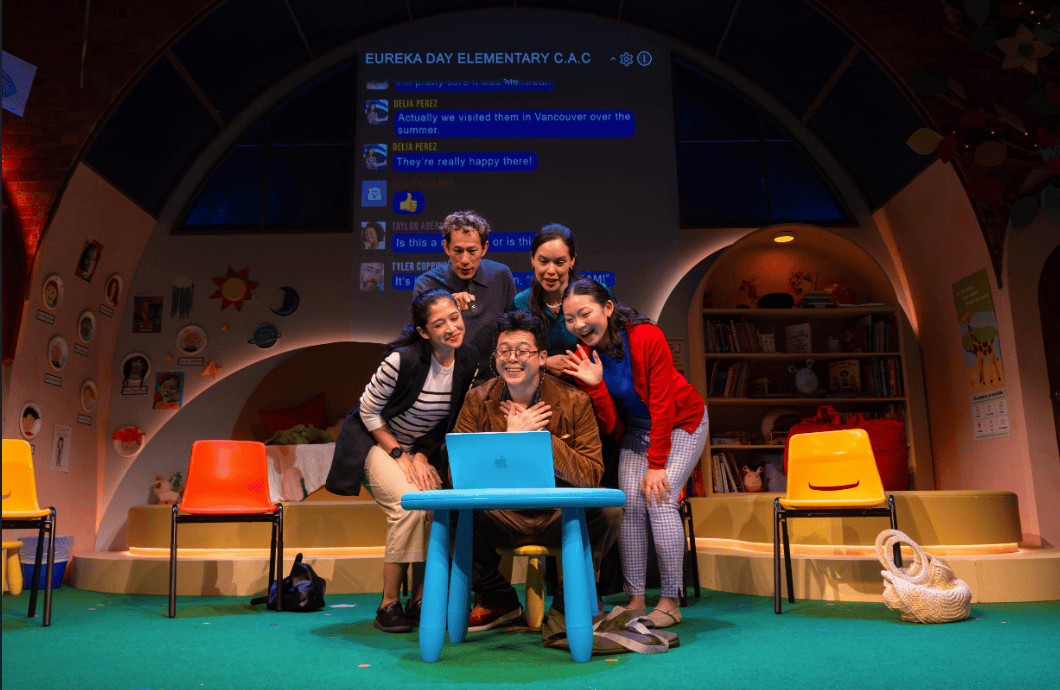
One of the production’s most inventive sequences is the school’s livestream, in which the committee’s discussion opens out into a stream of online comments. Opinions, advice and competing claims appear as the conversation becomes increasingly difficult to control. The device gives the audience a sense of the noise and confusion that can gather around a contentious issue, while making the digital world feel like an active presence in the room rather than a mere backdrop. It is both funny and uncomfortable to watch the committee struggle to manage a discussion that has taken on a life of its own.

The setting is one of the production’s greatest strengths. Petrina Dawn Tan’s set places the action firmly within an elementary school, with bookshelves, notices and welcoming messages scattered around the space. There are reminders that all feelings are welcome, invitations to visit the library and other affirmations of the school’s commitment to creating an inclusive environment. These details might seem like simple touches of school décor, but they become quietly ironic as the story unfolds. Here is a place where children are supposed to learn how to listen, respect differences and grow into considerate members of society. Yet the five adults entrusted with guiding this community repeatedly struggle to do just that. Their inability to listen to one another is all the more striking when played out in a space that is meant to embody the very values they claim to uphold.
The fact that this is a private school adds another layer to the contrast. It is an environment that appears to offer children something better, more considered and more progressive. But the adults’ behaviour raises an uncomfortable question: what are the children learning from the people who are supposed to know better? Tan’s set does more than establish a convincing school environment; it quietly reinforces the play’s central tension between the ideals a community displays and the way its members actually behave.
The production’s technical elements are similarly assured. James Tan’s lighting transitions subtly between different times of day, marking the passage of time without interrupting the flow of the action. Daniel Wong’s sound design and Sharin Zulkinia’s multimedia work help maintain the rhythm of the piece, particularly during the livestream sequence. The use of everyday objects and small physical actions also contributes to the comedy, giving the audience brief moments to absorb what has happened before the next exchange begins.
For all its humour, Eureka Day is not content to let its characters remain easy targets. Its most affecting moments come when the arguments briefly give way to glimpses of the people behind them. Wee’s Suzanne, in particular, is afforded a moment of vulnerability that complicates the audience’s view of her. It does not necessarily make her views more convincing, but it makes her more human. This is an important distinction, and one that reflects the play’s refusal to divide its characters neatly into heroes and villains.

That refusal is also what makes the production’s treatment of consensus so effective. The committee’s commitment to hearing everyone sounds admirable in principle, but the play asks what happens when the process itself becomes an obstacle to making a decision. Who gets to speak? Who is interrupted? Whose discomfort is accommodated, and whose concerns are quietly set aside? The characters are so intent on preserving a sense of community that they struggle to recognise when their version of inclusion has begun to exclude someone else.
There is a pointed lesson here, not just for parents or school committees, but for anyone who has sat in a workplace meeting, family discussion or online exchange where the appearance of agreement matters more than genuine understanding. The play’s Berkeley setting may be specific, but its social dynamics are familiar. Its characters are not unusual because they hold strong opinions; they are recognisable because they are so convinced of their own good intentions.
The final moments bring the play’s central questions into sharp focus. Another school year begins, and a new parent, Winter (Natalie Titus), is welcomed into the committee. The room has changed: even the books on the shelves reflect a new arrangement, with Suzanne’s donations no longer there. There is a sense that the school has moved forward and that a fresh start is possible. But when Winter suddenly coughs, the room falls still. The others turn to look at her, and the silence that follows is loaded with recognition. Has the cycle begun again? Jenkins handles this final beat with admirable restraint, allowing the audience to sit with the uncertainty before the blackout. It is a clever, unsettling conclusion that suggests how little it may take for old fears and familiar divisions to resurface.

Spector’s script is funny because it recognises the absurdity of people talking past one another, but its humour is never merely a punchline. Under Jenkins’ assured direction, the cast finds the humanity in the conflict, while the production’s thoughtful staging keeps the action lively and engaging. More importantly, it leaves the audience with something to consider beyond the laughter: whether being willing to listen is enough, if we have already decided that we are right.
Eureka Day is an accomplished, sharply observed production that balances comedy with genuine emotional and intellectual bite. Its five-star achievement lies not simply in how well it entertains, but in how skilfully it turns a room full of people arguing over a school policy into a mirror for the ways we behave with one another. It is the kind of theatre that sends its audience out still talking — and, one hopes, a little more willing to listen.
Photo Credit: Singapore Repertory Theatre
Eureka Day plays from 18th November to 6th December 2026 at the KC Arts Centre. Tickets available here
Production Credits
| Playwright Jonathan Spector Director Daniel Jenkins Cast Coco Wang Ling, Shane Mardjuki, Julie Wee, Benjamin Chow, Munah Bagharib, Natalie Titus Set Designer Petrina Dawn Tan Costume Designer Angeline Oei Lighting Designer James Tan Sound Designer Daniel Wong Multimedia Designer Sharin Zulkinia |

