
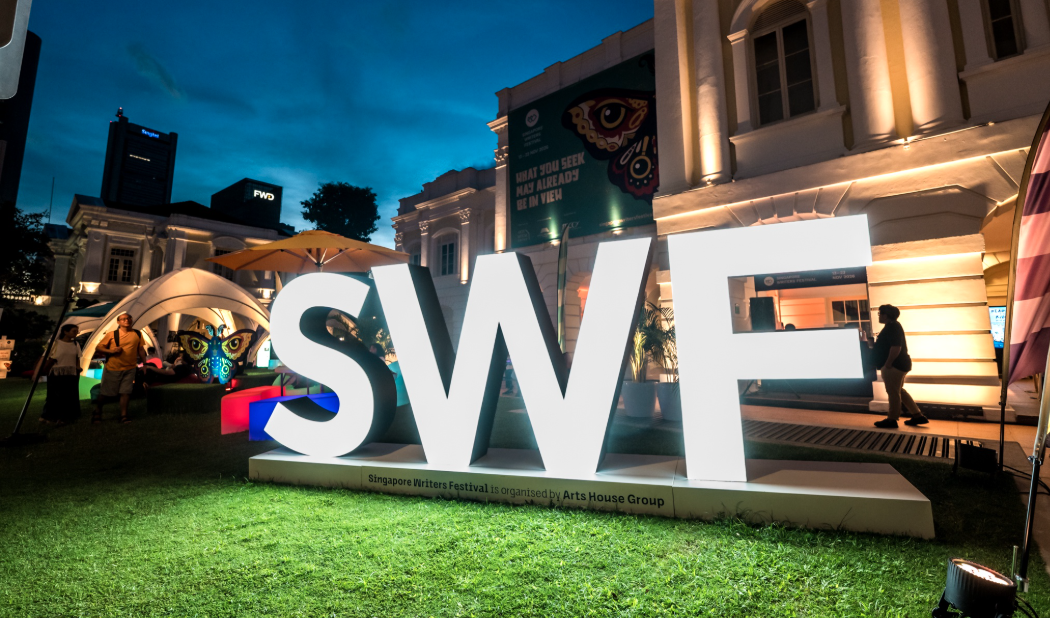
For ten days in November, Singapore became a meeting place for stories from around the world. The 29th edition of the Singapore Writers Festival (SWF), which concluded on 22 November, brought together close to 80,000 Festivalgoers for conversations, readings, workshops and experiences that explored the many ways literature helps us understand ourselves and the world around us.
Centred on the theme Hidden in Plain Sight, this year’s Festival invited audiences to look beyond the familiar, uncover overlooked narratives and question the assumptions that shape how we see the world. Across more than 240 programmes and over 20 venues, more than 400 local and international writers, moderators and speakers offered fresh perspectives on everything from family histories and migration to technology, identity, crime and the environment.
The enthusiasm was evident in the numbers. Festival Passes sold out for the second consecutive year, despite an increase in availability, while more than half of all ticketed programmes were fully booked. For readers, aspiring writers and the simply curious, SWF once again offered plenty of reasons to step into a conversation.

Some of the Festival’s most anticipated encounters brought audiences face to face with writers and thinkers whose work challenges the way we understand the world.
Award-winning novelist Amitav Ghosh drew a full house for his Festival Keynote, examining the narratives surrounding environmental grief and planetary collapse. He returned to the stage alongside Jemimah Wei and Balli Kaur Jaswal for What The Family Doesn’t Say, a conversation about family secrets, migration and the silences that can stretch across generations.
The response extended beyond the auditorium. Ghosh’s book-signing sessions drew lengthy queues, with readers waiting patiently for the chance to meet the author. Reflecting on his visit, he said: “But the best part was the enthusiasm and warmth of the audiences. After one of my events, I was signing for almost an hour and a half, and I was told that the queue was so long that it extended beyond the theatre.”
Elsewhere, sociologist and MacArthur Fellow Ruha Benjamin invited audiences to consider the hidden biases embedded in digital technologies, while author Stephen Witt unpacked Nvidia’s rise and the questions surrounding the future of artificial intelligence. Silvia Moreno-Garcia explored truth, deception and authenticity in writing, adding to a programme that moved between literature, technology and contemporary social concerns.
For readers drawn to darker narratives, the new Crime and Mystery Spotlight offered a different kind of literary adventure. Discussions led by authors including Seo Mi-ae, Faridah Àbíké-Íyímídé, Robin Stevens, Louise Hegarty and Ovidia Yu explored criminal psychology, literary mysteries and the craft of suspense. Audiences could also try their hand at mystery-writing masterclasses, investigate forensic storytelling in How 2: Solve a Bad Case of Poisoning, or take part in the sold-out tabletop role-playing programme Accuse You, Excuse Me.

One of SWF’s defining qualities is its celebration of Singapore’s multilingual literary landscape, bringing English, Chinese, Malay and Tamil voices into conversation. This year, Chinese, Malay and Tamil programmes increased by 15%, creating more opportunities for audiences to encounter different literary traditions and perspectives. The Festival also expanded its accessibility efforts, with programmes supported by live interpretation and AI-assisted translation tools increasing by more than 70%.
The conversations crossed languages, generations and cultural experiences. In Reading (and Writing) Between the Lines, poets Lutfi Ishak, Hartinah Ahmad and Samsudin Said considered how poetry can hold private longing, national memory and defiance within the ordinary. A Song That Has Shaped A Generation: Singapore and Taipei brought media personality Yu Neng together with Taiwanese writer-broadcaster Ma Shih-fang to explore youth and identity through the songs that have shaped generations.
Tamil-language programme நிலமும் நிலம் சேர்ந்த நாமும் We, and the Lands We Reach turned to the relationship between people and place, with writers Sayanthan and Latha reflecting on life after war and the ways landscapes shape personal histories.
Beyond the stage, the Festival also found ways to bring literature into everyday public spaces. Undercurrents, an installation by Malaysian artist Tang Yau Hoong and Singaporean illustrator Quek Hong Shin, transformed the Funan Underground Pedestrian Link into a space for encountering visual storytelling. Literary trails invited participants to uncover the architectural and cinematic histories of Singapore, while a gathering at West Coast Park brought audiences together with Orang Laut and Orang Pulau community members for coastal stories and a shared meal.


Not every Festival experience required a seat in an auditorium. Some of the most distinctive encounters happened in unexpected settings, where conversations unfolded over food, art and the pleasure of spending time with a good book.
The Salon series was a particular draw, with sold-out sessions at venues including Capella Singapore, Aman Gallery, COMO Cuisine and Kotuwa. The intimate format brought audiences closer to writers such as Booker Prize-shortlisted author Tan Twan Eng, Pulitzer Prize-winning illustrator and writer Tessa Hulls, poet Pooja Nansi and novelist Jemimah Wei. Against the backdrop of thoughtfully curated venues and dining experiences, these sessions offered a more personal way to engage with writers and their work.
For those looking for a quieter pause between programmes, the inaugural Reading by the River invited Festivalgoers to settle in with a book and enjoy the surroundings of the Singapore River. At Victoria Theatre, the Charles & Keith Connects Reading Room provided another welcoming retreat, with comfortable seating and a curated selection of books to browse between sessions.
The Festival also extended its reach through a 20% increase in in-conjunction programmes, opening up more opportunities for audiences to encounter literature beyond its main venues.

Young readers and emerging creatives had their own spaces to explore at SWF 2026. SWF Playground and the youth-led Youth Fringe brought together younger audiences with writers and creators including Josh Silver, Jessica Townsend and Rachel Smythe, creator of Lore Olympus.
Through workshops, live illustration battles and youth-curated conversations, participants explored everything from satire and writing to the portrayal of mental health in fiction. The programme encouraged young audiences not only to discover stories, but to experiment with creating their own.
The Festival’s mystery-writing challenge, The Ending Is Yours, took this invitation into schools. The open call received 537 submissions from 46 schools, asking students to devise their own endings to a story. Shortlisted entries were showcased in an exhibition, while the accompanying public voting campaign, The Verdict Is Yours, attracted more than 1,300 votes.
It was another reminder that a literary festival is not only a place to meet established authors, but also a space where new voices can begin to find their audience.

Behind the packed programmes was a wider community of supporters helping to sustain Singapore’s literary ecosystem. SWF 2026 welcomed a record number of individual donors and corporate sponsors, including Shaw Foundation, Lo and Behold Group, Moleskine, Fullerton Hotel Singapore and Singapore Airlines.
The Festival’s Leading Patron, Charles & Keith Group Foundation, supported the participation of women writers and presented the Charles & Keith Connects Reading Room at Victoria Theatre. The space offered Festivalgoers somewhere to browse, discover new reads and connect with fellow book lovers.
For Festival Director Yong Shu Hoong, this year’s response was especially meaningful as it marked the end of his tenure. “It has been heartening to see new and returning audiences come to the Festival with curiosity, enthusiasm and an openness to perspectives beyond their own,” he said. He added: “Over the years, I have seen how stories and the power of words can bring people together, spark unexpected conversations and help us see the familiar differently.”
His departure marks a transition for the Festival, which will welcome back Yeow Kai Chai as Festival Director for its milestone 30th edition in 2027.

Although the Festival has ended, some of its experiences will continue to reach audiences in the months ahead.
This year’s SWF Homage celebrated Singapore’s literary translators and their role in bringing local writing across languages and to wider audiences. Its interactive recording booth received more than 2,000 audio recordings from Festivalgoers. The exhibition will travel to Sembawang Public Library from 1 to 28 December 2026, followed by Bukit Batok Public Library from 29 December 2026 to 31 January 2027.
Selected programmes will also be made available through SWF Digital, while SWF Encounters will bring the Festival’s conversations and literary experiences to audiences throughout the year. The Golden Point Award is set to return in 2027, with details of its submission call to be announced in due course.

The next chapter is already taking shape. The Singapore Writers Festival will return from 12 to 21 November 2027 for its 30th edition, under the theme Make It New! and the direction of Yeow Kai Chai.
The milestone edition will celebrate Singapore’s literary landscape while looking towards new ideas, perspectives and forms of storytelling. Coinciding with ASEAN’s 60th anniversary during Singapore’s chairmanship year, it will also place a spotlight on regional voices, cross-cultural exchange and new possibilities for literary collaboration.
After ten days of discovering new writers, revisiting familiar stories and encountering ideas from beyond our usual perspectives, the Festival leaves audiences with a reminder of what literature can do: connect people, open up conversations and help us see what has been there all along.
Photo Credit: Moonrise Studio, courtesy of Arts House Limited
Singapore Writers Festival 2026: Hidden In Plain Sight ran from 13th to 22nd November 2026. For updates on the 2027 edition, visit the website here.

