
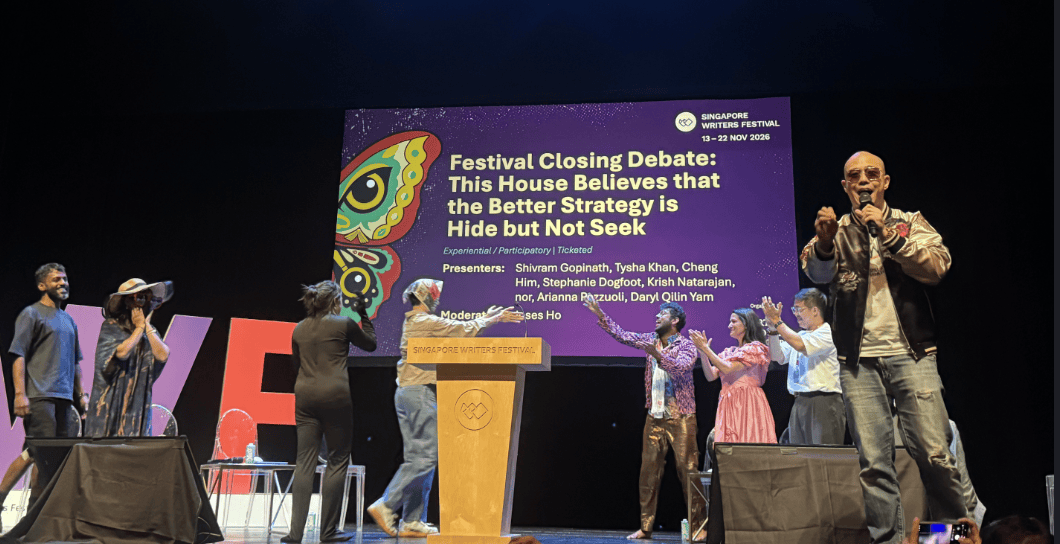
Can a PowerPoint presentation persuade Singaporeans to become more coquettish? Should an award-winning actress hide from the paparazzi? And what might happen when a debate about hiding and seeking becomes an evening of theatrical disguises, unexpected arguments and a little bit of mischief?
At the Singapore Writers Festival 2026 Closing Debate, the proposition and opposition went head-to-head over the motion, with a line-up of writers, poets and performers making their cases in styles as varied as their arguments. Moderated by Joses Ho, the debate moved between sharp social commentary, personal storytelling, Shakespearean flourishes, questionable statistics and outright absurdity.
The audience laughed often, sometimes at the ingenuity of an argument and sometimes at the sheer unexpectedness of where it was going. There was also a pleasing sense of perplexity: the speakers were not always interested in making things straightforward, and the audience was happy to follow them into the twists and turns.

Opening for the proposition and dressed ‘incognito’ in Singapore’s ‘national costume’ of a UNIQLO Airism tee, poet and spoken-word performer Shivram Gopinath began with the familiar mechanics of childhood hide-and-seek. The seeker has to stand with their eyes closed, count, then do all the work of searching, while the hiders get to remain tucked away, quietly watching the seeker make a fool of themselves.
It was a playful way into a more serious argument. Shivram questioned whether seeking was necessarily virtuous in a world where information, public narratives and even the things we believe we have discovered can be manufactured for profit. Algorithms, echo chambers and corporate spin, he argued, mean that what we seek and find may simply be an illusion designed to lead us somewhere.
He also challenged the assumption that hiding is cowardly. The powerful have long understood the value of concealment, whether through secrecy, institutional protection or control over information. Why, then, should ordinary people be expected to make themselves constantly visible?
For Shivram, the chronic seeker risks becoming intrusive: always digging, probing and demanding access, even to things that might be better left alone. He drew a line between curiosity and the destructive impulse to uncover everything, invoking the larger consequences of human ambition and the relentless drive to know more.
His speech also took aim at the promise of progress. We seek the elite school, only to find ourselves trapped in tuition; we pursue the dream job, then spend our weekends trying to recover from it. Life, he suggested, has been optimised to the point of structural madness. Instead of constantly chasing the next discovery or waiting for permission to speak in the spotlight, perhaps we should learn to live and speak from the shadows.
His final rallying cry was to be a little more clandestine, a memorable refrain that would return later in the debate.

The opposition’s first speaker, multidisciplinary artist and community worker nor, began by inviting the audience to close their eyes and take three deep breaths together. After this brief guided exercise, nor welcomed everyone back: it was safe to come out. The opening was gentle and disarming, but it set up a pointed challenge to the proposition. Hiding can be a strategy, nor argued, but it is important to ask who gets to choose it and who is being hidden by someone else.
Drawing on their work as a community worker at Project X, which provides social, emotional and health services to people in the sex industry, nor spoke about the ways marginalised communities are often denied control over their own stories. They described the making of The Missing Anthology: Stories from Singapore’s Sex Workers, a collection of poems, essays and artworks by sex workers seeking to reclaim their narratives from mainstream accounts that can be dehumanising or sensationalised.
nor also spoke about SQ21: Singapore Queer Families in the 21st Century, which brings the lives and stories of queer families into view. Through these projects, they made the case that visibility can be an act of agency: when people are able to tell their own stories, they can challenge the stigma and assumptions that have kept them out of public view.
Their speech was one of the debate’s most thoughtful interventions. It complicated the simple opposition between hiding and seeking by asking whose interests concealment serves. There is a difference between choosing privacy for oneself and having one’s identity, experience or community erased by others.
nor’s closing question “Are you hiding or are you being hidden?” brought that distinction into sharp focus.

The proposition’s second speaker, actor and writer Tysha Khan, took a decidedly different approach. Appearing in a sun hat, oversized heart-shaped glasses and a mask, she introduced herself in character as a newly minted award-winning actress overwhelmed by the attention that came with fame.
Her performance was a comic portrait of celebrity excess and exhaustion. Suddenly, everyone wanted a piece of Tysha: filmmakers wanted her in their projects, journalists wanted interviews, and strangers wanted to know everything about her. Before she became famous, nobody had paid her much attention; now, she could barely get a moment to herself.
Tysha turned this into a case for hiding as a way of protecting one’s time, privacy and autonomy. If people wanted to work with Sasha, they could make the effort to find her, send a handwritten letter or contact her manager. She was no longer going to answer every phone call or email.
Beneath the exaggerated celebrity persona was a more recognisable point about entitlement and boundaries. Public curiosity can become invasive, and the pursuit of visibility can have consequences, particularly for women in the public eye. There was also the question of whether people were interested in the person herself, or merely her success, money and public image.
Tysha’s character was so committed to her own importance that even the act of explaining why she wanted to be left alone became a performance. The audience was treated to a stream of complaints, celebrity anxieties and declarations of exhaustion, all delivered with wonderfully exaggerated conviction.
Her argument eventually extended beyond fame: sometimes, she suggested, the better strategy is not to chase what you want, but to decide who gets access to you and let the things meant for you find their way to your door.

Opposition speaker Cheng Him, author of Boh Beh Zhao, brought the debate back to the practicalities of survival, albeit through a series of increasingly absurdly violent examples. Known for his love of numbers, he opened by giving the audience the number 634, asking them to remember it. He then presented a scenario: imagine being trapped in a strange building with a serial killer on the loose. Would you hide, or would you seek the best escape route?
Cheng Him’s speech played with the idea that hiding does not necessarily make a problem disappear. If someone insults you, calls you stupid or kicks you, retreating does not mean they will stop. You may still be left with the hurt, while the person causing it carries on regardless. His comic refrain was that sometimes, rather than hiding from an uncomfortable situation, you have to show up and face it.
He returned repeatedly to the serial-killer scenario, puncturing the audience’s assumptions about what a sensible response might be. The speech was delivered in a conversational, deliberately meandering style, with audience participation and playful exchanges helping to build its comic rhythm.
The number 634 also became part of his larger joke about the venue’s capacity and the power of numbers. By multiplying the people in the room, Cheng Him turned the audience itself into part of his argument: confronted with a threat, there is strength in coming together rather than remaining isolated.
His speech was less a conventional case laid out in neat steps than a comic exercise in pushing the proposition’s logic into increasingly ridiculous territory. The audience was invited to play along, and the humour lay as much in the journey as in the destination.

If Cheng Him relied on numbers and audience participation, proposition speaker Daryl Qilin Yam arrived with something else: a PowerPoint presentation and a national movement. The author and Sing Lit Station co-founder made the case that Singaporeans should become more coquettish. His presentation turned the idea into a mock-serious programme for social transformation, complete with advice on identifying one’s target and cultivating an air of mystery.
Rather than pursuing people too eagerly, Daryl suggested, one should learn to become the person being pursued. The audience was walked through ways of making oneself more intriguing and approachable without appearing too available, a playful approach to attraction that he presented as having implications far beyond romance.
The presentation’s deadpan confidence was part of the joke. Daryl treated coquettishness as though it were a serious national strategy, complete with practical lessons that could supposedly transform how Singaporeans relate to one another, mentioning examples as far flung as the Prime Minister’s wife to how ‘chor lor’ we’ll end up otherwise.
It was a comic highlight, not least because the PowerPoint gave his argument the appearance of a workshop or policy proposal. Beneath the absurdity, however, was a familiar proposition: perhaps we do not always need to chase, explain ourselves or make ourselves immediately available. There can be power in leaving a little room for curiosity.

Opposition speaker Arianna Pozzuoli, an educator, author, storyteller and poet making her sixth appearance in the SWF Closing Debate, opened with a Shakespearean flourish: “Hiding, hiding. Wherefore art thou hiding?”
Her speech took the form of an extended, playful soliloquy, imagining all the possible reasons someone might retreat from the world. Perhaps it was a nosy relative, an awkward encounter with an ex, the haze, social media algorithms or the threat of artificial intelligence. But, she argued, life is made up of experiences that cannot be had from behind closed doors.
Arianna championed the pleasures of curiosity and discovery: running through the rain, getting lost in unfamiliar streets, walking long distances and stumbling upon unexpected kindness. Hiding, she suggested, can mean sticking to a script written by fear. Seeking, by contrast, is a willingness to be surprised by what happens next.
She also made a case for the value of seekers throughout history, pointing to discoveries and inventions that have expanded human life. The speech took several delightfully unexpected turns, moving from penicillin and electricity to haemorrhoid cream, baby shark and Ricola.
Bringing the argument back to the Festival, Arianna suggested that writers and readers were seekers by nature. Writers must be willing to fail, explore and take risks; stories can help people imagine lives beyond the roles imposed on them. She invoked Romeo and Juliet to argue that the tragedy might have been avoided had the families not hidden behind pride and old grudges.
For Arianna, seeking was ultimately about more than personal adventure. It could build empathy, justice and community. Her energetic, theatrical delivery made the speech feel like an invitation to step beyond one’s comfort zone and participate more fully in the world.

After the prepared speeches, the audience had its turn to question the debaters. This became one of the evening’s most entertaining stretches.
The speakers remained firmly in character, finding inventive ways to sidestep questions, turn them around or subvert the premise behind them. Rather than simply answering, they often treated each question as another opportunity to extend their performances and keep their arguments alive.
The audience was very much part of the exchange. Questions prompted fresh comic detours, and the speakers’ willingness to play along made the session feel less like a formal question-and-answer segment than another round of the debate itself.

The opposition’s final speaker, actor, writer and director Krish Natarajan, brought the evening towards a more impassioned conclusion. He picked up on the arguments that had emerged throughout the debate, particularly the distinction between choosing to hide and being hidden by others. Hiding, he suggested, can mean retreating from one’s potential, one’s identity or the possibility of connecting with other people. It can also mean allowing someone else to dictate what one is permitted to see or become.
Krish urged the audience to seek, experience and confront the uncomfortable parts of life rather than retreat into a false sense of safety. He returned to the abandoned-house-and-serial-killer scenario, turning it around to suggest that the threat might be one of our own making — something that can only be understood by stepping out of hiding.
In one particularly playful moment, he produced a series of apparently authoritative statistics to support the case for seeking. He then revealed that they were all fake, pointing out that the audience had accepted them without checking. It was a pointed demonstration of the very argument he was making: if we do not seek verification, we risk surrendering our judgement to whatever information is placed before us.
The speech then became a direct appeal to the room. Looking around at an audience of writers, artists and advocates, Krish questioned how a gathering so committed to truth and change could seriously argue for hiding. He revisited the work and biographies of the other debaters, using their creative practices as evidence of the importance of seeking stories, visibility, connection and truth.
His conclusion was powerful and rousing: artists and citizens have a responsibility to look beyond what is given to them, to question, to connect and to seek a better world. The opposition had put up a strong fight throughout the evening, and Krish’s speech brought its case to an emphatic finish. It was powerful enough to make him a serious contender for Best Speaker.

The final speaker of the night was proposition debater Stephanie Dogfoot, who made an entrance in an all-black morphsuit. The visual joke was immediate: she was there to argue for hiding, and had quite literally concealed herself.
Stephanie began by suggesting that a speaker’s appearance should not matter in a debate; the audience should judge the words, not the person delivering them. In the morphsuit, she was a blank canvas who could be anyone, a celebrity, a public figure or even someone else entirely. If seeing is believing, she argued, hiding can free the imagination.
As a performance poet, Stephanie made the case for concealment through the craft of writing itself. Poetry, she suggested, depends on what is left unsaid. Metaphor and implication allow readers to bring their own memories and emotions to a poem, making meaning for themselves. The principle of “show, don’t tell” is an invitation to trust the reader rather than spell everything out.
She extended the argument to the proposition team, pointing out that several of its members were poets who understood the value of subtlety and ambiguity. In her telling, hiding was not simply about retreating from the world; it was also about respecting the intelligence and imagination of others.
Stephanie then turned her attention to the opposition’s speeches, teasing nor’s guided breathing exercise, Cheng Him’s serial-killer scenario and Arianna’s Shakespearean performance. She also took aim at Krish’s dramatic reading of the debaters’ biographies, questioning whether the opposition had been seeking attention while making its case for visibility.
Her final argument brought the debate back to everyday Singaporean life. Using the example of a mysterious animal that periodically appears in the city and disappears again — and the people who quietly protect it — she called for a little more community spirit and a little less surveillance of one another.
What if Singaporeans simply allowed their neighbours to exist without constantly reporting, judging or scrutinising them? What if we minded our own business when someone behaved differently, dressed unusually or chose to live outside the expectations of others?
For Stephanie, hiding could be a form of freedom: a way of giving people room to be themselves without having to explain or justify every choice. Her closing appeal was not simply to conceal, but to let one another be.

When the votes were counted (by cheers), the proposition emerged victorious, with Daryl Qilin Yam taking home Best Speaker. His campaign for a more coquettish Singapore had clearly made its mark, although Krish Natarajan’s forceful closing speech gave the opposition a formidable finish.
The debate was a fittingly spirited way to close SWF 2026. It brought together writers, poets, performers and an audience willing to follow arguments wherever they led — from the politics of visibility and the reclamation of marginalised stories to celebrity privacy, serial killers, poetry, coquettishness and the importance of minding one’s own business.
What made the evening particularly enjoyable was the contrast between the speakers. Shivram’s lyrical case for staying clandestine met nor’s reminder that some people have never had the privilege of choosing whether to be seen. Tysha turned celebrity culture into an exuberant comic performance, while Cheng Him and Daryl found very different ways to make the audience part of their arguments. Arianna championed the pleasures of discovery, Krish delivered a rousing call for truth and connection, and Stephanie made a final case for the freedom that can come from being left alone.
The arguments were often absurd, sometimes unexpectedly moving, and consistently entertaining. It was a debate that did not take itself too seriously, even when it touched on serious questions about power, identity, freedom and the stories we tell about ourselves.
For a Festival built around the theme Hidden in Plain Sight, it was an especially apt final conversation: a reminder that what we choose to reveal, what we keep to ourselves, and what others prevent us from seeing are all worth examining, preferably with a little humour, a healthy dose of curiosity and, perhaps, a touch of coquettishness.
Singapore Writers Festival 2026: Hidden In Plain Sight ran from 13th to 22nd November 2026. For updates on the 2027 edition, visit the website here.

