
Haunted by the spectre of cultural imperialism and linguistic violence.
In the modern world, where the West has long been seen as the cultural capital, English remains the primary language of communication, seen as a necessity if one is to succeed. For many Asian countries, this has manifested in making it the lingua franca, to the extent that it becomes a source of pride and class to speak good English, regardless of proficiency in one’s mother tongue.
But if you peel back the history of the language and its spread, one might reveal an uncomfortable truth about its associations with war, violence and cultural imperialism.

When Korean artist Jaha Koo realised this, he was prompted to create the theatre piece Lolling and Rolling, whose title puns on the idea that there is no ‘R’ sound (among others), resulting in many loanwords from English forcibly changed to suit Korean tongues, or simply being unable to speak it. In considering this seemingly innocent fact, Jaha takes us down an investigation of how this can be traced back to the Korean War and beyond, and how language can be wielded as a political weapon and as a source of power.
Over the course of Lolling and Rolling, Jaha unearths various key moments in world history that affected the course of events in Korea, from a secret agreement between American and Japanese military leaders that allowed them to occupy the Philippines and South Korea respectively, to stark, violent close-ups of tongue-tie surgery, where tongue belts are sliced and augmented to help South Koreans pronounce the English-accented “r”, as newscasters speak of the growing trend in speaking English.
Less visceral but equally as disturbing are moments where we see American presidents speak of their involvement in the Korean War, particularly Trump’s insistence that Korea owes them a debt of gratitude, or a young Korean student making a speech in class, with a near perfect American accent singing praises of America. It is clear that South Korea remains in a curious relationship with America, beholden to them for having helped fight Communism, placing them on a pedestal and wanting to become them.

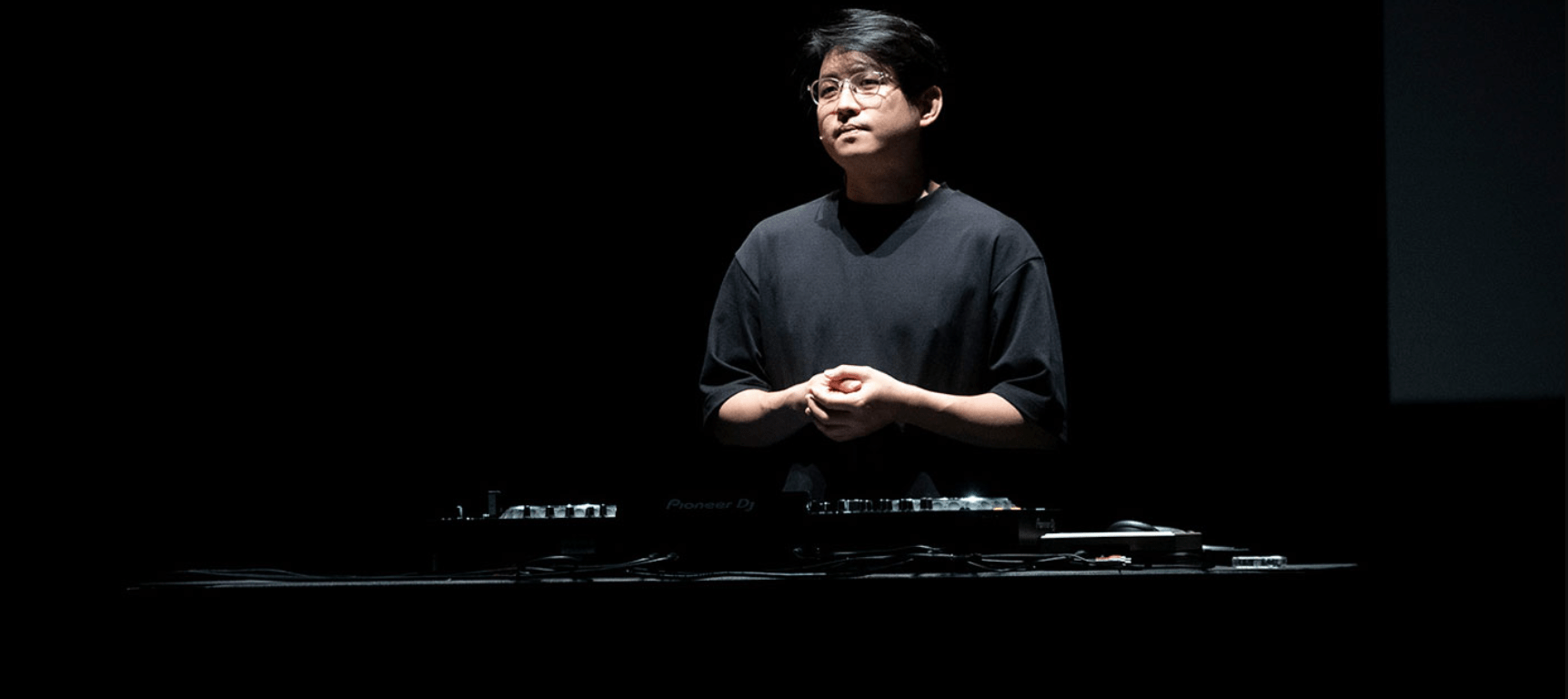
While Lolling and Rolling is primarily history lesson, it is also part ghost story, and it is here that it finds its emotional resonance through Jaha’s own experiences learning English. Standing behind a turntable, he explains how rather than using it for deejaying, this happened to be a tool for him to practice his English. All this can be linked back to his rather unusual English teacher, an American named Jack he met in Amsterdam, who recommended the turntable in the first place.
But as much as the two of them hit it off, Jack has a hidden connection to Korea, having served in the US military, and fought in the Korean War in the ’50s. It is this connection that perhaps makes Jaha and Jack that much closer, yet also makes their friendship fraught with suspicion and complicates it, as this man who helped liberate Korea finds himself exacting control over a Korean again, through his insistence on the use of English, chastising Jaha for still ‘dreaming in Korean’.
Throughout the show, as a musician first, Jaha also utilises trippy mood music, at times creepy, at times lo-fi, and either way, getting under your skin. Adding a layer of discomfort to seemingly ordinary images, this is especially felt as Jaha recalls a dream he has of driving down the dark, empty highways of Korea, and Jack materialises as a ghost behind him, questioning him about his learning of language and not recognising the technological marvel Seoul has become, from the barren lands during the Korean War.

Lolling and Rolling is ultimately about how Korea is haunted by the spectre of American superiority and cultural imperialism, proving how language and violence are deeply, intricately linked. Each time Jaha speaks his Korean-accented English, we almost feel his awareness of how he sounds, filled with both shame and anger. It is a tightly planned and staged production, bringing across salient and deeply felt points with a lethal combination of image, music and performance.
By the end, we hear Jack one last time as he reads an English translation of Kim Kwang-Kyu’s poem Spirit Mountain, about the disappearance of an entire mountain the speaker once knew in his childhood, tying in to a lack of recognition for how much Korea has changed since the war. But in English, the poem feels oversimplified, lacking musicality. In response to this, Jaha explains how he’s found the original poem, and committed it to heart. Reciting it in its original Korean without subtitles, as the lights slowly dim to a blackout, we may not understand the precise nuances of what he’s saying, but we sense a newfound sense of pride, an insistence on the beauty and glory of the Korean language, and how at least for a moment, the ghost of America is exorcised from this space.
Photo Credit: Marie Clauzade
Featured Image Credit: Bea Borgers
Lolling and Rolling played on 27th and 28th May 2023 at the Drama Centre Black Box. More information available here
The 2023 Singapore International Festival of Arts runs from 19th May to 4th June 2023. Tickets and full details of programme available here
Production Credits:
| Creator & Performer: Jaha Koo Ilse Delmeire Bart Huybrechts Wim Clapdorp Eunkyung Jeong |
 Bakchormeeboy
3 thoughts on “★★★★★ Review: Lolling and Rolling by Jaha Koo (SIFA 2023)”