

A series of exercises in self-reflection that leaves audiences wandering.
How much do you remember from your time in school? Most people are likely to tell you – not much, as we complained about the stress of exams and the pointlessness of learning certain subjects. But with participatory performance The School, the Singapore International Festival of Arts (SIFA) offers audience members a potential alternative education system to learn more about yourself.
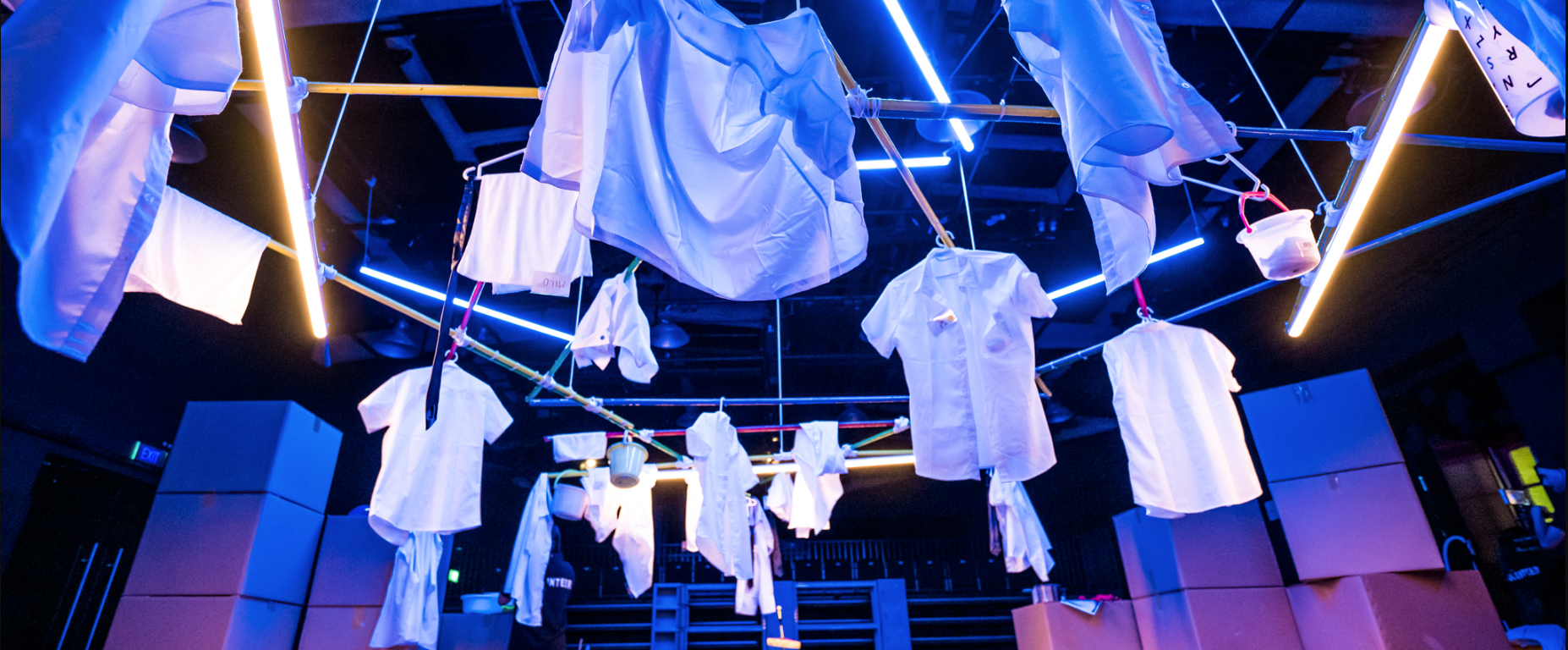
Co-created by Jean Ng, Li Xie and Joavien Ng, The School transforms Stamford Arts Centre into, well, a school, where audience members are told they are to play the role of students, on their first day. The initial registration process mimics that of an actual school – we write our name on a name tag, pick out a plain white uniform top in our size, and we receive a school bag with stationery and water.

Things get strange however, when we have our phones and watches locked away in our bags with a cable tie, removing our ability to tell the time or communicate with the outside world, while we are instructed to pick three body parts to represent us when we take our school photo, rather than a standard portrait. It’s clear this is no ordinary school, as we proceed to ‘assembly’ in the black box, where we keep our personal belongings aside, and continue to wait for the remainder of the audience to complete their registration.

All is still well at this point, as we are introduced to what to expect for the night ahead – our facilitators take the form of prefects, easily identifiable by their black ties, and sort us into our classes by getting us to choose and gather around a box containing items we’re drawn to. Divided into three groups, we begin our orientation programme, where we introduce ourselves to our fellow classmates, and play games that attempt to break the ice.

But this somewhat promising beginning fizzles out when we proceed for lessons, and it quickly becomes clear how this school has no clear goals or lesson objectives for its students. Without giving away too much, The School essentially forms a series of vaguely related exercises meant to prompt reflection and thought, but due to its extremely free form nature, lacks enough facilitation and direction for audience members to connect the dots and see the point or running thread of these activities.

Across the entire experience, The School encourages audience members to actively participate and share their thoughts. While the intent to provide space for reflection is sound, The School lacks sufficient instruction or parameters for audience members to fully immerse in the experience. There is a clear divide between audience members who come as their authentic selves, and audience members who choose to perform fictitious versions of themselves, and it becomes difficult to tell how far we are allowed to push or play with the set-up before we go overboard.

An early exercise for example, features the class setting rules, but it is never clear what purpose these rules are meant for, or in whose service they should be set. The more rebellious students constantly push back against this, eventually succumbing when the prefects insist on setting rules, seemingly for the sake of it. In a similar vein, other activities also remain too open-ended for us to focus on, leading to wildly differing responses that break the mood through refusal to participate as intended.

There are far too many activities conducted in a haphazard or purposeless way that detaches them from having meaning, as much as the prefects try to get the groups to reflect on the experience with a personal note read out loud at the start of each segment. It becomes clear that fatigue takes over as an increasing number of audience members are no longer able to immerse themselves in the world, and are simply trudging along because they paid for this, in the bleak hope that it gets better.

One particularly puzzling element is the regular appearance of a female character who enters each room unannounced, unacknowledged by the prefects and often possessing a sour expression on her face. From a graduate in a gown and cap, to a bitter bride clutching a paper cup, to eventually an old lady crocheting and knitting, this silent character feels shoehorned rather than utilised to enhance the experience, and we are left mind boggled as to her inclusion, except to perhaps vaguely emphasise the importance of appreciating life at every moment before it passes you by.

Most egregious of all is perhaps the fact that the school context is completely unnecessary and tacked on for the sake of it, relevant only in the sense that it wants us to learn something. Too much of the time it seems focused on committing to the theme on a surface level, to the extent that one has to wait in a room for an extended period of time just to wait for the ‘bell’ to signal the next movement. There are no teachers, references to examinations or CCAs or other school activities, and ultimately feels so far removed from a school experience that it could easily be replaced by anywhere else, or even relinquish a theme altogether.

Essentially, the complete lack of scaffolding and immersion is what makes this production a head scratcher, with no clear checkpoints or goals for its ‘students’ to achieve, leaving us floundering and expected to make meaning on our own. This chaos is especially felt when we reassemble as an entire group, and the open-ended nature of the production reaches its peak. The room is in a state of disarray, filled with plasticine dioramas, unappetising homemade lunches, and cardboard box towers, photos of our body parts strewn all over. Even in the final group discussion, no real breakthroughs or revelations are prompted, before we are literally asked to do nothing for ten minutes.

Quite simply, learning is intentional and not left to chance, and The School has failed to set itself learning objectives and outcomes that steer and drive the reflection process, or even set our minds and behaviour to play intended roles. As we hang up our uniforms, if it’s one thing we’ve learnt, it’s that obedience and co-operation is inherent in Singaporeans, but betrayal of that quickly leads to rebellion and selfishness instead. Supposedly, every school is a good school, but The School most definitely proves otherwise.

That is not to say The School is entirely without merit – after all, the intent to provide a safe, meditative space for reflection, away from the noise and distraction of our phones, is a necessity in today’s fast-paced world. What should be considered more then, would be the specific aim behind each individual activity, and the cohesiveness under the school context, with a little more specific guidance and goal-setting required throughout the work to encourage cooperation and healing.
This is particularly important with regards to closure at the end of each activity, where such an open-ended work needs its facilitators to bring the audience back home after allowing them to stray so far, some so much that they’ve completed removed themselves from the immersion in the work. Only then would The School be more able to form a proper framework for its goals, and allow its participants to feel bonded over a shared positive experience, rather than one which more likely leaves them feeling lost than centred.
Photo Credit: Moonrise Studio
The School played from 30th May to 4th June 2023 at Stamford Arts Centre, as part of the 2023 Singapore International Festival of Arts. More details available here
The 2023 Singapore International Festival of Arts runs from 19th May to 4th June 2023. Tickets and full details of programme available here
Production Credits:
| Jean Ng | Writer and Director Li Xie | Co-creator Joavien Ng | Co-creator |
 Bakchormeeboy