
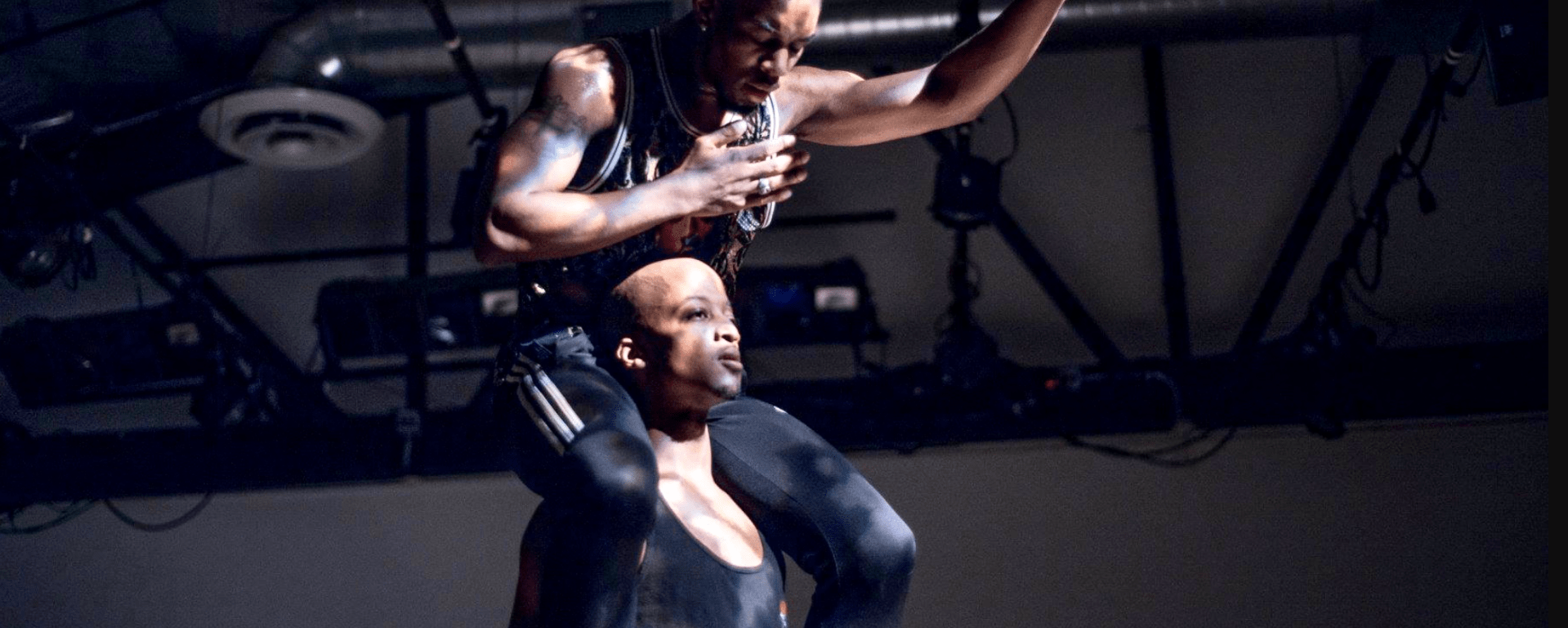
Starting its journey as a commission by the Art Institute of Chicago, in response to the work of visual artist Charles Wilbert White, Chicago-based dancemaker, poet, writer, curator, and all-around Renaissance artist J’Sun Howard, aMoratorium was born as a way to coalesce White’s exploration of African American history, culture, and lives.
Through the dance-theatre piece, Howard explores Black male identity, visibility, temporality, and its absence, and further examines death as it relates to the Black church and Black spiritual traditions. Accompanied by collaborator-performers Dedrick “D. Banks” Gray and Timothy “Solomon” Bowser, and DJ Jared Brown, the intimate performance deals with and challenges racial supremacy, police brutality, global anti-Blackness, homophobia, and xenophobia, in our highly-charged socio-political climate.
How did it all begin, and what does it mean to live as a minority today? We spoke to Howard and asked about the process of creating this piece, the pressure of existence, and how one copes with the prospect and weight of it all. Read the interview in full below:

Bakchormeeboy: A moratorium refers to a temporary prohibition of an activity, or delay. Why the title?
J’Sun Howard: The audience goes under a temporary prohibition of activity to see Black men be in a way that they might not have seen them before. The Black men also get a temporary prohibition of living in a world that doesn’t want them to exist. Being a dancer or performer or choreographer is still not something that is seen as “acceptable” for Black men to do, so doing something we have a passion and love for lets us exist in our full capacity if only temporarily. When you put aMoratorium together, “amor” is a Spanish masculine noun for love. And love is something you can’t put a “temporary prohibition of activity or delay” on.

Bakchormeeboy: The piece was initially a commission by the Art Institute of Chicago in response to a retrospective of Charles Wilbert White. How much did you know about White’s work prior to the retrospective, and how did the exhibition directly inspire aMoratorium?
J’Sun: I knew little of White’s from different art classes I took in undergraduate school and going to some museums. However, at the time, I didn’t realise he was from Chicago until I was asked to respond to his retrospective.
What inspired me the most were the black and white drawings. Looking at them, the stories my grandparents told of growing up in Southern, GA would come up looking at them. There’s one of two Black men. One is holding a scythe and the other is sharpening it. It made me think of my maternal granddad who built his house on a one acre farm. Some of the strength and resilience you see in aMoratorium comes from that, as well as some of the gestures you see in the black and white drawings. There are a few where the figure has their hands lifted to the heavens and somewhere a guardian is holding and embracing a child. Some of that is in the aMoratorium too.
Bakchormeeboy: White once said ‘”I am interested in the social, even the propagandistic angle of painting that will say what I have to say. Paint is the only weapon I have with which to fight what I resent.”. In your own art philosophy, is dance then a means to fight what you resent? Or is it a little more nuanced and complicated than that?
J’Sun: Dance is my primary weapon but I also write poetry and do some visual art. I’m less confident about my writing and visual art, so it takes me a while to share it. Yet, it’s more complicated than that. What I’m trying to do with dance is use it as a practice of practising freedom. Umm, I feel as though it opens up more ways to use dance as a “weapon.” The practice of practising is kind of like Malcom X’s phrase “by any means necessary” where it instructs to use whatever methods necessary to bring about social and political change. Essentially, for what I’m thinking about dance specifically, is putting the body on the line. To not be afraid of living freely.

Bakchormeeboy: In America at least, to exist as Black automatically seems to equate having to spend one’s entire life fighting, resisting racism, inequality and white supremacy. How heavy does that burden feel, and how do you cope with that pressure of existing in such a world?
J’Sun: It’s exhausting. All of it is designed to be heavy and burdensome, so we won’t fight or resist or be resilient. In September, walking to rehearsal for a new work I’m making now, I was passing a building an older white maintenance man was clearing out leaving from a gangway with a leafblower. I stopped to look down the gangway at him to let him know people were passing by. A white lady walks by. He says nothing. A Hispanic lady who’s pushing a stroller walks by. He says nothing. After I passed, he muttered loud enough so I could say something along the lines of “I hate these motherfuckers. Go walk on the other side of the street.” In the era of Trump, it has emboldened racist people to not disguise/hide their hate. If you know me, I don’t bother anyone and keep it to myself. I was taken aback and fought every ounce of my being not to go back and confront him. If I would’ve confronted him, had an altercation, and the police were called, the police would’ve taken his side. A small incident like this could’ve made it where I didn’t make it to rehearsal or back home. That day, having rehearsal helped immensely.
Since I’m the only person in my family living in Chicago, being around friends and artist friends takes the pressure off . . . cooking homemade meals from scratch, seeing all kinds of art, writing, listening to podcasts, and being by myself to think and ponder also takes the pressure off. Oh, and travelling internationally: Shin-Nagata in Kobe, JP has been like a second home. There, the heaviness is lifted and I can just be.

Bakchormeeboy: aMoratorium specifically explores Black male identity, which faces expectations and stereotyping from both within and outside of the Black community. How hopeful do you feel about the future when it comes to equal rights, treatment, and better representation for Black males?
J’Sun: I feel hopeful and not hopeful at the same time. I look at all the cultural innovations from Black men on TikTok and other social media platforms that inspire many people and want them to keep the energy and keep going because it can make change. But sometimes it’s only for a viral moment.
Keith Lee is one example of how Black men are making change through social media. He’s a former MMA fighter, now a TikTok food critic who brings attention and awareness to Black family owned restaurants that are providing great food and service throughout the US in Black communities.
Then, a few days ago, a police woman pulled over a 24-year old Black man in Alabama for changing a tire. Compliant, and while he was handcuffed, she shocked him with a stun gun anyway. And she also lied about him having the drug fentanyl on him.
This last thing is ironic, there’s a fellowship for BIPOC artists through Dance/USA. I applied twice and didn’t receive it either time. One of the interesting pieces of feedback from one of the panellists my first time applying for aMoratorium was that it is “boring.” I thought to myself after hearing that, is that what Black men are reduced to when you have only seen Black men portrayed one way in the media (hypermasculine) and in dance (hypermasculine)?

Bakchormeeboy: You’re considered an artist whose work spans genres and disciplines – why was the form of dance-theatre chosen specifically for this work? How does an hour-long piece possibly capture the essence of the Black male identity? Or is it meant more to raise questions, rather than to educate?
J’Sun: I think that’s just how it came to be. I wasn’t thinking of a specific form for aMoratorium. I was letting it reveal itself to me while I was making it. But I did think a lot about how I grew up in the church and how that always seemed like dance-theatre when things got lively at times the preacher really riled the congregation. I sense some of that in White’s work too. The figures you see in the drawings and paintings had to use dance-theatre via religion to have a catharsis for surviving enslavement.
In the grand scheme of things, my intention was to make sure that my collaborators – Dedrick “D. Banks” Gray and Solomon Bowswer – had enough agency inside of aMoratorium to be themselves, play, connect with each in different intimate ways, and allow them to bring whatever they’re feeling on the interior while they’re performing to the exterior. To see their humanity instead of the already prescribed stereotype of hypermasculine or thug.
Bakchormeeboy: What do you feel people should care about more?
J’Sun: Each other.
Cover Photo Credit: Kiam Marcelo Junio
All other photos: Kristie Kahns
aMoratorium plays from 17th to 18th January 2024 at the Esplanade Theatre Studio. Tickets available here
M1 Singapore Fringe Festival 2024 runs from 17th to 28th January 2024 across various venues. Full line-up available here, with tickets available from BookMyShow
 Bakchormeeboy