
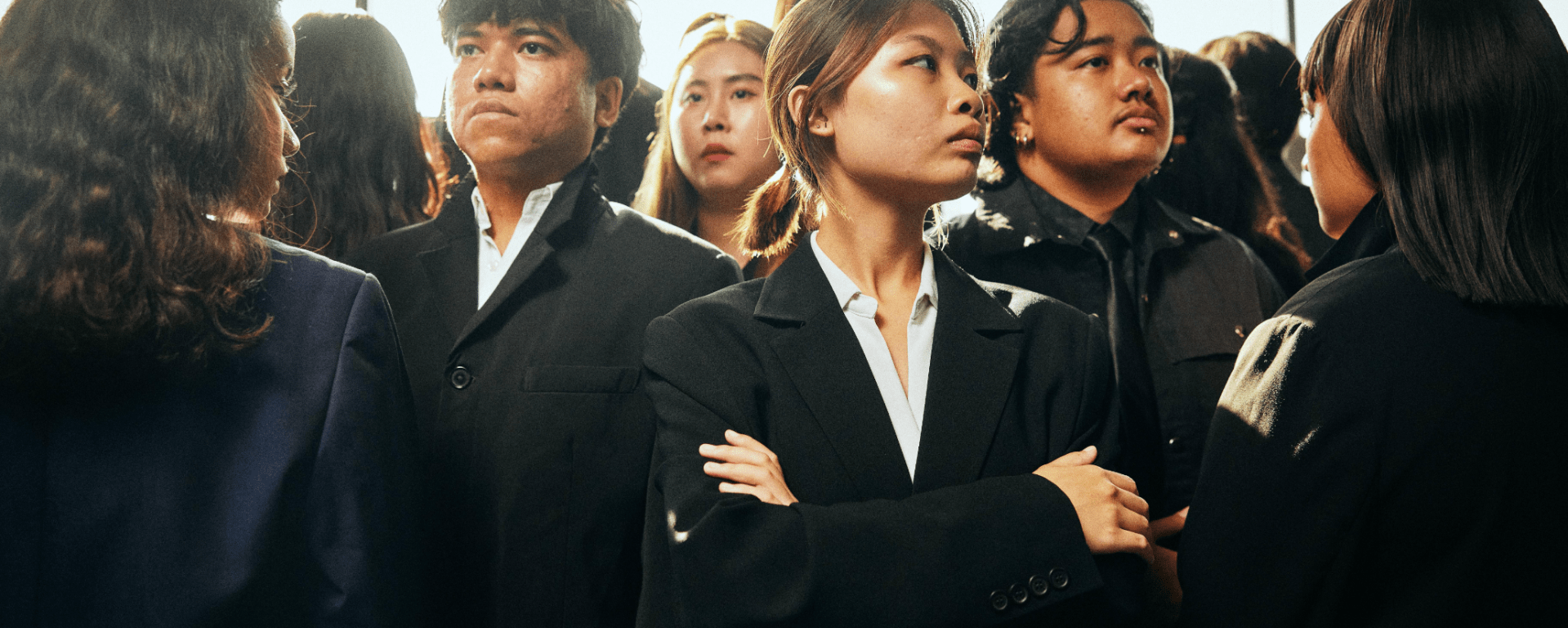
To span the length of the human experience in a single production sounds like an impossibility, but when THOM PAIN (based on nothing) premiered at the Edinburgh Festival Fringe in 2004, critics remarked that the deceptively simple one-man show about a man and his suffering in life.
Now, that show will be performed in Singapore, by students of Nanyang Academy of Fine Arts’ BA (Hons) in Performance Making programme, under the tutelage of theatremaker Edith Podesta and choreographer Yarra Illeto, where they will expand the monologue into an ensemble show instead.
How does all of it come together to help us see the humanity in others, to see the extraordinary in the ordinary, and to save the life of the audience? The surreal and insightful production promises to explore the human condition itself with wit, empathy and a plea for enlightenment, as we seek authentic connection amidst loneliness and find meaning in our experiences.
Read our interview with Edith and Yarra in full to gain some insight into the relentless pursuit of human significance before it premieres this January:

Bakchormeeboy: Why did you two decide on this play, especially considering how it was originally a monologue when you have an entire ensemble of students to direct?
Edith: I first read THOM PAIN many years ago and always thought it would make a good ensemble piece. I never thought of it as a monologue, it always struck me as a dialogue, a conversation that the audience steered.
I was further inspired by this Graham Greene quote from “The Heart of the Matter”; ‘No one can speak a monologue for long alone – another voice will always make itself heard; every monologue sooner or later becomes a discussion.’
This is not the first time I have directed a monologue for an ensemble. In 2008 I directed “The Fever”, a monologue by Wallace Shawn with an ensemble of students from LASALLE. And most recently “Kaspar” by Peter Handke for the 2019 M1 Singapore Fringe Festival with an ensemble of seven NAFA students.
Bakchormeeboy: In that same vein, how did you reimagine the work for an ensemble, and how much does it deviate from its original iteration while still holding on to its key ideas?
Edith: In the play, Eno defies the expectations associated with traditional storytelling. Thom Pain constantly disrupts the conventional narrative flow by frequently interrupting and contradicting himself, disrupting the intangible flow and rising action we often experience in well-made plays. Thom emerges as an unpredictable narrator, becoming an unreliable witness to his own life. At times, he openly reveals vulnerability and pain, only to swiftly counter these moments with humour or detachment.
In this reimagined version, the ensemble takes Thom Pain’s contradictions and brings them to life. The actors externalise his internal conflicts, personifying his paradoxes and giving tangible form to his conflicting viewpoints. Each actor assumes a distinct ‘Thom Pain’ persona, embodying an individual facet of his character – from Thom at seven years old to the twenty-five-year-old Thom, from Thom in love to heartbroken Thom.
This approach allows the audience to witness the simultaneous existence of different Thom Pains, emphasising the complexity and multifaceted nature of his experiences and perspectives. It gives a kind of Rashomon Effect to Thom’s characteristics, motivations, fears, and tendencies.

Bakchormeeboy: What was it like preparing students for this performance, especially in terms of the relatability and how they found significance in it?
Edith: The play taps into universal human experiences such as love, loss, regret, and self-reflection. So not only did the ensemble find “Thom Pain” relatable from an artistic standpoint, but also because the dialogue positions the students (as with the live audience) as intimate confidants of Thom Pain, bidding them to approach the material with empathy and compassion.
Bakchormeeboy: Unlike a company where members are more likely to share the same goals, students come together as a matter of fate, bringing with them their own individual backgrounds and perspectives. Beyond sharing the same training, what else goes into ensuring that the students form a cohesive ensemble?
Edith: Much of the groundwork is laid out for me, as the students have already spent time together in various classes and rehearsal rooms. The students and I dedicated the first half of the rehearsal process creating compositions that explored the physical, aural and interior worlds of the play. Each devising process gave the students the opportunity to rotate roles, periodically providing everyone a chance to take on different responsibilities and highlight their individual strengths. I find this way of working strengthens the collective understanding of the play, but also emphasises the value of each student’s unique contribution in a cohesive ensemble.

Bakchormeeboy: The goal most students have upon entering an arts institution is to become a professional – but as always, seeing as how space and opportunities are limited in Singapore, how do both of you act as mentor figures to your students to ensure they are both realistic yet hopeful about prospects?
Edith: The unique advantage of arts institutions is the constant collaboration with peers, and the invaluable opportunity to network with like minded artists across programmes.
As an educator and arts partitioner I advocate for diversification, as I’ve found that the cultivation of a range of transferable skills not only increases the chances of finding fulfilling work, but also empowers individuals to create their own opportunities.
And of course this collaboration between NAFA and M1 Fringe provides practical experience through workshops and rehearsal, working towards a performance on a professional platform. This kind of practical exposure helps students understand the industry and develop valuable professional skills.

Bakchormeeboy: Especially with how NAFA is now moving towards its vision and future of being a founding member of the UAS, have there been any changes in the way students might see their education, or the way both of you have been conducting classes? Has there been a change in expectations?
Yarra: The performance ecosystem evolves at a progressive rate that acquires knowledge from various pools of study. The performance-making course allows students to hone their specialty while diving into various other disciplines to diversify their practice and craft. Students’ expectations will always be challenged with each industry project, as the nature of interdisciplinary work holds no conventional form.
As artist-educators the classroom is anchored by the core values of the course yet requires room to find innovation within the transference of concepts and process of meaning-making. Education naturally shifts to support the students’ evolution within the contemporary climate they live and work in.

Bakchormeeboy: Considering how much ambivalence seems to cloud Singapore, what is one thing you feel we as citizens should care about more?
Edith: Will Eno’s work reminds us that we all grapple with questions of existence and belonging. In a review of the 2018 Olivia Butler version of the play, journalist Jennifer Vanasco sums up the central diegesis of the play; “the world, Eno is saying, is both beautiful and doomed, simultaneously. To be human is to always be about to die.” So what makes life worth living? How will each of us imbue our lives with meaning?
Photo Credit: Crispian Chan
THOM PAIN (based on nothing) plays from 18th to 21st January 2024 at the NAFA Studio Theatre. Tickets available here
M1 Singapore Fringe Festival 2024 runs from 17th to 28th January 2024 across various venues. Full line-up available here, with tickets available from BookMyShow
 Bakchormeeboy