
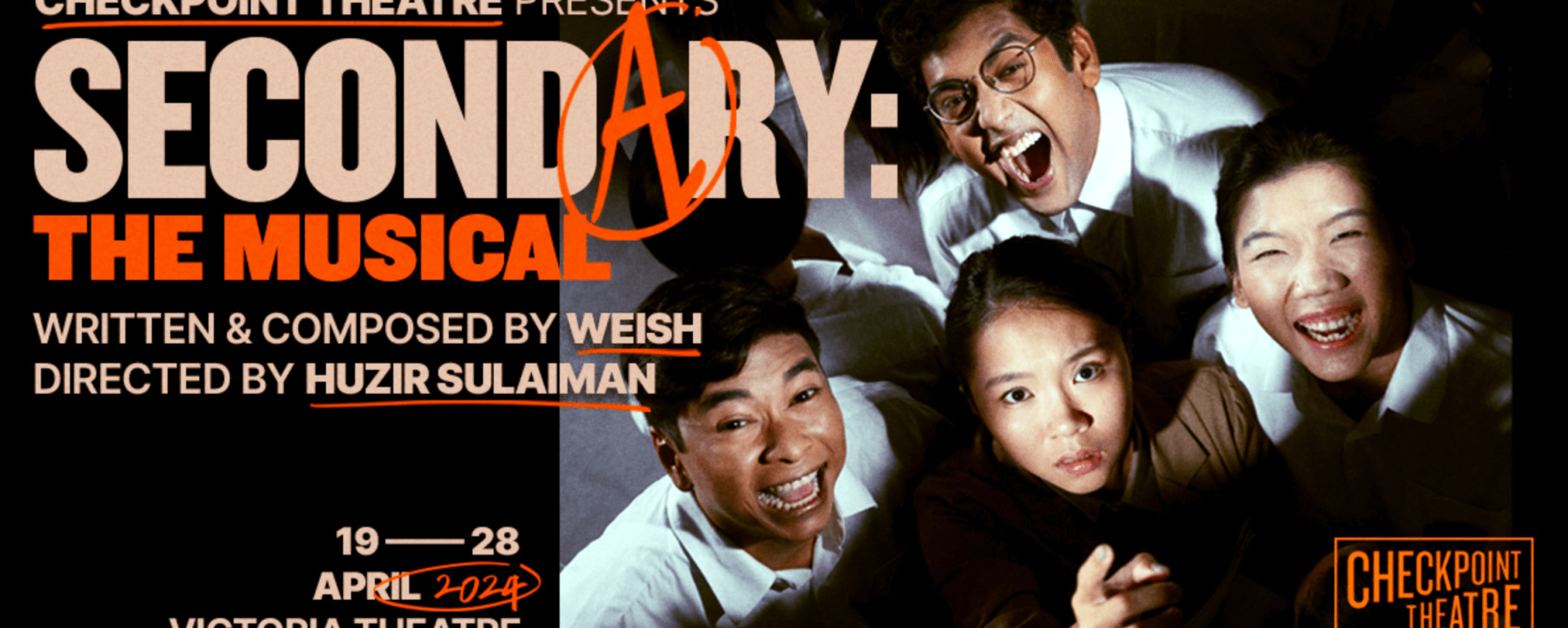
Searing critique of Singapore education system identifies the cracks in and those who slip through it.
The topic of education has always been a hot one in Singapore. Despite being hailed as having one of the world’s best, the education system has almost always been a trial by fire for any student going through it, rewarding those who excel with the promise of praise and greater heights, while throwing those who aren’t academically-inclined aside, often with immense fears of never amounting to anything because of it.
In Checkpoint Theatre’s latest production, electronic musician weish makes her musical debut, as playwright, composer and musical director of Secondary The Musical, based off her own experiences as a former teacher under the Ministry of Education (MOE). Directed by Huzir Sulaiman, the musical centres on Lilin (Genevieve Tan), an MOE scholar and literature teacher at the fictional Huxley Secondary School in 2015, her final year of teaching before being slated to transfer out to a role at MOE HQ. Her feelings are mixed – on one hand, she’s more than ready to leave for greener pastures where she believes she can make more palpable change. On the other hand, her heart aches for her students in 3F, dubbed the worst class in the batch with little hope of a future for themselves.

If the storyline sounds familiar, it’s because almost all education-centred shows follow roughly the same storyline of how ruthless and unforgiving the education system can be on youths, whether it’s Jack Neo’s film I Not Stupid or The Necessary Stage’s play Those Who Can’t, Teach. But what makes Secondary The Musical a welcome addition to the canon is its focus specifically on at-risk students, and the ways educators try – and fail – to help them. Lilin is essentially a character moulded in part after weish’s own experiences as a teacher, and rarely has any play been able to so accurately depict the woes of the teaching profession onstage.
From the beginning, we’re already introduced to Lilin’s inner voices- literally, as a motley crew comprising manifestations of Empathy, Humour, Panic, Cynicism, Optimism and Discipline (played by the ensemble of Ethel Yap, Nadya Zaheer, Adeeb Fazah, Tiara Yap, Joshua Lim and Audrey Luo), each dressed in oversized, heavy bales of clothes that make them seem like children pretending to be adults, perhaps a reference to how even teachers feel out of their depth at times when dealing with students. These entities appear each time Lilin has to make a decision on the best course of action as to how to interact with students, constantly worrying that a single wrong word could cause a situation to spiral, or permanently scar them.
As Lilin, Genevieve Tan is finally given a leading role in a major local production, and she makes the most of her time in the spotlight, bringing out the character’s inherent sense of care, and relatability in being caught between students and staff, trying to find a happy medium that pleases both sides. Lilin’s journey is a relatable one to anyone who’s been in or knows someone in the education sector – a teacher goes into the job wanting to teach after all, and understands the emotional labour that comes with the domain, and when burdened by additional pressures of the job, from administrative work to constantly being reminded of the looming exams and need to stick to the syllabus, we see her begin to crack, so close to escaping to HQ.

On the flip side, there’s also Maths teacher Charlie Chu (Teoh Jun Vinh), who takes a rather different approach compared to Lilin, choosing to maintain professional distance and focus on getting by each day with as little drama as possible, clearly disillusioned after years in the industry. Primarily used for comic relief, Charlie is often seen cracking cringe-worthy Math puns in an attempt to draw laughs from his class, taichi-ing questions away with a timely ‘what do YOU think?’, or even performing entire choreography-heavy numbers with an ensemble of students. But for all the frivolity, Charlie often ends up the voice of reason for Lilin, reminding her not to get so involved, and a sobering example of what happens to educators who become burnt out and end up quiet quitting on the job, with Jun Vinh balancing both these aspects rather well.
Finally, amidst the throng of colleagues, there is also Mandy (Rebekah Sangeetha Dorai), HOD of Literature and the de facto ‘villain’ of the story, who stands not only between Lilin and her new HQ posting, but also acts as an obstacle to the students promoting, judging their behaviour and attempting to enforce arbitrary moderation to reflect the ‘expected’ standard each class should produce. Stern and foreboding, Rebekah cuts an imposing figure each time she sweeps onto stage, always carrying with her an aura of authority and command in her voice, clearly understanding how to instil fear and obedience in all who encounter her. But Mandy isn’t without sympathy, as she reveals that she herself is a victim of the education system too, pressured into excelling to come out on top in the excellent ‘My Own Life’, allowing Rebekah to show off her vocal chops and add layers to her character, and the tough love she dishes out.
The symbolism of the school’s name should be obvious to anyone who’s read Brave New World, Aldous Huxley’s magnum opus, that imagines a utopia where each and every person is happy, so long as they conform to the rules and stay within their assigned roles, suggesting a rather bleak parallel and interpretation of Singapore’s own situation. Petrina Dawn Tan’s rather expensive-looking set, clean and modern, is focused on circles, from the round floor to the spiral staircase, and suggests the cyclical nature of education itself, never escaping the structures it’s created for itself. Underneath it however, even with the improved facilities and beautiful infrastructure, it forgets its most important resource of all – the students, whose problems overshadow even the tree in the corner growing from the ground suggesting the school’s focus on growth mindsets.

And that is why in Secondary, the most important characters are Lilin’s three notorious students – Reyansh (Krish Natarajan), a high-achieving, well-to-do student who happens to be placed in 3F, with an obsession for measuring things out to make sense of the world and a passion for physics; Omar (Shahid Nasheer), a social media champ with hang-ups over his parents’ divorce and his father’s emotional distance; and Ming (newcomer Tricia Tan), a rough girl facing family problems at home and the shame stemming from it, but with an immense amount of empathy. The trio forms the heart of Secondary, and are an integral part of what makes the show so successful, with their friendship forming the emotional core of the work, feeling for them as they encounter one frustration after another, from teenage angst, rifts in friendship, to clashes with teachers. Of the three, Tricia Tan is particularly outstanding for the realism with which she plays Ming, and despite her lack of stage experience, is extremely believable in the role, the sense of world-weariness clear in her voice and body language. These are fully-formed characters and human beings who do not deserve to be sacrificed for the sake of the bell curve, where a single point could spell the difference between progress and being retained for a year.
Secondary takes its time introducing all these characters, establishing each of their backstories and narratives over the course of the first act. It’s a slow but comfortable way of easing us in, yet always with a sense of urgency looming, never far from reminding us that the dreaded year-end exams are fast approaching. But once all the storylines are in place is when it finally begins to show its true potential. In the play itself, the students end up studying a local short story titled ‘Understudies’ during Lilin’s literature classes, which deals with a fictional version of Singapore, and emphasising clones that are created for the express purpose of fulfilling the role of their originals. It is through literature that the students begin to see the (in)significance of their own lives in the eyes of the education system, and are able to raise difficult questions, no matter how badly phrased, thanks to Lilin’s patience and encouragement.
And by the end, it is literature itself that forms the central conflict, where a lesson observation of Lilin’s class leads to a fracturing of trust between her students and herself, when she has no choice but to exact the worst possible punishment for a disciplinary issue that she would usually close one eye to. What Secondary recognises is the delicate ecosystem of a school environment, where trust is everything, and establishing appropriate teacher-student relationships is one of the most difficult daily struggles for any teacher, afraid to overstep the boundaries of friendship or risk losing respect. To that end, Secondary finds in Lilin an everyday hero, where she is always trying to find the light and positive aspects of her students, fighting for them where she can, and ways she can uplift them because she just wants the best for them, and champions teaching as a profession full of labours of love.

In taking on the triple role of playwright, composer and music director, weish is essentially the creative drive behind this musical, her voice and signature is clear across every scene. Much of how much one enjoys Secondary as a musical is dependent on how much one enjoys weish’s music. As an electronic musician, there is no live band, with all backing tracks pre-recorded and played for the cast to sing over. weish’s style of composition works such that most of the songs aren’t immediately memorable, often more atmospheric and pensive rather than the typical bombastic, in-your-face style of theatre. Take Lilin’s opening song ‘Aiya’ for example, which puts a spin on the typical Singaporean sigh of exasperation, soulful and resigned, as Lilin ponders how long more she has to stay in this role.
weish shows her range however, with songs that really develop each individual character’s personality, particular with numbers like ‘Buang Aku’, a hip-hop and rap number where Omar expresses his disdain for his father and his wish to be acknowledged, which Shahid Nasheer delivers with resolute angst and anger. weish’s sense of flow and rhythm is on point throughout each track, ensuring that there’s a steady beat to follow while never stretching her actors beyond their capability – these are rarely vocally-challenging, and depend more on catching the right stresses and tempo, with clear enunciation. Penultimate number ‘House’ is particularly affecting, as it takes a poem written by Ming, its lyrics powerful and reflective of the strain she’s under. Elsewhere, weish also allows for some songs requiring more energy, such as ‘Because Why’ or ‘One Point’, where choreographer Hafeez Hassan gets the ensemble to do some innovative movements with desks, while also allowing lighting co-designers Petrina Dawn Tan and Tai Zi Feng to bring the set to life with pillars that glow purple, or overhead lighting that flashes bright for dramatic effect.
Secondary The Musical‘s story may be familiar, but its heart is in the right place, bringing with it a fresh take on what a musical can be and what a musical should be with weish’s unique compositions. Above all, it is the real emotions and experiences present in this show that make this as affecting as it is – for anyone who’s ever felt like they do not fit within the system, where it chews them up and spits them out the moment they are deemed unworthy, and for educators who try as hard as they can to do their best, only to be bested by the weight of their duties and the crushing pressure of conformity. In real life, weish may have left the Ministry, but in the musical, Lilin ultimately chooses to stay on, not just at MOE but at Huxley, continuing to press on and do the best she can. Even in the face of crushing bureaucracy, perhaps it really is passion that drives teachers to continue doing the best for their students, and all they can do to ensure that future generations come out of Secondary school, scarred but still striving.
Photo Credits: Checkpoint Theatre
Secondary The Musical played from 19th to 28th April 2024 at Victoria Theatre. More information available here
Production Credits:
| Playwright, Composer, Musical Director weish Director, Dramaturg Huzir Sulaiman Cast Genevieve Tan, Ethel Yap, Nadya Zaheer, Adeeb Fazah, Tiara Yap, Joshua Lim, Audrey Luo, Rebekah Sangeetha Dorai, Teoh Jun Vinh, Tricia Tan, Krish Natarajan, Shahid Nasheer Choreographer Hafeez Hassan Set and Lighting Designer Petrina Dawn Tan (Doodle Productons) Lighting Co-Designer Tai Zi Feng (Doodle Productons) Sound Designer, Sound Engineer Shah Tahir Costume Designer Max Tan Music Producers and Arrangers Ian Lee, Daniel Alex Chia (PK Records) Assistant Recording Engineer Jeriel Lim (PK Records) Vocal Coach emmeline Assistant Directors Marc Gabriel Loh, Vishnucharan Naidu Hair Artist Ashley Lim Make-Up Designer Bobbie Ng, The Make Up Room Creative Access Artist and Advisor Grace Lee-Khoo |
 Bakchormeeboy
4 thoughts on “★★★★★ Review: Secondary The Musical by Checkpoint Theatre”