
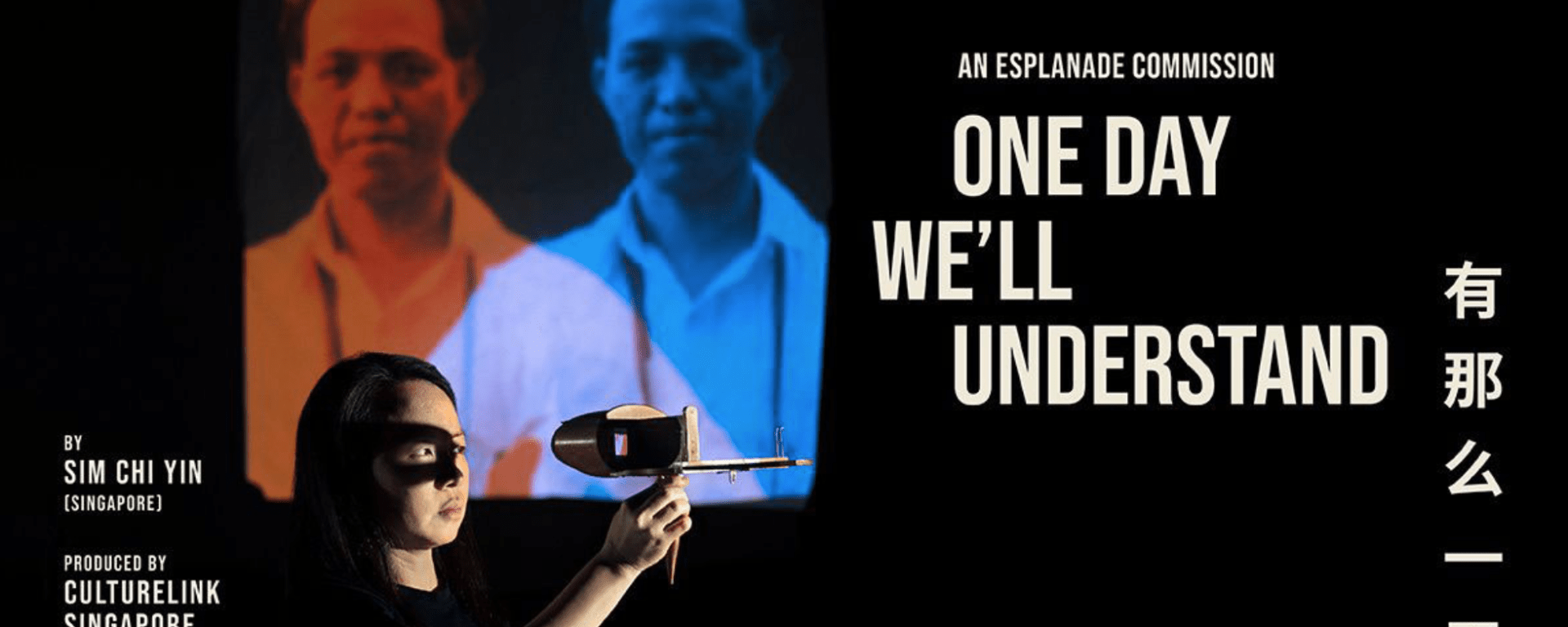
For artist Sim Chi Yin, history has always formed an integral part of her work and practice. Be it presented in the form of photography or film or even book-making, Sim’s work often takes her into the recent past, excavating and researching into academia and accounts to unearth previously hidden narratives. Through her artistic interventions, she paints a more complete picture of what has come before us, all of which comes together to provide viewers not just with visual representation, but a means by which to perform historiography, and perhaps, inspire us to better understand and access our past as well.
In her newest work, Sim steps out into the spotlight, and takes on the role of curator, creator and performer, in multimedia production One Day We’ll Understand, which plays this August as part of the Esplanade’s The Studios season 2024. Set against the backdrop of the Malayan Emergency, One Day We’ll Understand sees Sim drawing on her large body of evocative photographic and filmic work, as she explores her own family history, and what it means to inherit the legacies and losses left behind by her forebears.

“It’s been about 13-14 years since I started a quest to uncover my own hidden family history, specifically regarding my late paternal grandfather in Perak, Penang, who was written out of the family story due to his involvement in the Barisan Sosialis in Malaya and China, during the Malayan Emergency,” says Sim, on the journey and inspiration behind the work. “Prior to this, I’d been doing 15-20 minute lecture performances since 2017, where I had to use the short time to contextualise and explain this complex, faraway concept of the Malayan Emergency to foreigners who had no connection to and idea about this specific war or even this specific part of Southeast Asia. So I used my grandfather as an entry point, writing a letter to him, overlaying it with videos and images, and then presenting it live. This combination of personal narrative and the power of live storytelling created something unique, and made it more accessible.”
It so happened that in 2019, when she did a performance at Hanart TZ Gallery in Hong Kong, Mark Teh of Five Arts Centre in Kuala Lumpur, came on as a discussant, and approached Sim to consider expanding it into a fully staged work, opening up the possibility of what a longer narrative would do to aid in the storytelling. The idea never quite left her head, and come 2021, Sim was doing a residency at NTU CCA, when the Esplanade then approached her to do an open studio reading, and made her realise that it was indeed possible to turn it into a full length work. “I had no prior knowledge or expertise in doing a performance of that scale, and while I did initially want to have someone else to be onstage, I was asked to perform it myself, since it was very personal,” says Sim. “At the same time, I knew I couldn’t do this alone, and found collaborators in the form of Tamara Saulwick to direct, and Drama Box’s Kok Heng Leun to come on as dramaturg.”
“As a one hour performance, my biggest learning point has been the process of letting go of self-consciousness and learning to come into the space. Bringing on Cheryl Ong onboard was crucial—while the piece is essentially a monologue, her sounds creates a duet between us. The multiscreen projection, with projections on both the walls and floor, adds another layer. Nick Roux, the video artist who also worked on Dragon Ladies Don’t Weep, is a multimedia magician who takes my video work and reinterprets it. He quietly works at his computer during rehearsals and then surprises us with his results, stripping away or recombining elements to create something new,” she adds. “This fully collaborative work couldn’t be done alone, and I feel extremely lucky to work with this team. They are all at a stage in their careers where ego isn’t an issue, and it’s been so rewarding to be part of such a process.”

With this decade long collection of material, often scattered across multiple forms, from English and Chinese archives, to oral histories in both languages, and even visual footage shot over a decade, Sim had her work cut out for her in terms of finding a clearer thread that would structure the entire performance for the stage, particularly with all the material she already had and still had yet to retrieve. “Sometimes I felt precious about the material, debating whether to include a specific scene or video, and at the advice of my director and dramaturg, if something wasn’t work narratively, it had to be cut. It was challenging navigating through the vast amount of material, but I’m grateful to them for finding a structure that works for the stage,” says Sim.
“There are quite a lot of threads, and every thread led me down a new a rabbit hole, for example, one of the things I’m particularly interested in is the almost entirely hidden story of the deportees from Malaya to Southern China — the British rounded up about 30,000 deportees over a 12-year period from 1948-1960,” adds Sim. “This is a piece of history that very few people know about, and even within academia, it has been very lightly researched. I’ve read all the papers written so far—you can count the journal articles on one hand. So that led me to 40 oral history interviews that were spread out over six territories: southern China, Malaysia, southern Thailand, and a couple in Singapore.”
“Another thread I wanted to pursue was the remnants of this world and the sites of memory from this period. For example, I took a series of landscape photos in southern Thailand, places where something significant happened in this world, like a specific ambush or a river that people remember as the ‘river of blood’ from both sides, or the jungle complex that was a base for the communists. I also looked within the British colonial archives, particularly the photo archives, and reviewed all the photos in the Imperial War Museum collection relating to Malaya, then created a series to reinterpret these images,” she continues. “I kept adding more and more things to the work that emerged with the process — like collapsing antiques, magic lantern slides, and collecting glass slides. My entry point was collecting around Malaya and British Malaya colonial slides of Malaya, and I ended up collecting things depicting Southeast Asia in general. So the performance draws from this body of visual work but also uses a lot of material I haven’t yet turned into visual art pieces, including aspects of my family history.”

While Sim has extensively explored these themes in her other visual art work, the performance version is strongly anchored to her family history to give it stronger emotional grounding. “The family element is mostly used as a narrative thread we use to address broader themes, where it hopefully leads into themes that have wider resonance, including memory, loss, and the search for the future. It’s about figuring out what to do with these complex and contested histories we inherit and how to interrupt the record before passing it to the next generation,” says Sim. “Contemplating the future and the idea of transgenerational inheritance is crucial to me. In the performance, my own child comes into the work in a way that isn’t present in the individual artworks, and it presents me grappling with multiple roles—as a researcher, artist, niece, mother, and parent. It’s a challenge to retell these difficult histories to our children and consider what they take from it. Take for example how when my child was born, I consciously revived my grandfather’s name by naming him Yiwei, which incorporates the ‘Yi’ from my grandfather’s pen name, Shen Yi, used for anti-colonial editorial, and this was a subtle but deliberate act of restitution on my part.”
Broadly speaking then, the performance uses family history as a vehicle to explore broader, more universal themes, linking that to wider history eventually, while still recalling what the child inherits from the past and how in the present, one can find one’s own feelings towards the violence and trauma present in the colonial archive before passing on that history to the next generation. “In a book I released in 2021, the family history goes even more personal, and focuses on my grandmother, who was left behind with five children and a strict mother-in-law. It addresses the trauma of losing her husband to politics and her life as an archetypal poor widow,” says Sim. “For the development of this work, I examined all the material to see which aspects translate best to the stage and my family’s journey. As part of the process, I even went on multiple trips with older family members to China and Malaysia, capturing video footage that is used sparingly in the performance.”
In a way, Sim is trying to reconcile the tensions between attachment and detachment, finding emotional truth and power beyond it being an academic exercise. “I’m already one generation removed from the events that happened, and I think about how my oldest uncle, who witnessed my grandfather’s arrest in 1948, still chokes up when recounting what happened. Despite being 89 years old, he becomes emotional recalling that moment—seeing his father handcuffed at the family shop and marched down Jalan Besar. It’s incredible how he remembers the scene in such graphic detail and still gets choked up, revealing the emotional proximity and impact of these memories,” says Sim. “For the older generation in my family, the topic is definitely more sensitive. Many living in Malaysia or Singapore don’t want to be associated with communism. It’s not just fear but a product of being conditioned by the politics of their time. The sensitivities around being associated with the left in contemporary Malaysia and Singapore have influenced their reluctance to discuss these topics openly. But to me, what’s important isn’t whether my grandfather was a communist or not, but more to focus on how he had ideals and convictions for which he stood and ultimately died for.”

Securing funding for this work has certainly not been smooth sailing due to its controversial and sensitive content. Nevertheless, Sim strongly believes in the need to understand the complexities of our own country’s history and narratives, in the continued process of decolonisation of the mind. “There are still conversations that need to be had in both former metropoles and colonies, and I see myself as part of a small but growing movement of younger scholars and filmmakers re-examining anti-colonial histories of Malaya, and thankful to know that I’m not doing this alone—there are others working on these issues as well,” says Sim.
On the impact she hopes her work has, Sim considers the way the very specific issues find a place for discussion and deeper thought on the contemporary themes it explores. “Art has a unique way of translating and transposing difficult and contested topics, offering access to these subjects that might be challenging to address directly. Sometimes, art is the last avenue to explore these issues, and I hope that these artistic methods can open up lines of curiosity for individuals and families,” says Sim. “In my conversations, particularly in Malaysia, I’ve found that this history barely scratches the surface for many families. I’ve encountered young Malaysians who similarly share stories about relatives who disappeared or were involved in the jungle during the Emergency. Many family stories remain untold because we were too late to collect them before the people who knew them passed away, which is why I hope greater interest is generated from this.”
“And while it is about history, we do deal with wider themes such as memory, loss, and forced migration. The parallels between historical and contemporary issues are striking, such as how the offshoring of unwanted populations still occurs today, as seen in Australia and the UK with asylum seekers. The legacies of the Malayan Emergency continue to influence laws and policies, like the anti-sedition laws and the ISD and ISA frameworks,” she adds. “The work is designed to invite contemplation rather than deliver a didactic history lesson. It switches modes—sometimes I am simply a granddaughter, other times a history lecturer or artist. The historical context is presented with a light touch, aiming to provoke thought about the nuances and complexities of history rather than rewriting it. It’s about examining how we inherit and interrupt historical narratives and considering how we pass these stories down through generations.”

Sim also assures us not to be deterred by the massive amount of information and history contained in the work, and to just allow the work to chart its course and follow along. “History and memory are distinct concepts, with memory often reflecting the fragility and unreliability that should be embraced rather than criticized. Unlike History with a capital H, which aims for a comprehensive and objective account, this work respects the personal and fragmented nature of memory, my work acknowledges the non-linear, episodic nature of memory, mirroring its inherent flaws and using oral histories to provide a deeply personal perspective,” says Sim. “This is an artwork, not a definitive historical account. It offers one version of the past, focusing on broad memories rather than a neatly trimmed narrative. I’m exploring speculative aspects of artmaking, akin to Saidiya Hartman’s concept of critical fabulation.”
“I respond by highlighting the value of a more visceral, nebulous form of knowledge that exists between so-called facts. This space, as Hartman describes, involves foraging in archives and questioning the line between history and imagination, focusing on the deeply personal and flawed aspects of memory, and approach that doesn’t present fiction but rather navigates the space between historical fact and imagination, embracing the gaps and ambiguities in memory and history,” she adds. “Some academics are exploring the notion of a just memory and ethical history, advocating for the inclusion of marginalized voices and considering their positions without ideological bias, and this work seeks to invite thinking across these ideological lines.”
Ultimately, the work itself is significant because of its deep dive into our own national histories, grappling with our approaches and attitudes towards colonialism and the vestiges of violence, trauma and memory past, to better re-interpret and present history for the future generations. “The story of this particular war is polarized in Malaysia, Singapore, and the UK, often presented as either ‘pro’ or ‘anti’ in the dominant narratives. This shouldn’t be the case, and I want to blur this fault line, addressing the complexities and nuances of the story,” concludes Sim. “It is a deeply personal history, with decisions made by individuals that may not be easily understood by later generations. There is a need to rethink both sides of the narrative, not to remain neutral but to foster understanding and empathy across divides.
One Day We’ll Understand plays from 30th August to 1st September 2024 at the Singtel Waterfront Theatre. Tickets available here
The Studios 2024 – Fault Lines runs from July to September 2024 at the Esplanade. Tickets and full programme available here
Production Credits:
| Concept / Performer Sim Chi Yin Sound / Performer Cheryl Ong Director Tamara Saulwick Dramaturg Kok Heng Leun Video Artist Nick Roux Lighting Design Andy Lim Technical Manager Yap Seok Hui Executive Producer Goh Ching Lee |
 Bakchormeeboy