

Fathers in Asian society have always had certain stereotypes associated with them – a sense of the austere, reserved and detached from openly expressing love for their children, and perhaps, even as a microcosm of the greater paternalistic, patriarchal governance style adopted by those in power. In many ways, a father is often an anchor within a family that determines their relations and dynamics, resulting in incredibly strong respect or resentment towards him.
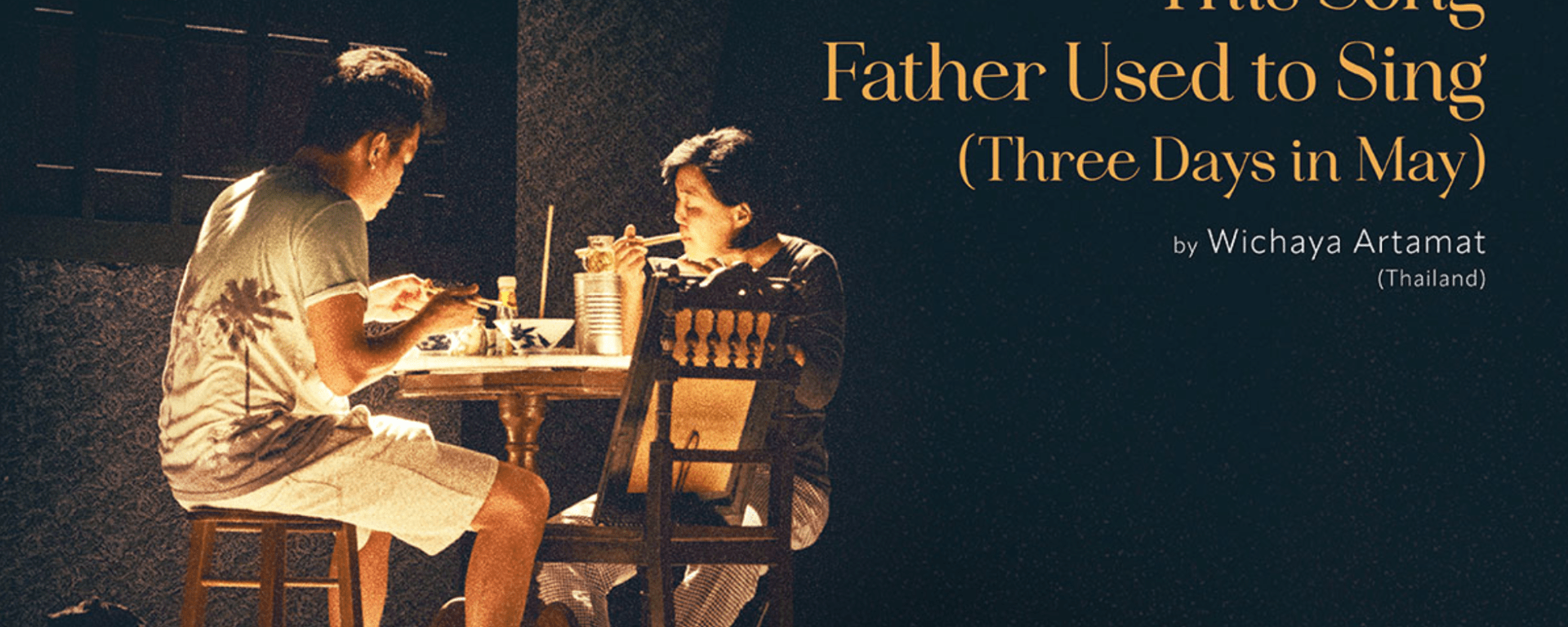
Playing as part of the Esplanade’s The Studios season, award-winning Thai play This Song Father Used to Sing (Three Days in May) arrives in Singapore this September to tell the story of a pair of Thai-Chinese siblings who perform a traditional Chinese ceremony in remembrance of their late father. Performed thrice, each time in May in a different year, the play sees them in absurd conversation as they cook, eat, chat and joke about nothing in particular. Written and directed by award-winning playwright Wichaya Artamat, the play was awarded Best Play by the International Association of Theatre Critics, Thailand Centre (IATC) in 2016, and was nominated for Best Performance by a Male Artist, Best Performance by a Female Artist, and Best Original Script awards in the same year, before touring to major European festivals such as Festival d’Automne, Theater Spektakel, Kunstenfestivaldesarts and Wiener Festwochen.

Marking his debut production to be staged in Singapore, we spoke to both Wichaya and producer Sasapin Siriwanij on the intent and significance of such a play, especially with its political metaphor and undertones, the way it deals with fatherhood and its shadow, and the concept of survival and carrying on. “We started with two actors and began the process of creating a play together, where we focused on the father figure in Thai society,” says Wichaya. “Much of the play was initially devised, where the actors improvised memories of their fathers, which then explored the collective memory of people in Thailand, particularly the father figure, their own fathers, and their families.”
“From there, we figured that we wanted to explore how this older sister and younger brother have their relationships influenced by their backgrounds, their childhood experiences, and their perceptions of their parents, particularly the father. The focus is on the present, and the play intentionally avoids political context, allowing for a range of interpretations,” he continues, commenting on the presentation style of the play. “We also wanted to present body transformations as a way for the children to process their grief, and as an exploration of how to address family stories in a non-romanticised manner. The play allows for both humour and emotional depth, creating a space for viewers to engage with the story and discover meaning for themselves.”

“While the play’s story is quite linear and chronological, it unfolds in a bit of a slow burn without a dramatic climax. The focus is on the siblings coming together to address their father’s legacy. And theatre is the perfect medium for it, because it captures the immediacy of everyday life, with each performance being unique,” adds Sasapin. “The story unfolds in a seemingly ordinary setting—a house where siblings gather. Although it appears mundane and politically unrelated, this is precisely what Wichaya wants to highlight; his intent is to reveals how political influences seep into everyday life and domestic spaces.”
One of the most significant motifs in the play that audience members might recognise is a Teresa Teng song that keeps playing in the background, almost like a ritual while the characters interact onstage. “The songs and rituals in the play serve as a platform for remembering the father figure rather than for religious purposes or fixed structures. They form the backbone of the actors’ meetings, symbolising the father’s presence and providing a space for them to come together. These elements are less about worship and more about creating a shared experience,” says Sasapin. “My own memories of my parents are actually quite closely tied to the show. As a Thai-Chinese family, we used to sing the same songs portrayed in the play, which makes the show very familiar to me. Although my father has passed away, the overwhelming love and connection I felt sometimes felt suffocating. It’s a complex relationship—love mixed with denial and rejection, even during the mourning period.”

On how the work represents his artistry and ethos, Wichaya pauses and considers how he simply wants to provide situations without necessarily beating audiences over the head with a specific message or idea. “In thinking about my own father, I thought about how we have different political views, which sometimes leads to disagreement. However, since I’m their only son, we still have to communicate despite our differences. My work similarly seeks a way to communicate or open a space for discussion, inviting the audience to reflect on their surroundings and everyday life,” says Wichaya. “I aim to provoke thought about what happens outside the piece, encouraging viewers to connect with the broader context, particularly now that I’m writing more original works after previously experimenting with different types of performance, including spoken plays and adaptations.”
Commenting on the current state of Thai contemporary theatre, Sasapin is happy that it’s growing more, even if still in its nascent stages. “In the current scene, there are a lot of original plays being created, with independent artists writing their own scripts and shows,” says Sasapin, on the current state of contemporary theatre in Thailand. “This contrasts with other cultures with strong theatre education that often focus on classic works. Artists are increasingly drawing inspiration from books or societal incidents and producing their own writing, whether visual or linguistic. Creativity is thriving, but there’s also a part of me that notices there’s a new trend that is going towards creating works that are flashy and designed to be “Instagrammable,” prioritising spectacle over substance.”

Perhaps then, in focusing on creating such a ‘real’ performance, Wichaya finds a way to put the spectacle aside and really allow the audience to focus on the beating heart of the play, particularly when considering greater overarching issues in Thai society. “The class-based mentality in Thailand, though not formally acknowledged, influences many aspects of life. It may not be openly discussed in the media or addressed officially, but it affects how people think and interact with each other,” says Sasapin. “Despite efforts to modernize and progress, this ingrained mentality often hinders genuine advancement.”
“There’s a growing inequality in Thailand, extending beyond economic issues such as how there’s a persistent belief that some people deserve more privilege or a louder voice than others, often based on their level of education,” concludes Wichaya, as he reflects on this year’s The Studios theme of ‘fault lines’. “This issue has been ongoing since around 2014, and sometimes I wonder whether we really are progressing as a nation. Sometimes you see initiatives like the marriage equality bill, which are seen as advancements, but on the ground, we still need deeper discussions needed to truly address issues of equality and human rights. There’s a gap between these ‘achievements’ and the meaningful progress that still needs to be made.”
This Song Father Used To Sing (Three Days In May) plays from 6th to 7th September 2024 at the Esplanade Studio Theatre. Tickets available here
The Studios 2024 – Fault Lines runs from July to September 2024 at the Esplanade. Tickets and full programme available here
 Bakchormeeboy