
Rizman Putra is probably best known for being one of the most high-energy performers in the local theatre scene. With credits that range from the physically-demanding, such as Al in A Clockwork Orange, or even behind the scenes as director on works such as Pandan, or even leading the band Tiramisu as an alternative, counterculture musician, Rizman has pretty much done it all – and is still hungry to do more.
In recent years, Rizman has even been venturing into the visual arts scene, with one of his big debuts being the experimental work Chonteng (literally ‘doodle’) at Teater Ekamatra’s space at Aliwal Arts Centre back in 2019, where he took over the entire space, doodling fascinating imaginary creatures spawned from his subconsciousness. Now, he’s bringing that to the 2024 Singapore Night Festival, with his new exhibition “The Happiest Days of Our Lives” taking over Stamford Arts Centre.
“It was a long time since I last ventured into visual arts, at least, until I received an invitation from Coda Culture to do a solo exhibition a couple of years back,” says Rizman. “I thought it would be fun, and took inspiration from a show I was doing at the time directed by Natalie Hennedige, and used my lines in the show to create drawings. Then came Chonteng for Ekamatra, before I had a residency in Paris, where every day I would go to the studio and just draw. I made a lot of drawings without really knowing what to do with them, and eventually, it became this idea where we would transform a space into a more immersive setting.”
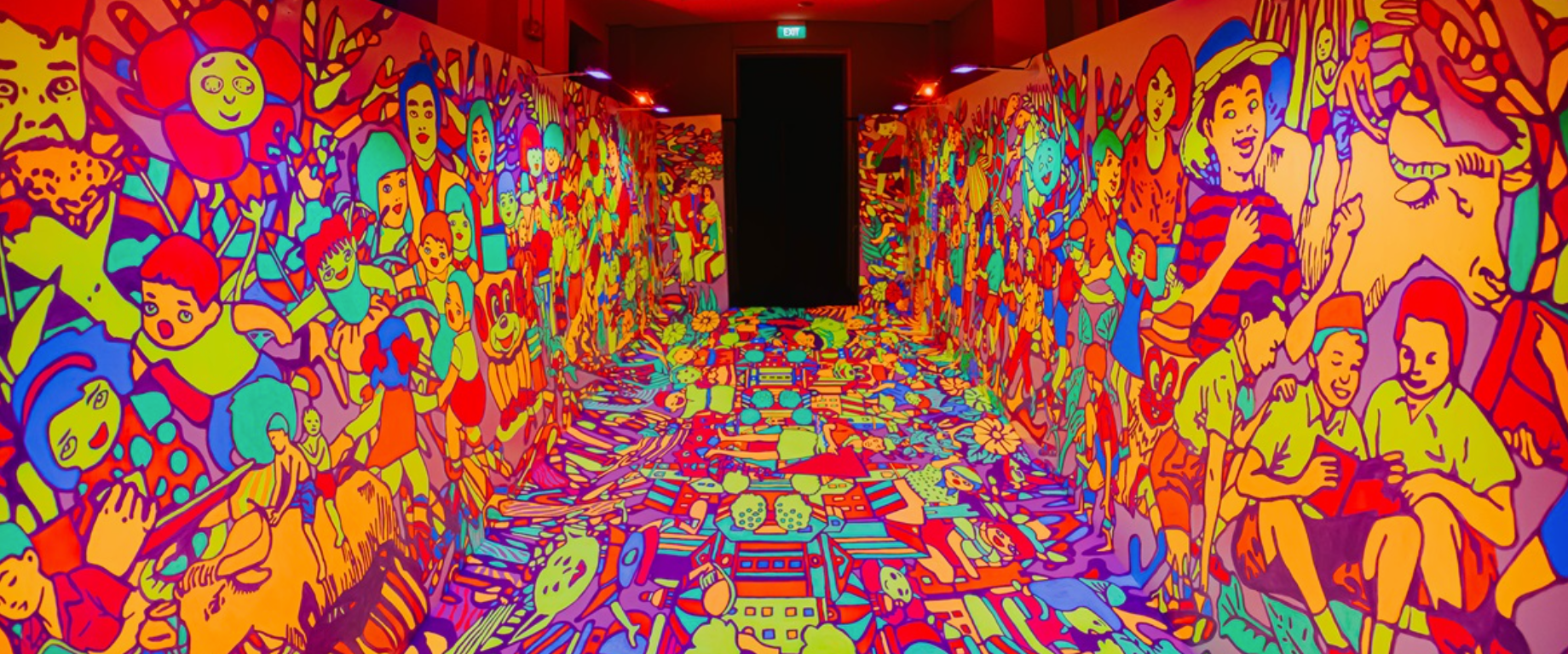
That idea extends now to “The Happiest Days of Our Lives”, which takes the form of a blacklight immersive mural inspired by the rich history of in the Bras Basah.Bugis precinct. Formerly home to many educational institutions like a Japanese Elementary School in 1920 to Waterloo Girls School in 1984, the centre’s history led Rizman to think of the creativity, curiosity, and playfulness that filled schools.
“David (SNF director) approached me back in February to do this project, and gave me a few choices for the space, one being Stamford Arts Centre. I didn’t know the history of the space, so I started off by researching old photos,” says Rizman. “One of the early photos I found showed Japanese kids reading textbooks, and I thought, ‘I like textbooks, I like vintage illustrations.’ I looked at the space and felt its energy, and decided to start collecting old photos and drawings from my mum’s old textbooks for inspiration, and managed to amass over 200 photos.”
This installation draws on the nostalgic illustrations of old textbooks, capturing a vanished world. It aims to transport the audience into a vintage era of the 60s-90s through vibrant neon imagery. The mural reimagines these classic illustrations, immersing viewers in a captivating, blacklight-activated neon realm that honors the past. “The blacklight paint is specially imported from the USA and has this intensity to how it captures neon light. It takes maybe five layers of paint to get to the final product, with time needed for each layer to dry before continuing,” says Rizman.
“It was a crazy because we only had 17 days to install it, with the team working from 8 a.m. to 9 p.m. with only two breaks: lunch and tea. It’s a solo work, but I also needed assistance to execute it. The assistants said it was like climbing a mountain – they would come to work, not talk to anyone, put on headphones for 8 hours, and just get to work. I prepped them beforehand, told them that it would be a tough mental journey, where not everyone can work at that intensity. But last weekend, when you see the queue for the exhibition stretched all the way to the main gate, when you see the painting and projection together and get lost in the image, it’s all worth it.”
On the inspiration to use blacklight, Rizman recalls his experiences and idea behind it. “Blacklight is something I’m familiar with from working with a props-making company at Zouk, where I dealt with neon lights every day for a month,” says Rizman. “At the same time, we had the challenge of how these fluorescent paint only had so many colours, and we had to figure out the most creative way of using them – it’s like when you were a kid, using just 12 Staedtler pencils, and figuring out which colours to use for your drawings. But those limitations also informed the work, and turned it into something quite wide-ranging in terms of how it has many ways you can interpret it—you can create your own narrative because it’s so huge.”
Within the mural, you’ll find little Easter eggs and joyous surprises, from aliens, to even a depiction of multiracial children performing a rendition of the song ‘The More We Get Together’, inspired by Rizman’s own brother back when he was in primary school. “There’s a lot of simplicity in the work, a lot of simple beauty from all these memories. The work isn’t really meant to have a very deep meaning, but more of to encourage people to sit in the space for a while and take photos,” says Rizman. “And well, when a moment means something to you, even if you won’t remember it exactly, for some of these families, when the children grow older, and look back on these photos, maybe they’ll remember that feeling they had when they came here, much like how the mural itself also looks back on happy memories of the past.”
As for what lies ahead for Rizman, he thinks back on the projects this year where he’s been looking back on history, much like this work. “This year, I did Air with Drama Box, and looked at the lives of the orang laut. And before that, I did a project with NADA where we found old Malay songs and recreated them into something new,” says Rizman. “It really got me into history, imagining people back then and thinking about the future, or what the first people creating electronic music were like. Sometimes it’s strategic—you’ve got to make history cool again, polish it. History can be quite dry, but look at what SNF is doing to evoke all those feelings of yesteryear – it’s working for me at least, and making it quite fun.”
“As for my future, even though I’m at the age where I should be sitting still, I can’t. I’m so restless and full of energy, and can’t chill out. So besides theatre and performance, I really want to keep exploring new things, finding more exciting things to keep myself occupied. That’s why I take on projects like these, and not only create work that’s transgressive or counterculture, but also at this point, perhaps also look towards creating more work that’s beautiful as well.”
The Happiest Days of Our Lives is on display at Stamford Arts Centre till 7th September 2024, 7.30pm – 12am. Admission is free. Find Rizman Putra on his website and Instagram.
Singapore Night Festival 2024 runs from 23rd August to 7th September 2024 around the Bras Basah.Bugis precinct. More information available on nightfestival.gov.sg
 Bakchormeeboy