
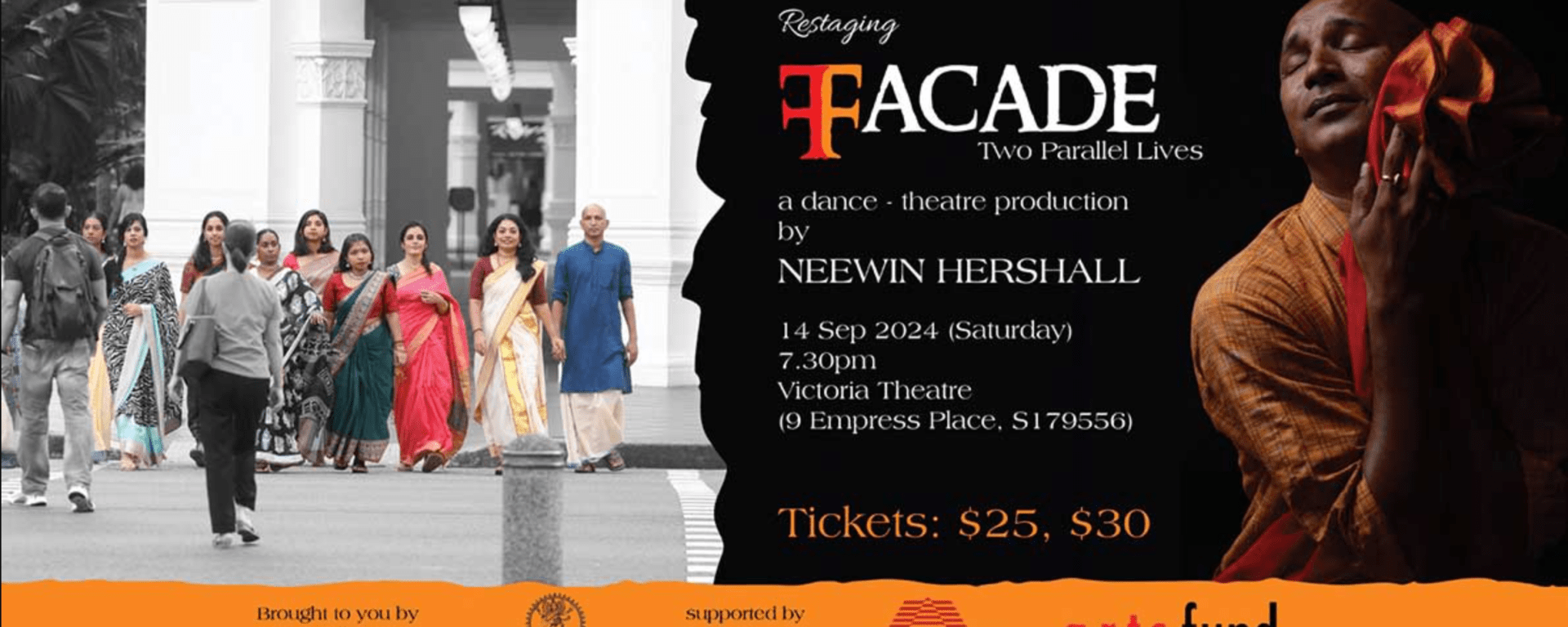
Resolving the line between the personal and the professional.
Over the years, Bhaskar’s Arts Academy has consistently pushed and evolved the Bharatanatyam form, yet always maintaining its core tenets and philosophy. In their latest production, Bhaskar’s Arts Academy brings back resident choreographer Neewin Hershall’s FACADE – Two Parallel Lives, the first time it’s been staged since its premiere in 2017, and showcases the company’s ability to blend film, theatricality and traditional Bharatanatyam dance into one cohesive, affecting production.
Initially performed as a solo work by Neewin, this new staging of FACADE expands on the original presentation by including nine of Bhaskar’s Arts Academy’s Company dancers in this version. Thematically, FACADE primarily revolves around the fine line we draw between our professional and private lives, particularly for performers, as they separate the two from each other. The performance itself opens as we watch a livestream of Neewin and the dancers backstage preparing for the performance, before smoothly transitioning into a filmed segment, as Neewin sits alone in the dressing room. Exchanging a series of messages with his wife, the conversation is deliberately left abstract as we’re left to wonder about a mysterious ‘her’ possibly in the audience tonight, before Neewin hurriedly ends the conversation and prepares for the performance.
Segueing into a Bharatanatyam segment, we watch as Neewin joins dancers Anusree Sreekumar, Bavani Devi Jesus Ilango, Dhanya Sivasankaran, L Divyaasri, Lekshmi Chandran, Prishalini Rajendran, Shamini Subramaniam, Vaarsha Nair, and Vishnupriya Nadarajan onstage. By having witnessed the ‘backstage drama’ that took place beforehand, Neewin’s performance is given even more weight, as he seems to have left it all behind, and places all his attention on the performance, bereft of any anxiety or worries. The other dancers are in sync and moving together, and shows off a troupe that has been well-rehearsed to execute every movement properly.
As the segment ends, we instead transition to another film segment, this time flashing back to a village somewhere. We are never explicitly told what is happening here, but we can imagine that the woman in the village is the same one Neewin was asked about, someone he knows or once knew, and we understand that the two of them were at some point, much closer. Now given the chance to reconnect, being in the same town, Neewin wants to take that opportunity and run with it, and we transition from film to a stage presentation.
But Neewin is left with only disappointment at what he finds. An empty door descends to indicate Neewin in a room of some kind, and within that space, all that is left is remnants, and not this woman herself. He kneels, his eyes filled with emotion as he realises she’s gone, regret as he wonders if things could have been different. The rest of the dancers come onstage to perform again, and Neewin puts on a strong front, his face all smiles while they perform the next act, as cohesive as before, garnering the warmth and appreciation of the audience.
Towards the end however, we see Neewin run offstage suddenly, and when he returns, his back is turned to us, audibly panting and distressed. He composes himself, turns around to face us and continues to dance, emotion coursing through him. Perhaps this is the coming together of both the private and professional selves, where the trauma and sadness Neewin experiences behind the scenes can both help and harm; while it conveys how it takes a toll on his mental state, it also enriches and informs the performance in other ways, allowing him to channel the energy into a more positive outlet.
In its final scene, Neewin is alone once again, sitting in front of a hand mirror. The cameras zoom in on him, and his face is magnified onscreen for us to see. He is visibly disturbed and affected, yet begins to put on black, red and white face paint, reminiscent of the Kathakali style of theatre. Throughout the process, the face of a god (or is it a demon?) flashes onscreen from time to time, perhaps the intended final look he is intended to achieve, grinning in a sinister manner. Neewin seems to realise this, reacting with shock and horror each time it happens, and we wonder if he is being haunted by his past, coalescing and becoming this terrifying entity, before we abruptly cut to black.
Over the final credits, a girl sings a haunting melody, as we view footage of what appears to be a morgue. It is a dark end to the entire piece, as we are left to wonder what becomes of this fictitious version of Neewin, and if he ever quite manages to recover from it. Left hanging, FACADE – Two Parallel Lives then begs the question – how much can we hide of ourselves before being forced to confront it? And when we do, will it be too late? Perhaps the answer lies in remaining as professional as we possibly can, but ensuring that we do not neglect these demons when we have a chance to exorcise them once and for all.
FACADE – Two Parallel Lives played on 14th September 2024 at Victoria Theatre.
Production Credits:
| Concept & Choreography Neewin Hershall Film direction, Background music, Post-production & Publicity collateral design Deepu Karunakaran Script & Production management Shubaashini Vijayamohan Stage cast Anusree Sreekumar, Bavani Devi Jesus Ilango, Dhanya Sivasankaran, L Divyaasri, Lekshmi Chandran, Prishalini Rajendran, Shamini Subramaniam, Vaarsha Nair, Vishnupriya Nadarajan Film cast Santha Bhaskar, Bijulal Kalarangam, Renjith Babu, Vijna Vasudevan, Sasrika, Chalani, Renu & Renuka Music A. Durgaprasad, Balakrishnan Keerthana, B.V. Balasai, B.V. Raghavendra Rao, Deepu Karunakaran, Devisree, Fayaz Khan, Karthikeyan Ramanathan, Nagai Narayanan, Srinibas, Sivaprasad P.K, Sruthi Sagar & Rijesh Gopalakrishnan Lighting design A Kumarran Set design Randy Chan & Amelia Lim (Zarch Collaborative) Costume design Nishalini Lakchimanathas Costume, Makeup & Hair Selvi Parvathy Costume Narthaki Photography & Livestream support Lijesh Karunakaran, Sajin Ravi, Adarsh Vincent Kurian & Subbiah Rajakumar Programme booklet design Soneiya Chandra Kumar Stage management Tan Ching Ting Assistant production management Thava Rani Mohan |
 Bakchormeeboy