
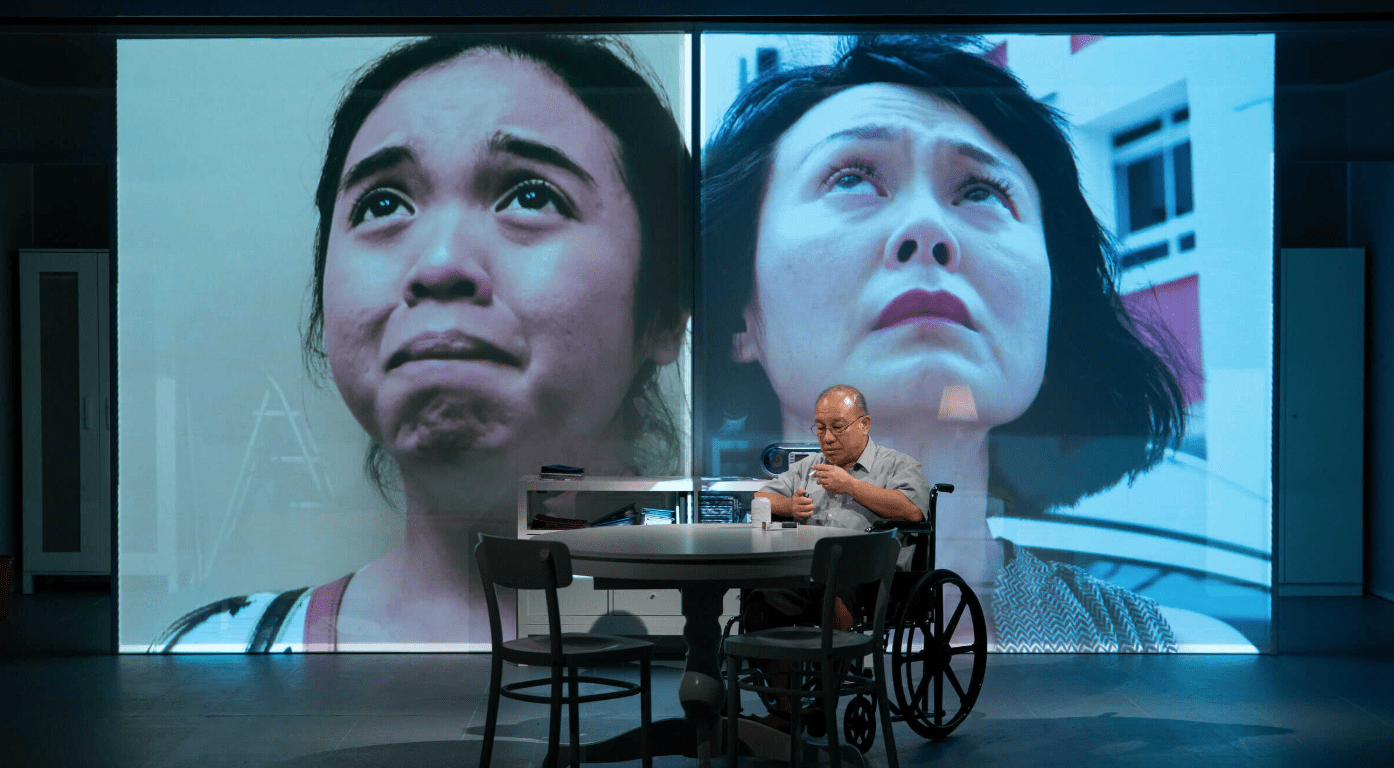
2025 restaging of Thomas Lim’s play on surveillance, power and agency stands the test of time and proves itself a modern classic of Singapore theatre.
When Thomas Lim’s Supervision premiered in 2018 as part of Wild Rice’s Singapore Theatre Festival, it established the then emerging writer as a promising new figure in the playwright’s circle, with the characters authentically Singaporean, unabashedly showcasing the ugly side of our prosperous nation, and the individual struggles all of us go through. And on rewatch, its themes and message ring clearer than ever before.

Supervision returns this year with Glen Goei as director once more, and two of three new cast members. Supervision sees grumpy old Teck (Julius Foo) receive a new housemate – Indonesian domestic helper Yanti (Amirah Yahya), hired by his daughter Jenny (Janice Koh) to assist him in his daily activities, after his mobility is greatly affected by a stroke. An interesting dynamic then begins to develop between the three of them; with Jenny and Teck at loggerheads over how he should be watching his diet and caring for his health, Yanti is caught between following her employer’s strict orders, lest she be fired, and the growing friendship between herself and her new ward. But each time she does something to help Teck, for some reason, Jenny instantly knows what’s going on.
At first glance, Supervision is a story about Singaporeans’ relationships with domestic workers. But beneath that, it probes into something far deeper: the cost of control, and the surveillance culture that seeps into our most intimate spaces. Jenny quickly becomes the play’s antagonist, a figure of paranoia and obsession—checking Yanti’s bag, digging through trash, installing CCTVs even in the bathroom, and of course, threats of deportation to cast fear into Yanti to ensure complete and total obedience. As Jenny fearmongers and brings up cases of maids running away or abusing their elderly wards, we can’t help but wonder how many of us have inadvertently become or know of a Jenny ourselves, and how we can afford to let the paranoia slide while still maintaining that sense of authority and ability to protect ourselves and our families.

Janice Koh’s return to the stage is nothing short of revelatory. After a long hiatus due to health reasons, her performance carries both fire and fragility. Jenny is controlling, yes—but also desperate. You sense her trying to prove her worth as a daughter, to win the love of a father who seems incapable of offering it. Koh delivers a masterclass in complexity: her Jenny is cold, calculating, yet heartbreakingly human. Right from the beginning, there is already a sense of vulnerability to her, almost as if she’s using this new arrangement to gain some kind of foothold and power, to impress her father as a capable and loving daughter, something that clearly he never seems to appreciate.
Janice commands the stage with razor-sharp precision, portraying a woman who’s as unyielding as she is quietly broken. The way she shifts — from authoritative, to suddenly, surprisingly, achingly human — is a feat of emotional dexterity, earning our empathy even when we least expect it. You hear the awful irony in her voice when she tells Yanti she wants their relationship to be build on trust, but also see her as a woman who is trying her best to win affection in a losing battle, using all the techniques at her disposal, without any idea how little effect it has. Her final monologue is a gut-punch—raw, painful, and unforgettable—cementing her status as a class act through and through, and you fully understand the weight and stress of being the sole caregiver to a person who will never love you for it.

Alongside Janice, both Amirah Yahya and Julius Foo match her beat for beat. Amirah brings an emotional clarity and vulnerability that makes it impossible not to root for her. From the beginning, you already see her with the odds stacked against her, in a much more perilous situation than the others, where a single misstep could cost her everything. Her voice tentative and meek at first, we warm to her easily as we watch her quiet resistance and the way she befriends Teck, genuine in all she does with a winsome smile. You feel her frustration and fear emerge when she discovers the CCTVs, trembling each time she does something even a little subversive, and knowing how impossible it is for her to fully win over Jenny, is the beating heart of this play.
Julius as Teck on the other hand, is equal parts curmudgeonly and deeply poignant. His physicality is on point, the lower half of his body moving weakly when he practices walking on his own, and the gruff exterior gives way to pitiful sobs when he realises how little agency and dignity he has left over his own life, grieving not only the loss of his wife, and his own bodily functions, but also any form of enjoyment he once had, from braised pork to cigarettes, as we wonder for him what exactly is there left to live for, if living is so painful. At times exasperatingly stubborn and at others as feeble as a baby, Teck often emerges as a surprisingly wise voice of wisdom when it comes to how to live life and treat others, even if he sounds like he’s scolding you while doing so. Among all three, the chemistry sizzles, balancing humour and heartbreak with grace, the tension always taut, almost palpable in the air.

On the design side, Wong Chee Wai’s set design mirrors Teck’s life: stark white, sterile, drained of colour and warmth—like his porridge. The semi-translucent walls serve a dual purpose: they allow us to see the action clearly, but also reflect the play’s central tension around privacy and exposure, and how there’s always someone watching. Koo Chia Meng and Andrew Ng’s multimedia is cleverly woven in to the play, used not for spectacle but for story. When Yanti discovers the surveillance cameras Jenny has installed, their presence becomes an eerie fourth character, raising the stakes and deepening our unease, where we see all the going-ons from all angles.
Most of all though, it is the newly filmed video sequences that help add to the emotional overtones of the play – watching Yanti explore Paya Lebar for the first time, seeing Teck having a smoke on the balcony, or Jenny with brows furrowed as she looks at the time. These wordless close-ups tell us more than dialogue ever could, capturing a loneliness and longing that connects them all. In a play so concerned with being watched, these are the moments that let us see them for who they are.
How much do we sacrifice for the illusion of control to make ourselves feel better, when most of the time, becoming so overbearing and insistent is precisely what tears us apart, fearful that we will be judged or punished on every small mistake, always walking on eggshells. It is this lack of trust between each other that leads to the constant policing of behaviour, and what prevents us from living life on our own terms.
By the end, Supervision reveals itself as less about authority than about powerlessness—the desperate need to control something, anything, when life feels like it’s slipping away. Whether it’s Jenny micromanaging Yanti, or Teck clinging to what pleasures he can, everyone is trying to assert agency in a world that keeps taking it away. The surveillance, the rules, the mistrust—these are symptoms of deeper fears: of being irrelevant, unlovable, replaceable, all stemming from a society obsessed with order and control. There are no easy answers here, where the play dares to linger in discomfort, in moral grey areas, in the tension between compassion and control. With emotional depth, unflinching honesty, and piercing insight into modern domestic life, Supervision once again reaffirms its place as an essential part of the Singapore theatre canon at its most intimate and urgent.
Photo Credit: Wild Rice
Supervision played from 27th March to 12th April 2025.
Production Credits:
| Playwright Thomas Lim Director Glen Goei Cast Janice Koh, Julius Foo, Aminah Yahya Dramaturg Alfian Sa’at Composer Julian Wong Set Designer Wong Chee Wai Lighting Designer Tai Zi Feng Multimedia Designers Koo Chia Meng & Andrew Ng Sound Designer Paul Searles Costume Designer Theresa Chan Hair Designer Ashley Lim Make-Up Designer Bobbie Ng |
 Bakchormeeboy
2 thoughts on “★★★★★ Review: Supervision (2025) by Wild Rice”