
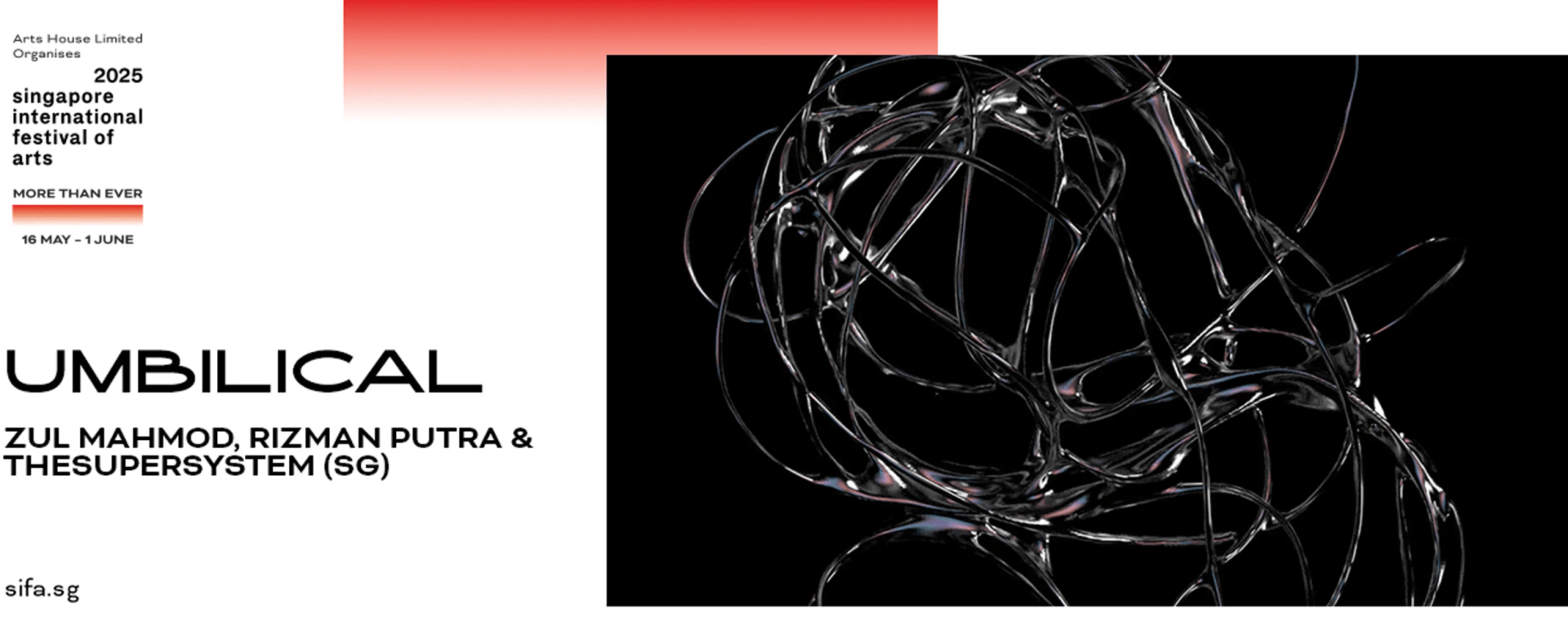

In an age of rapid progress, history can slip through our fingers. Premiering as part of the 2025 Singapore International Festival of Arts (SIFA), Zul Mahmod, Rizman Putra, and thesupersystem (Heider Ismail) invite us to Umbilical, a multi-faceted performance that invites us into the depths of memory, identity, and the subtle violence of separation, excavating the history of the Causeway as Singapore turns 60.
Umbilical is a multi-sensory performance that reaches into the layers of identity, memory, and shared histories, exploring the emotional ripples left by the 1965 separation of Singapore from Malaysia through a compelling mix of movement, sound, projection, and AI. “Natalie (Hennedige, SIFA Festival Director) brought the three of us together to do the project,” Zul recalls. “All of us worked with each other in different capacities, and we had different areas of expertise; with Rizman specialising in performance and Heider in projection work, which created plenty of potential for us to come up with something together.”

The title Umbilical evokes the moment of birth—when a baby is first severed from its mother. Here, it becomes a direct metaphor for Singapore’s independence from then-Malaya, with the Causeway standing as a symbolic thread between two lands. “Heider was the one who came up with the title,” Rizman explains. “Beyond referencing the Causeway, it was really about layered identities and relationships—that’s where we started, researching stories behind the connection.”
But this isn’t a history lesson, and neither is it a conventional theatre piece. Rizman, known for his boundary-pushing physical performances, serves as the audience’s wayfinder. “My body becomes a vessel for information to be translated into movement,” he shares. “Sound and visuals aren’t just backdrops—they’re part of the cast. When I perform, I’m elevated by Zul and Heider’s work, integrated into the whole.”

The show unfolds across several chapters, traveling through time—from long before our Independence in 1965 to the very formation of the land itself. “The first chapter explores the origins of the region—Sundaland—and the flood that came before the Causeway,” says Rizman. “It moves through geological beginnings into the political and emotional ruptures that followed.”
“Each chapter is filled with very intentional emotion, and for me, in terms of sound, we decided to go in a more abstract direction to lead the audience to feel a certain way, focusing on generating more intensity or moments of contemplation,” says Zul.

Heider emphasises the use of historical references in their visuals: “In my projections, I’ll be visually referencing historical images and geographical maps, like in the first chapter, introducing the land itself and us trying to reference Sundaland itself, from both a literal and scientific point of view.”
But the umbilical metaphor has even deeper resonance than connection alone, as it reveals many little domino effects of Separation that impacted Singapore in surprisingly significant ways. “Umbilical is also about the disconnection—how our threads might be more fragile than we think, and the causes of separation,” Heider says. “So we extend it a little more thematically, beyond the Causeway itself, and think about how different entities and collectives, or certain groups of people in certain areas have been separated.”
“One personal discussion we had was about how P. Ramlee left Singapore during the Separation, and how the whole Jalan Ampas studios disappeared after he left for Merdeka Studios,” says Rizman. “There were surprising resonances in the arts that you don’t realise happened because of this Separation.”
“There’s also an interesting fact we unearthed in our research – the destruction of the Causeway during World War 2 led to its reconstruction, and that also led to a change in the flow of water, affecting the ecology and how fishermen could no longer fish as well,” notes Heider.

Though Umbilical coincides with Singapore’s 60th year of independence, the trio isn’t out to commemorate. “That timing is purely coincidental,” Rizman says. “For us, anniversaries tend to celebrate triumph. But this work is more of a resistance to that idea. We’re interested in the emotional mess—uncertainties, unresolved feelings. Instead of looking back to celebrate, we’re looking beneath.”
Heider adds: “To me, Umbilical is a soft celebration. It’s about the birth of Singapore as a nation, where Singaporeans found themselves adrift, suddenly funnelled into a whole new world. It’s about all these disruptions that came about because of Separation, and all the uncertainties, and how strange it was to think how far we’ve come, where those tensions have dissipated and now, we can just cross the Causeway that borders us with a passport. It’s a celebration of that, while thinking about the past, with a strong hint of wistfulness, and nostalgia.”
Zul reflects, “Even in celebration, we cannot forget the past. What makes it celebratory is how we have triumphed past generations of uncertainty and confusion. We cannot deny all this tumultuous history that happened, and how it’s affected our relationship with Malaysia, like rifts and old scars between family members.”

One of the show’s more intriguing elements is how the trio integrate technology into the performance, welcoming it with a hint of caution. “Technology has both potential and dangers. It’s opened up a lot of possibilities as a new form of expression. But also, I fear how it’s being fetishised. You know the whole Ghibli-filter saga, as an artist I feel the pain on a very personal level. So to integrate technology, we can’t just blindly use it or jump onto trends, but to simultaneously embrace and resist it by thinking further about what we can do with it,” says Rizman. “By having me as a human, physical body in the performance, I believe that I help anchor the humanity of the work, rather than letting the visuals and projection and technology take over, helped by the costumes, which fulfil both aesthetic and functional purposes.”
In spite of his main tools being technological in nature, even incorporating AI, Heider echoes this: “Technology is an extension of humanity; without humanity, it’s just a tool, like a hammer. You can use it wisely, in the right way. AI has so much potential, and I can see how it could allow humans to push boundaries and try new possibilities and open up all these new worlds for us.”
Zul adds, “We should not be using technology for the sake of it. Some questions I ask myself include whether I can achieve something without technology, or if the technology would enhance and expand the work further. Like how a painter has different mediums, it all boils down to what is the message you want to send,” says Zul. “In this show, the sound and the visuals are crucial elements, and even take over at certain points, where the audience is intended to become immersed, and have their emotions pushed further through these.”

The team is attuned to the generational shifts in perception and memory. Rizman observes, “We are living in such an accelerated era, where we do so much that there’s no time to even think about what happened yesterday or reflect on things. The moment you are done with the day, you need to think about tomorrow or next week. These days, history has become something that is so easily forgotten. Even iconic buildings are constantly being demolished and modified and changed, there’s no sense of place for people to think about the past, where so many memories can only be found on internet archives.”
As Umbilical draws nearer to its premiere, the artists take a moment to reflect on the festival’s subtitle ‘More Than Ever’, and what we need more than ever before. “In history, there’s always two sides of the story, and we want people to take an active interest in finding out more, whether from the internet or finding historians or oral histories. I hope the younger generation especially grows an interest in this, beyond treating it as a one-off history lesson,” says Zul. “When you see what’s going on in the world right now, what we can all stand to have more of is empathy. And for the performance, it’s the hope the audience will be present in that space and really enjoy the piece, without having preconceived ideas of what it is or what things are, and be ready to appreciate history more.”
“More than ever, we need to remain porous to each other, to uncertainty, to wonder,” says Rizman. “In this time of heightened noise, we need to be more mindful of each other. We don’t know what to expect in the future, so maybe we all need to be more emotionally intelligent, more present, and just to be nicer to each other, all of which we’re trying to get people to think about more through this piece.”
Umbilical plays from 16th to 18th May at the SOTA Studio Theatre. Tickets available from BookMyShow
The 2025 Singapore International Festival of Arts runs from 16th May to 1st June 2025. Tickets and more available here
 Bakchormeeboy