

Multidisciplinary performance in the heartlands marks a sweaty start to 2025 edition of SIFA, with little consideration for the spatial limitations of an outdoor venue and an ill-fated attempt to make art ‘accessible’.
Bedok was one of the earliest documented places in Singapore, fast growing from its origins as a Malay and Orang Laut-inhabited fishing village, to becoming one of the most heavily populated heartland districts today. Taking advantage of its status as a bustling urbanised area today, the 2025 Singapore International Festival of Arts (SIFA) has decided to create a festival hub in Bedok this year, as a means to dispel the elitism of the arts, and engage ordinary members of the public with a multidisciplinary showcase of work at the custom-built SIFA Pavilion at Bedok Town Square.
Thinking back to Bedok’s coastal roots and heritage, the Festival Pavilion encompasses several installations throughout the SIFA period from 16th May to 1st June that deal with the sea and the passage of time. These include multimedia artist Brian Gothong Tan’s Speculative F(r)ictions, using screens around the Pavilion to display glitch art and ‘speculative CGI’ constructing imagined myths of Singapore, as well as Quek See Yee’s Hearsay, where participants engage in the act of weaving. The combination of these simultaneous activities makes for a rather busy Pavilion, in an already busy area, and feels a little like cramming New York’s Times Square into a small space, everything fighting for attention at once.

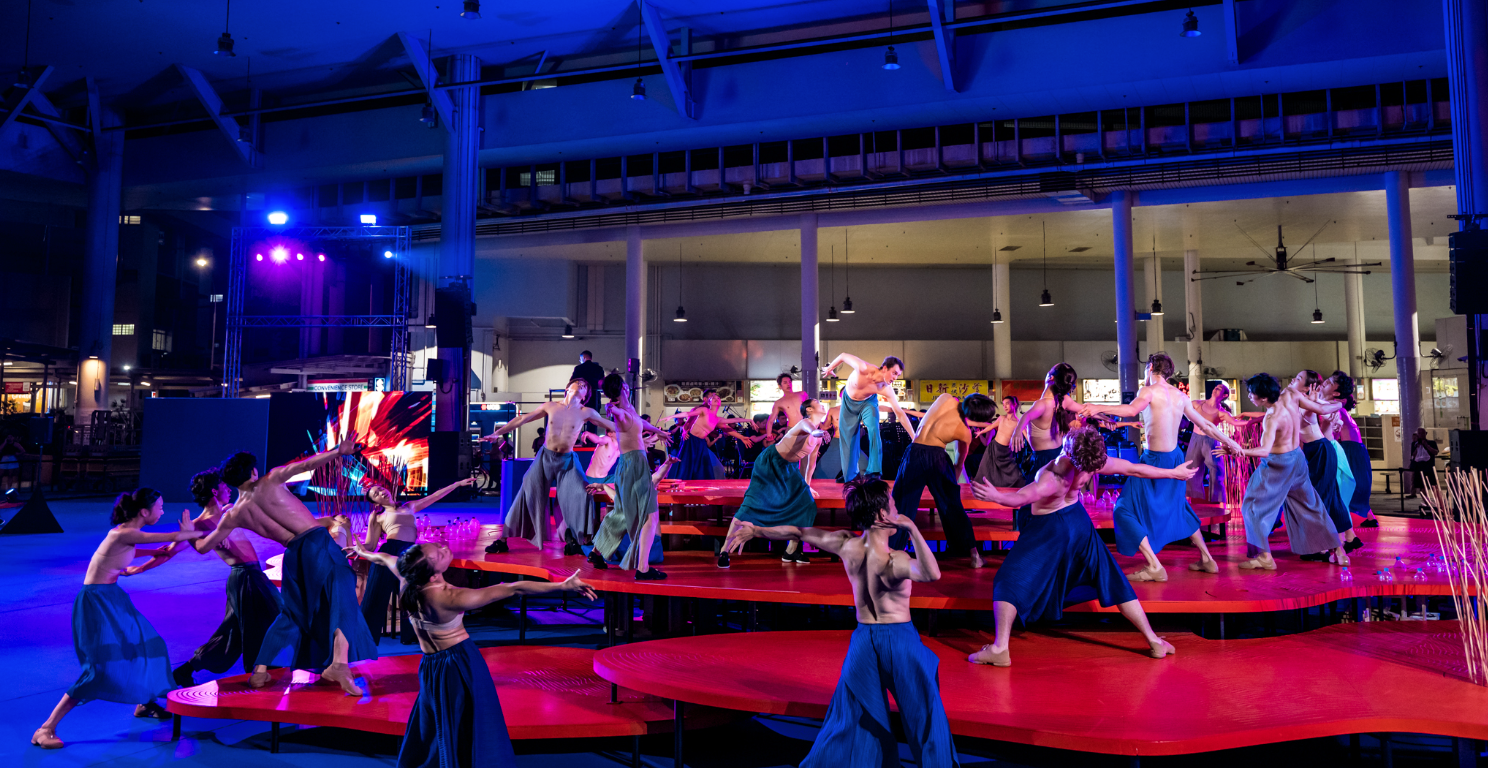
This extended to when the main performance of opening night began as well. At the centre of the Pavilion is Wang Ruobing’s installation Beneath Tide, Running Water, meant to be an artistic interpretation of life beneath the sea, and representing the symbiotic relationship between corals and single-celled algae. Comprising tiered red, rounded platforms, there are various mechanisms affixed under them that see upcycled plastic water bottles pop their heads out of holes, and clumps of reeds that rustle. These bottles and reeds are untreated, not at all decorated, and feel more like pollution amidst what rarely, if ever, feels like an undersea scene.
This installation also acts as the stage for the performance segment of The Sea and the Neighbourhood, a free multidisciplinary performance from various groups that plays one every evening, anchoring the first weekend of the Pavilion. This would comprise an original composition Ode To The Sea by Orchestra of Music Makers, and a dance performance Pact of Water by Singapore Ballet. The concept of having such an event seems intended to provide a spectacle and draw curious onlookers in, driving engagement with the arts, and indeed, a small crowd began to form when the performance began.

While the performance has three runs, it seems rather ironic that on opening night, there was a strong sense of exclusivity for such a community-focused event in a public space. Many of the ushers were seen shooing members of the public away from the performance area, including both elderly and wheelchair-bound potential audience members, relegating them to the fringes of the Pavilion, and creating the impression of an invisible barrier between ordinary Bedok residents and invited guests.
The layout of the space as a whole was also rather odd. When the performance began, the fringe activities still continued to play, including the videos from Speculative F(r)ictions, as well as a single man weaving away for Hearsay, hidden away at one corner yet strong stage lights still shining down on him. It’s a strange, distracting and frankly confusing curatorial choice to have all these happening at the same time. Meanwhile, whatever the Orchestra of Music Makers was playing was effectively muffled by the ambient noise from the nearby hawker centre, without a proper sound system to amplify or direct the music, while drummers found themselves losing their rhythm and struggling to catch up at points.

The dance performance itself, choreographed by Christina Chan, is a challenging one. It is firstly, impressive to choreograph such a large number of dancers to move in synchronicity, often ending up in large formations that encircle the central installation, as if performing a ritual, showcasing their strength and poise by engaging in lifts, leaps and turns evidently honed from their training. There is an ebbing and flowing of movement, meant to resemble the sea, and great expenditure of energy in making it feel like the movement of water. Sweating in the heat, their half naked bodies glisten under the stage lights, dressed only in loose fitting trousers as styled by Brian Gothong Tan. The effort is clear – catching a glimpse of them ‘backstage’ (a makeshift box), they gulp down bottles of water and wipe their sweat as best as they can before pulling it together and entering performance mode when they file out again onstage, doing their best to navigate the unusual space and venue, battling the elements as best they can.
But to what end does all this effort amount to? Pact of Water is very much an experiment, moving away from traditional ballet forms and choreography to supposedly ‘push’ Singapore Ballet into new territory. This is already clear from the fact that none of the dancers wear ballet flats, instead donning black trainers and jazz shoes. In addition, the choreography seems ill-suited for the space; while it does take note of the size of the stage, most of the solos and duets face a single direction throughout the night, where audiences on the left and right of the rounded performance area never get to see those performers head on. From any vantage point, it often looks like a mass, and it is difficult to appreciate the complexity and skill level the dancers display from such angles and proximity.

The same goes for guest performers – visually-impaired Claire Teo on vocals, oud player Azrin Abdullah, and bansuri player Raghavendran Rajasekaran. Throughout the night, they are seated at the side, waiting their turn, before they are led by a dancer onstage, given the platform to showcase their art while the dancers surround them. But it is after they do their talent that they slink offstage with no fanfare, quietly retreating to their seat. It is only Claire, who impresses with the additional task of being lifted when she performs, that leaves a slightly bigger impact than the others, and for some reason, later on, begins to sing after standing up from her seat as well instead of returning to the stage. There is something about the whole affair that feels more akin to tokenism rather than representation; even former Singapore Idol finalist Mathilda D’Silva, who appears midway through to perform a brief, ambiguously jazzy number, is there on an ‘if you know then you know’ basis, her own role as a leading figure in marine sustainability completely a mystery, before retreating into the shadows.
Kudos to the dancers for playing their part, and the crew for being so vigilant and attentive, but at the end of the day, all this set-up still begs the question – who exactly is this performance for? Is it meant to be a showcase of Singapore’s artistic talent? Is it trying to get ordinary audiences to appreciate high arts? Is it then dumbing down and diluting the form of the high arts to become more accessible for the everyman? And if it truly is free, then why are there so many odd decisions to gatekeep it? In many ways, The Sea and the Neighbourhood exists as a paradox of our arts scene, meant to evoke the cool waters of the sea but leaving us thirsty and sweating buckets in the heat. It feels more akin to a Chingay or National Day Parade style segment than one we would associate with the prestige of SIFAs past.

In that sense, The Sea and the Neighbourhood, and by extension, the SIFA Pavilion as a whole provokes what seem to be important questions – beyond fleeting engagement each time a large-scale performance is activated in the heartlands, what is the greater long-term goal? How many people will actually understand or take an interest in orchestras or ballets after watching this performance, and will they only watch when the arts is dragged into the humid heartlands for them to enjoy for free? A showcase like this seems to remind us that so much of our art seems to lack heart, seems to lack in wanting to say anything of weight and actual significance to our people. Or worse – that we believe our people are only interested in these momentary spectacles, before glancing, snapping a photo, and returning to our chwee kueh before it gets cold.
Photo Credit: Moonrise Studio, Courtesy of Arts House Limited
The Sea and the Neighbourhood runs from 16th to 18th May 2025 at Bedok Town Square. Admission is free, more information available about the Pavilion available here
Singapore International Festival of Arts runs from 16th May to 1st June 2025. Programme and tickets available here
Production Credits:
| Singapore International Festival of Arts | Curation Wang Ruobing | Installation Design Philip Tan | Composer & Conductor Christina Chan with Singapore Ballet | Choreographer Brian Gothong Tan | Video Artist, Spatial Design & Costume Stylist Andy Lim | Lighting Design rongzhao | Sound Design Singapore Ballet | Performer Orchestra of the Music Makers | Performer Claire Teo | Performer (Vocals) Azrin Abdullah | Performer (Oud) Chew Wah Yong | Performer (Bass) Daniel Sassoon | Performer (Electric Guitar) Gabriel Hoe | Performer (Keyboard) Mathilda D’Silva | Performer (Vocals) Raghavendran Rajasekaran | Performer (Bansuri) Wilford Goh | Performer (Violin) Chap Chee | Performer (Percussion) Jenson Koh | Performer (Percussion) Cindy Yeong | Production Manager Ian Tan | Technical Manager Theresa Chan | Costumes Coordinator Dr Samuel Wong | Additional sound audio recording – Pipa Zhan Bao | Additional sound audio recording – Chinese opera |
 Bakchormeeboy