

Missed opportunity for new, emotional perspectives of the Japanese Occupation, with innovative techniques let down by shaky execution and cohesion.
In the Singaporean history and social studies syllabus, portrayals of the Japanese Occupation in World War II have always unequivocally painted them as the villains, where Singapore (then renamed Syonan-to, or ‘light of the South’) lived under a reign of terror, afraid to offend these Neo-colonialists lest they be tortured or worse, put to death. But if one digs deep enough, one would discover that just like any colonial rule, amidst the darkness is always some form of light, with humanity’s unerring will to live and retain some form of normalcy amidst change.
Presenting a different take on Syonan-to years is Alan Oei and Kaylene Tan, with their new work A Thousand Stitches, which premiered as part of the 2025 Singapore International Festival of Arts (SIFA). Co-directed by both Oei and Tan, and written by Tan, A Thousand Stitches continues the duo’s partnership and exploration of the life and times of fictional Singaporean artist Huang Wei (with paintings done by Oei). In the performance, we are introduced to Emma (Xuan Ong), an art conservation student restores a portrait by Huang Wei of a Japanese woman from World War II, stitching a ‘senninbari’, or thousand stitch belt, that women would sew for soldiers going to battle, an amulet of good luck where every stitch represents a wish the sewer makes (hence the show’s title).

However, while documenting her process via video, Emma has a mysterious, supernatural encounter, where she comes face-to-face with the painting’s subject herself – Mizuki Kawamoto (Mihaya Shirata), who comes to life and begins to share about her life during the Occupation, and her own relationship with Huang Wei. Over the course of the performance, Emma becomes increasingly drawn to Mizuki’s recount of how the lives of Huang Wei and her own family became entangled when he is commissioned to produce propagandistic art for the Japanese, and learns new facts about life under Japanese rule.
A Thousand Stitches‘ main pitfall is how it cannot decide if it wants to present a documentary or gripping wartime drama, resulting in a relatively heavy narrative that is pulled in too many directions to focus on or feel endeared to. The crux of this comes from how both Emma and Mizuki often feel like spectators in a narrative far larger than their own, only able to offer commentary without much direct involvement. As such, our own understanding of the story similarly feels limited, where we are rarely, if ever, fully attached to the going-ons of Mizuki’s family, thanks to how to focus is instead placed on her father, Huang Wei and his son.

What this results in is a mostly flat pacing, where Mizuki and Emma discuss and talk about routine and situation, rather than emotion. There is almost always a sense of detachment and distance, such that by the time we reach the show’s climax, where the origin of the painting is revealed and the tension ramps up, any form of sympathy or sadness feels unearned from the lack of build-up, and brought out only in the moment. Perhaps this is also in part due to how the main storyline is interspersed with so much detail about the daily lives of Singaporeans at the point, where the segues into factoids are more distracting than elegantly integrated.
That being said, in terms of its execution, A Thousand Stitches attempts several innovative techniques, to varying degrees of success. Much of it revolves around live film, where Emma wields a video camera, using both a tripod and handheld formats to give audiences a closer look at minute details. Sometimes this is done to great effect, such as the zooming in onto the painting, where Emma seems to be drawing out a literal red thread from the canvas leading directly to Mizuki’s appearance, creating an air of mystery. This is also especially well done when the production utilises dioramas and miniatures to present the story, where the angles and cinematography allow us to appreciate how well-constructed these props are, while Emma and Mizuki’s voiceovers remind us of children playing with dollhouses, albeit a little darker in its content.

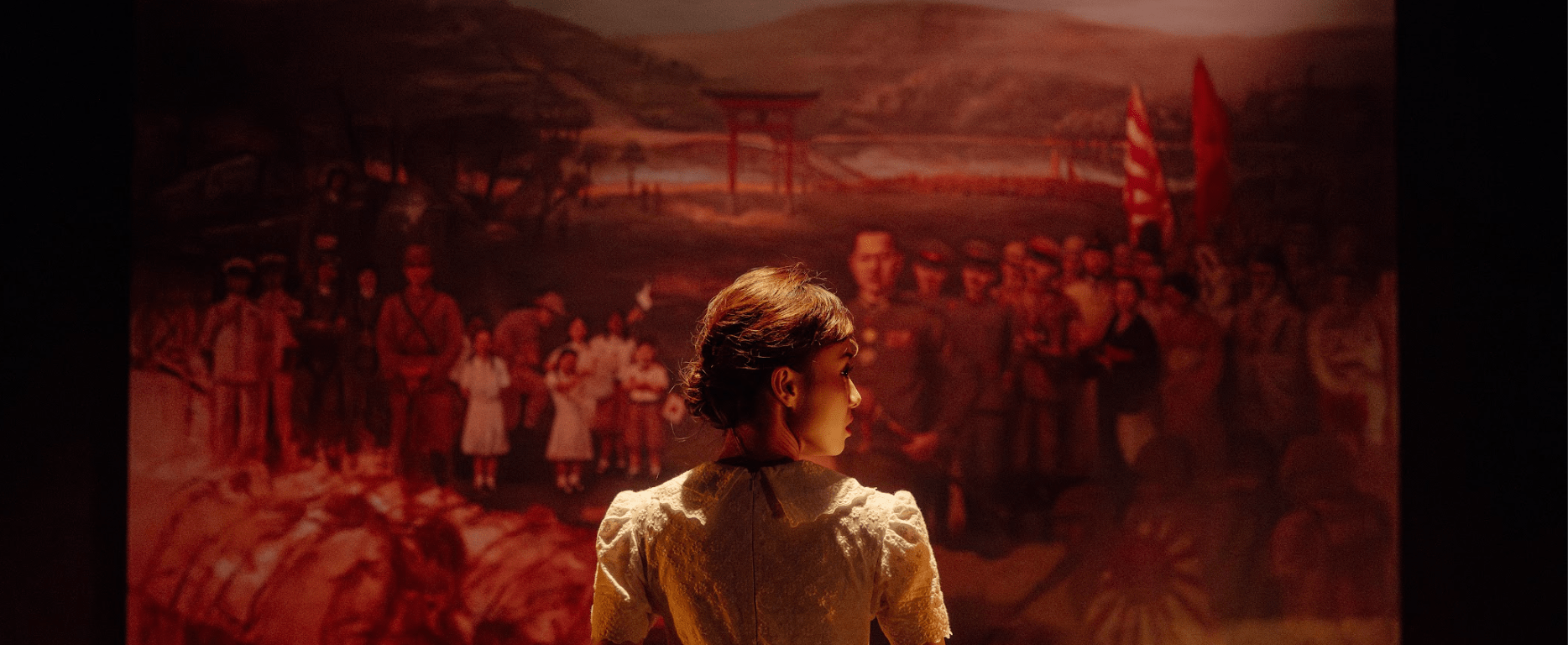
Later on, there is also an interesting use of kamishibai, or Japanese paper theatre resembling hand-drawn slides, where Mizuki seems to take on a more colonial slant, re-telling the way local children (with the requisite Chinese, Malay and Indian representation) reacted to the Japanese arriving on Singapore shores. Especially towards the end of the story, the line between reality and propaganda becomes blurred when we see the pictures come to life through digital animation, no longer just a matter of reflecting what the camera sees. We are left unsure how much of Mizuki’s narrative to trust, casting doubt on the entirety of her story and how biased a narrator she might be, and whether what she sees is clouded by her own upbringing and background.
From a practical point of view however, there are times when the shaky handheld camerawork is more distracting to watch, more headache-inducing than artistic. Projecting the footage onto a black backdrop is also problematic, where the colour quality is often compromised, and the details end up faint, such that even surtitles for when Mizuki speaks in Japanese are hard to read. Essentially, the grand ambitions that A Thousand Stitches possess often feel too big for its execution to fulfil; it is a rare opportunity for multimedia designer Brian Gothong Tan to showcase a rich variety of theatrical storytelling methods, but it ends up weighing the production down with its determination to wow the audience with each new trick while compromising on how it all comes together.

While it wants to emphasise the transgenerational impact of war, A Thousand Stitches winds up caught in an unusual conundrum, where it presents a plethora of information while keeping history enshrouded in mystery. There is a frustrating detachment from its central characters, where while ostensibly meant to be emotional, from depicting horrifying depictions of a bombing to the impressive reveal of a large propagandistic painting, we are left unsure why exactly we should be feeling any kind of sympathy or even curiosity towards the woman in the painting. Both Alan and Kaylene have layered this work with symbolism, but much of the significance ends up lost in translation, where there are so many directions the show wants to go in and cultural touchstones it wants to hit, it loses sight of a central goal to keep audiences invested. A Thousand Stitches ultimately feels like a show that might have been better as an installation or an exhibition, where audiences are left to form their own interpretations, and let the art speak for itself.
Photo Credit: Crispian Chan
A Thousand Stitches played from 23rd to 25th May 2025 at the Drama Centre Black Box.
The 2025 Singapore International Festival of Arts runs from 16th May to 1st June 2025. Tickets and more available here
Production Credits:
| Kaylene Tan | Writer & Co-Director Alan Oei | Artist & Co-Director Brian Gothong Tan | Multi-media Designer & Props Bang Wenfu | Sound Designer & Composer Petrina Dawn Tan | Lighting Designer Angeline Oei | Costume Designer Ken Takiguchi | Translation Ashley Lim | Hair The Make Up Room | Make up Daniel Chai | Voice Recording Engineer Crispian Chan | Photography Teh Yee Sheng | Video Director Xuan Ong | Cast Mihaya Shirata | Cast Elijah Hendriawan | Video Appearances Jhavesh Jharred Sundaresan | Video Appearances Lim Kai Xin Lucian | Video Appearances Shayna Nadine bte Saiful Fadli | Video Appearances Sonya Nadine bte Saiful Fadli | Video Appearances Tashi Jain | Video Appearances James Jordan Tay | Associate Producer Varian Tan | Technical Manager & Sound Engineer Jasmine Khaliesah | Stage Manager Mirra M Z | Assistant Stage Manager Jessica Chew | Assistant Production Manager Claire Tan | Additional Props Sulastri Subari | Video Operator Summer Rae | Production Assistant |
 Bakchormeeboy