
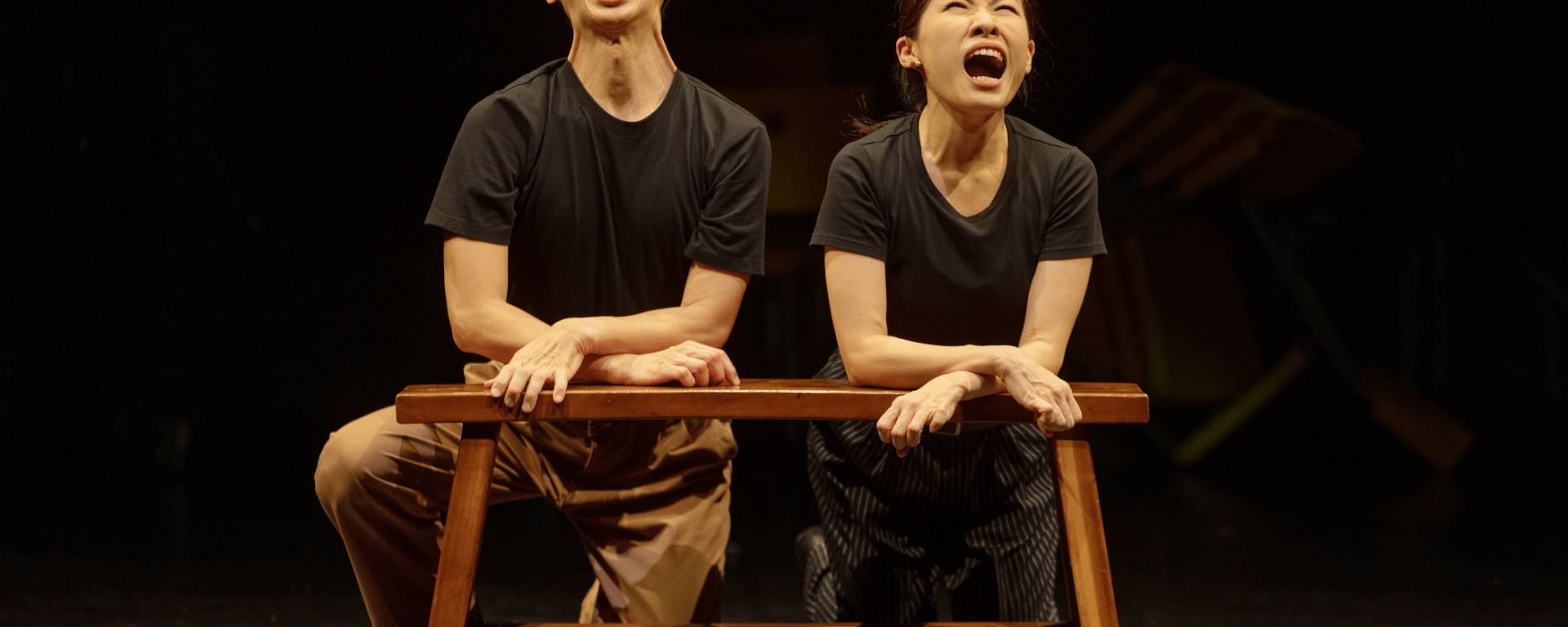
Metatheatrical musing on artmaking is a hit, thanks to emotive, powerful performances and staging by Nelson Chia and Mia Chee.
There’s good reason why so many parents in Singapore dissuade their children from pursuing a career in the arts; as much as it’s an industry that brings entertainment, joy and provokes thoughts in the countless audiences who witness it, it’s also a notoriously unstable scene, where being a full-time artist is often unsustainable and runs plenty of risks and requires sacrifice. Whether it’s fighting over limited venues to stage a show, praying that audiences will spend money on tickets when they’re spoilt for choice in a crowded market, or getting funding from government bodies, artists ask themselves the question each day – why do they persist when things can get so hard, and where do they find the drive to carry on?
For Nine Years Theatre, who’ve been in the scene since 2012 and grown and evolved with each era, founders Nelson Chia and Mia Chee have whittled down the artist’s dilemma into a single production, as they question why even make art, with the premiere of Waiting For Audience at the 2025 Singapore International Festival of Arts (SIFA). First presented as a work-in-progress last year, this now fully-realised production sees both Nelson and Mia playing actors A and O, who arrive to use the same space, only to realise they’ve both been double-booked on the very last day of the theatre’s life before it faces demolition. Their shared frustration leads to an ingenious compromise: split the stage in half and each perform their own show. What unfolds is a lively two-hander filled with physicality, humour, and sharp wit, layered with moments of competition, and ultimately, respect, showcasing Nelson and Mia at the top of their game.

Compared to Nine Years Theatre’s usual fare, Waiting For Audience adopts a lighter approach to its staging, and features a pared down set that puts all the focus on the performers. In the SOTA Drama Theatre, we are whisked into an old theatre full of memories, where old props, dusty benches, and the echoes of performances past fill the space, likely one that hasn’t been used in a long time. We are immediately struck by a sense of nostalgia, curious about all the stories that are hidden within this space, how every prop tells of a previous production or iconic scene it was involved in. This is a theatre with a soul, where remnants of the past cling to it, and occupy its space, even when no one else is there. This is amplified further as Que Sera Sera plays in the background, and A and O emerge – shocked as they encounter each other. They recognise each other, and immediately begin to argue before realising they’ve both been conned into being double booked at the theatre.
The solution? To begrudgingly ‘share’ the space. Bringing in the same luggage bag, perhaps representing the similar baggage they carry, they divide the space into two, and compete with each other on wowing the audience, and so begins a battle of one-upmanship with each other. In a rarely seen feat of comedy from both of them, Nelson and Mia riff off each other’s words, showcasing a suite of performance skills that range from opera to slapstick, all while sharing their backstories as they talk about the various dignitaries and distinguished audience members who would attend their shows. The SOTA Drama Theatre is a tricky space with its curved shape, but both Nelson and Mia make full use of its potential to pull audiences completely into the show with their energy. The two of them have fantastic chemistry with each other, catching the rhythm and wordplay exactly right, leading to a punchy, well-paced performance that never lets up, two confident actors completely in their element with much energy emanating from them both.
Most of all though, there’s something brilliant about how Mia and Nelson incorporate the company’s partners and supporters into the performance, making the piece feel metatheatrical and wonderfully self-aware. The surtitles in English (a smart move, considering the linguistic blend and plenty of wordplay incorporated into it too) help the show reach across language divides, without losing the nuances of Chinese, Hokkien, or even a surprising rap battle rendition of Macbeth. They play up their reactions to each other, use big movements to exaggerate, but always share an unspoken language between them, a connection that allows their emotions to be felt by everyone in the room. And even beyond the clever staging and sharp performances, what truly elevates the piece is its meditation on the value of space, including the emotional and historical space that theatres hold. As the two warm up, argue, collaborate, and eventually sit side by side on the once-divided bench, the show transforms into a gentle reflection on impermanence, memory, and the collective dream we call theatre.

Just as we think that everything is going to go well, both A and O start receiving the rejections, last minute apologies of being unable to attend the performance, and their faces fall, their emotions plain to see. It becomes clear that there will indeed be no audience left to watch the show. Yet, even with an empty theatre, A and O feel the presence of someone still there, the ‘theatre spirit’ itself that reminds us how even when the audience doesn’t come, the act of completing the story is what truly matters. The show must go on, and as we hear the production call outs, the sound of crew moving things backstage, hands moving and now the actors in just plain black clothing, the lights come down and A and O perform one last dance.
As they reminisce in the space, we see them recall all the memories here, all the times they’ve performed here and lived for the applause. They finally sit together on the bench, cleaned of dust by A, no longer a prop for them to fight over but instead a shared space for them to tell a story. Que Sera Sera plays in the background, and while whatever will be will be, the fate of the theatre sealed, there is something magical in how the actors continue to fight on, to put on the best show they can. In the span of those last minutes, their storytelling ability leaves us enraptured, transporting our minds through winter to spring, to depths underwater before surfacing back to the stage again. We want to believe, and Nelson and Mia make it easy to, with the vivid world they’ve created for us in our mind’s eye, a picture we all believe in and can visualise before us, as one audience.
This is a show is not just about two performers and an old building; it’s about why we create, why we tell stories. why we wait, and who, exactly, we’re waiting for. In its bittersweet finale, as much as we know that nothing lasts forever, Waiting For Audience serves as a reminder and call to treasure and cherish what we have before it’s too late as we consider how this theatre will cease to be a theatre, its purpose lost. Watching A and O, Nelson and Mia looking at each other, happy as they showcase their art one last time, hanging there for a brief moment in time, we realise how theatre reminds us of the joys of living, the power of the imagination, and we are thankful for the people who pour themselves into it, whether or not an audience is watching.
Photo Credit: Crispian Chan
Waiting For Audience played from 30th to 31st May 2025 at the SOTA Drama Theatre.
The 2025 Singapore International Festival of Arts runs from 16th May to 1st June 2025. Tickets and more available here
Production Credits:
| Nelson Chia | Director, Playwright & Cast Mia Chee | Producer & Cast Emanorwatty Saleh | Spatial & Lighting Designer Ng Jing | Sound Designer Lam Dan Fong (The Backstage Affair) | Production Manager Jed Lim | Set & Lighting Coordinator Tennie Su | Stage Manager & Surtitlist Kareen Low (The Backstage Affair) | Assistant Stage Manager Wong Yun Jie | Crew Cheow Jiong Ling (The Backstage Affair) | Props Master Ryan Ng | Associate Sound Designer Meng Jiao Yang | Sound Operator No. 1 Olivia Yi-Le Hatton | Wardrobe Crew Tan Yi Kai | Lighting Programmer |
 Bakchormeeboy
2 thoughts on “★★★★★ Review: Waiting For Audience by Nine Years Theatre”