
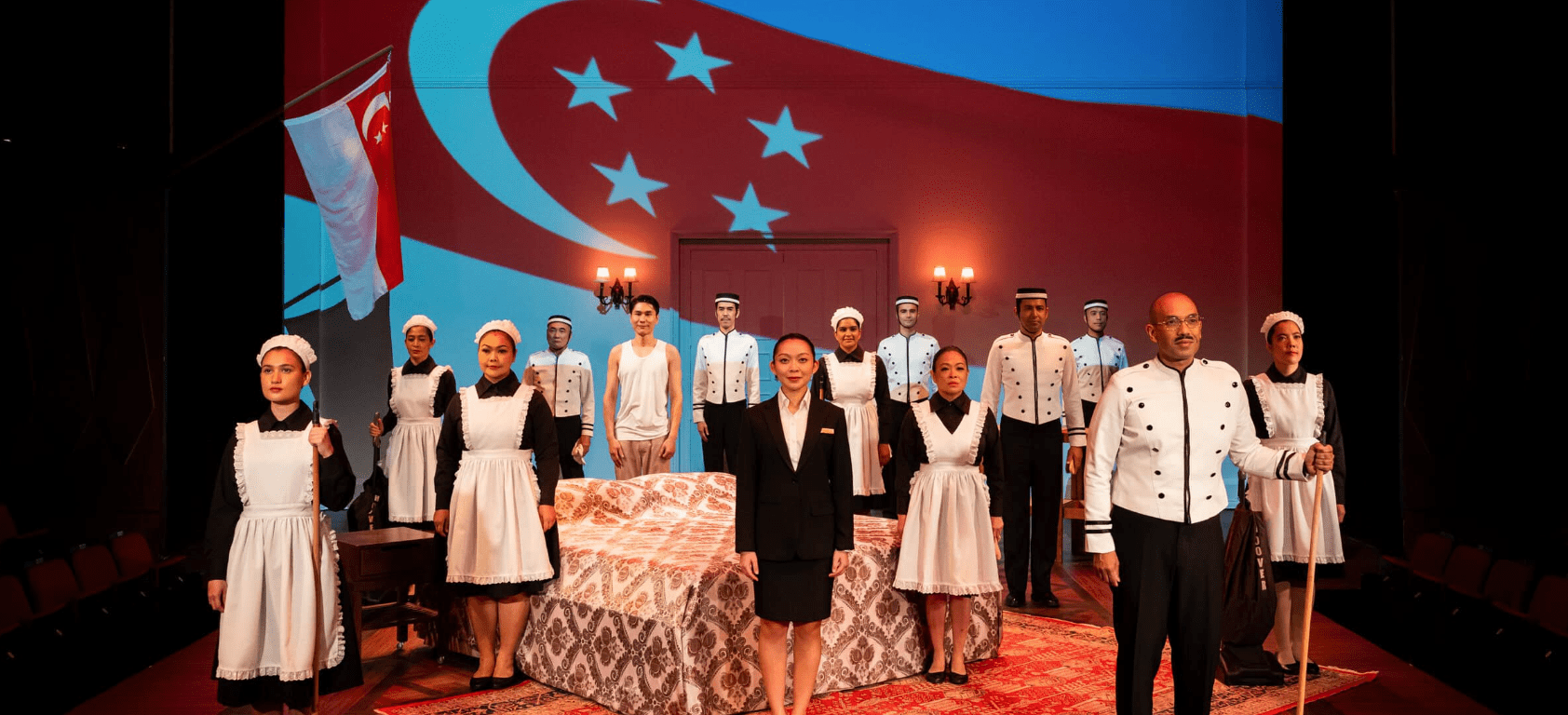
Ten years on, Hotel remains a five-star experience, and a love letter to Singapore’s resilience and ever-changing nature, alive with endless possibility.
When we first watched Hotel in 2016, Singapore, and the world, were different. It was before the global pandemic reshaped how we gathered, before Wild Rice unveiled its own theatre at Funan, and before the leadership changes that now signal a new chapter in our nation’s history. Ten years on, Hotel has established itself as a play and more: it is Wild Rice’s magnum opus and a cornerstone of contemporary Singapore theatre, a five-hour epic that continues to sell out shows in its fifth staging. That endurance is rare, and profoundly moving. In a decade defined by upheaval and uncertainty, Hotel has remained steadfast, offering audiences a mirror of ourselves, our contradictions, our struggles, and our resilience through the years.
Today, as Singapore steps into a new era under fresh leadership, Hotel feels more urgent than ever. It reminds us that identity is ever-shifting, that nations evolve just as people do, and that the act of telling our stories is itself a form of strength. It is a production that holds up both pride and possibility, a testament to how far Singapore theatre has come, and how it can and will continue to grow, inspire, and reflect who we are in this new decade of change.
Originally premiering in 2015 in SG50, it seems fitting that we’re revisiting the show again in 2025, during Wild Rice’s 25th anniversary, and at the height of SG60 celebrations as the nation reflects on its history and what’s to come. Alfian Sa’at and Marcia Vanderstraaten’s script remains unchanged, and in all honesty, it is near perfect as it is – telling the story of a grand hotel in Singapore that opens at the turn of the century in 1915, and tracing its life over the next hundred years into 2015, as guests come and go, and Singapore changes hands from the British to the Japanese, to becoming a part of Malaysia, to independence in 1965. Comprising ten scenes, we check in every ten years to glimpse a moment unfolding in a single room – Cantonese nannies, Malay film stars, Japanese soldiers, transsexual sex workers, wedding guests, suspected terrorists, and more. Years go by, but the hotel remains, the rooms rearranged, the uniforms changing, while traces of the past linger across time, as it continues hurtling forward in an ever-changing Singapore.

To purchase a ticket to Hotel is to make a commitment to spend precious time in the world that Wild Rice has recreated once more for us, and every minute is worth it. Playing at Wild Rice’s home in Funan, Hotel now takes on an incredibly intimate atmosphere, thanks to Wong Chee Wai’s simple but effective set – defined by a grand set of double doors and furniture that shifts with each era. What is particularly impressive is the dedication to historical accuracy, where bed linen, sofas and tables change as each decade goes by, alongside multimedia designer Brian Gothong Tan’s wallpapers, projected onto the room, alongside montages of archival video footage to represent each time period, be it the raucous Bugis Street of the 70s, or even Lee Kuan Yew’s funeral juxtaposed with Pink Dot in the 2010s.
Of the design team however, it is Theresa Chan’s costumes that leave audiences most impressed. Every single actor onstage plays both guests and hotel staff, transforming through countless costume changes that are as dazzling as they are meticulous. Each look is an entire ensemble, complete with character-specific shoes and accessories, and hotel uniforms overhauled from pre- to post-independence. This meticulousness deepens the sense of immersion, where every vignette feels like a fully realised microcosm. We may only glimpse the characters mid-quarrel, mid-decision, mid-celebration, yet each scene suggests entire lifetimes unfolding before and after.

Hotel is a masterstroke of theatrical planning. The way it is structured ensures we are always engaged throughout, like a collection of short stories strung together by their shared location, each vignette a microcosm. The encounters are fleeting, but unforgettable, and the miracle of such a production is that you want to linger in this room, spend an eternity with each guest, yearning for their entire life story even when the doors finally close and the set changes for the next scene. Hiding Easter Eggs and moments of continuity across time, the audience is constantly encouraged to look for and remember tiny details, from character names and their subsequent descendants, to recurring props and objects that make their appearance years later. Above all however, Alfian Sa’at and Marcia Vanderstraaten have crafted a work that brims with personal voice, each character authentic in their concerns and commentary, balancing humour and tension in just the right amounts, and smoothly transitioning between them both, ending up sprawling yet intimate, funny yet heartbreaking, Singaporean yet universal. You go from guest to long-term resident, swept into lives that flicker in and out but always leave their mark.
What Hotel gets right is its sense of uncertainty that lurks in every scene, always threatening to ruin joy or a moment of levity. It is this dramatic tension that keeps us alert and hanging on, aware that the carpet may be pulled from under us at any time. The early decades (1915, 1925, 1935) confront Singapore’s colonial inheritance head-on. In 1915, the sheer horror of empire is laid bare, where a holiday to Singapore is disrupted by a public execution of Indian mutineers, and how that completely shifts one woman’s perspective of her husband. The violence is disguised as civility, and both Coco Wang and André Jewson excel here, the former a picture of sympathy as she realises the demon she’s unwittingly married, while Jewson feels genuinely threatening when he raises his voice, face and eyes filled with rage as he exerts control. It’s an uncomfortable scene precisely because the allusions to the modern day death penalty are clear, the racism and cruelty present even today.

In 1925, Yap Yi Kai and Pam Oei are childhood friends, foreigners in Singapore and Malaysia, working as maids. Both performing fully in Cantonese while maintaining character and emotion, the decision honours the real voices of the past while reminding us how language can both connect and alienate, particularly when their fun is disrupted by an Irish nun (Rebecca Ashley Dass, commanding and serious) and the struggles of translations are played up for laughs. While initially light-hearted, it’s a scene that quickly gives way to the silent horror of maid abuse, revealed in parts and without ever showing the actual abuse onstage, only its effects, both physical and psychological.
1935 shifts the scene to post World War I, a seance led by an Indian astrology expert (Sindhura Kalidas), where four skeptics experience a supernatural visit warning of the oncoming war. Spooky and more than a little unnerving, there is the genuine sense that something is amiss as we watch each possession happening in turn, the initial dismissals and jokes turned terror. This segues nicely into 1945, the end of the Japanese Occupation, as the Japanese prepare for repatriation back to their home country. The drawn-out staging reflects the long, weary hangover of war, as if time itself has slowed under occupation, as we watch Munah Bagharib as a comfort woman, wrestling with being left behind in Singapore by her Japanese lover (Moo Siew Keh) and their son. Operating across both Malay and Japanese, both halves of the couple handle the dialogue with gusto, and you feel the audience breathe a collective sigh when she realises there is no ship coming for her.

These chapters force us to reckon with how power is exercised over bodies and over nations, with these dynamics echoing into our present forms of neo-colonialism. Each time a new colonial master takes over, we hear its respective national anthem, capturing the disquieting feeling of unbelonging under these unexpected rulers. But Hotel is not unrelenting gloom, and Wild Rice understands the need for lightness, with scenes like the Bollywood-inspired 1955 scene bringing a burst of chaotic joy. The least realistic of all the scenes, this segment harkens back to Singapore’s golden era of cinema, as familiar figures from local film history come together to propose a new film for Singapore to be proud of. Music, dance, and comedy lighten the mood considerably, reminders that art has always been a way to endure hardship, and results in an audacious scene filled with joy.
1965, however, is the most layered of these years in the first half, providing a sharp, moving metaphor for Singapore’s merger and separation from Malaysia. Split across a triptych of scenes, we see various hotel staff dealing with the fear and uncertainty of newfound independence; Pam Oei and Yap Yi Kai are reunited, this time as chambermaids, and joined by Siti Khalijah Zainal as they wonder how race relations will change, while Dwayne Lau and Moo Siew Keh replaced the Malaysian flag with the Singaporean one, reflecting on the significance of its imagery and symbols. Finally, Coco Wang and Brendon Fernandez play a hotel manager and repairman in the throes of a torrid affair, a thinly-veiled metaphor for Singapore and Malaysia as they come to terms with how it would never work out with each other. By the end of the scene, the three groups gather in a single room to watch Lee Kuan Yew’s tearful speech, and the scene captures a nation in painful flux, caught between intimacy and rupture, fear and possibility. The anthem swells, and Part One closes on a note both heartbreaking and patriotic.

When we return to the theatre, 1975, in contrast, throws us into a fever dream, queering the narrative in the spirit of Angels in America. Paying tribute to the wilderness of the heady 70s, this scene unearths the history of Bugis Street and our transgender past, where Singapore was the first country in Asia to legalise gender reassignment surgery. As Brendon Fernandez plays an Eurasian transgender, he grapples with the various binaries he does not conform to, from gender to race to nationhood, and in that dissolution lies possibility, as Singapore carves out its own identity. In its own way, it’s one of the most radical chapters of the show, amidst the appearance of giant penises and Prime Minister, and nothing if not an absolute riot to witness in all its campy nature.
As the decades progress, Hotel narrows its gaze to the private: families broken and reforged, love tested by race, culture, and time, as it examines the basic building block of our nation. 1985 completes the set-up in 1945, with the reunion of a Japanese son (Moo Siew Keh) and his mother (Munah Bagharib, undergoing a complete transformation into an older nenek) profoundly moving, a moment of reconciliation that feels both personal and historical. The tension and anxiety is palpable, and Munah does an impressive job at unearthing years of hate and sorrow when she finally opens up, while Siti Khalijah provides timely comic relief as the granddaughter with no idea of the significance of the scene she sees before her.

1995 shifts into comedy with an interracial wedding, a thoroughly enjoyable scene that captures a family drama caught between the tension of negotiating identity. The writing here is so precise: expertly balancing goodwill and discomfort, showing how love persists even amid prejudice and misunderstanding, and is an inspired way to involve most of the cast in this scene, each one going over the top during the heightened emotions of a wedding, with all’s well that ends well. As such, the shift to 2005 is perhaps one of the show’s most biting scenes, where Ghafir Akbar goes from effeminate stylist in 1995 to Malaysian businessman, bringing his mother and son to Singapore on holiday. Prefaced by a haunting image of the twin towers burning on 9/11, the spectre of terrorism reduces daily life to security checks and suspicion, and the glitzy veneer of Singapore’s golden film age peels away to reveal a nation ruled with an iron fist, always ready to enforce the script.
To end off such an epic on a satisfactory note then, is a near-impossible task, but one that Wild Rice has pulled off with aplomb. In its final scene in 2015, everything has changed – hotel ownership, hotel staff who hail from every corner of the world. At the heart is a long-term guest dying from cancer who has decided to make the suite his final resting place, and rather than subscribing to a typical happy ending, Hotel rounds off on a more reflective note – that identity itself is constantly in flux, and that rather clinging to past glories or fixed identities, we must be ready to welcome global shifts and become what the future demands of us.

Co-directors Ivan Heng and Glen Goei have outdone themselves. This staging of Hotel features cast members who have been with the show from the very start, cast members who joined later iterations, as well as completely new members. Despite the difference in familiarity, both co-directors make it feel as if this is the cast the show was always meant to have, with palpable chemistry and extraordinary performances. The range of the cast is astonishing, slipping from feminine to masculine, from comedy to hysteria, from musical to tragedy, from one dialect to another, all with fluid grace, every transition marked by a choreographed group number, dancing to the Spice Girls, or performing more interpretive physical theatre movements, with staff cleaning up and ensuring things move on. The ensemble is quite simply, chameleonic, and because they feel every emotion, so do we.
On its tenth anniversary, this revival feels like a homecoming and a farewell all at once. Hotel has grown alongside Wild Rice: from its triumphant debut in 2015, through the turbulence of opening its own theatre, surviving COVID, and nurturing a new generation of performers. This production honours its veterans while uplifting younger actors, ensuring continuity while embracing change. One might feel the need for an additional scene for 2025, but to be honest, it ends on precisely the note it needs to – bittersweet and wistful that it’s over, but proud of how Wild Rice has presented Singapore’s messy, diverse, contradictory story, laid bare with so much love. It is a surprisingly hopeful show, a labour of love that leaves audiences with strength. People come and go, but Singapore continues to endure in one way or another. A cornerstone of Wild Rice’s legacy, Hotel remains a shining star in our local theatre canon, a show that proves theatre can make you laugh, weep, think, and believe in the same breath. Hotel doesn’t just give you a room with a view; it gives us a view of ourselves and a window into the soul of Singapore. And that, truly, makes for a five-star stay.
Photo Credit: Wild Rice
Hotel plays from 14th August to 21st September 2025 at Wild Rice @ Funan. Tickets are sold out, but audience members can purchase standing tickets. 20 standing tickets will be available at $60 each per performance, and will be on sale 1 hour before Part 1 at the Box Office (Funan L4), i.e. from 6:30pm (Tue and Thu) and from 1:30pm (Sat and Sun). More information available here
Production Credits
| Playwrights Alfian Sa’at, Marcia Vanderstraaten Directors Ivan Heng, Glen Goei Cast Ghafir Akbar, Naoshi Amakawa, Munah Bagharib, Rebecca Ashley Dass, Brendon Fernandez, André Jewson, Sindhura Kalidas, Dwayne Lau, Lim Kay Siu, Moo Siew Keh, Pam Oei, Siti Khalijah Zainal, Coco Wang, Yap Yi Kai Set Designer Wong Chee Wai Lighting Designer Alberta Wileo Multimedia Designer Brian Gothong Tan Sound Designers The Gunnery & Paul Searles Costume Designer Theresa Chan Hair Designer Ashley Lim Make-Up Designer Bobbie Ng |
 Bakchormeeboy
2 thoughts on “★★★★★ Theatre Review: Hotel (2025) by Wild Rice”