
“Chekhov was never really writing about Russia; he was writing about us,” says acclaimed director Simon Stone, his voice brimming with intent. “It was always about what happens when the world moves on, and how we’re not ready.”
It’s a sentiment that lingers, this idea that Chekhov’s melancholic comedies of inaction, his portraits of ordinary people caught between eras, might still hold the mirror up to our modern world. For Stone, that mirror has found a new surface in Seoul.
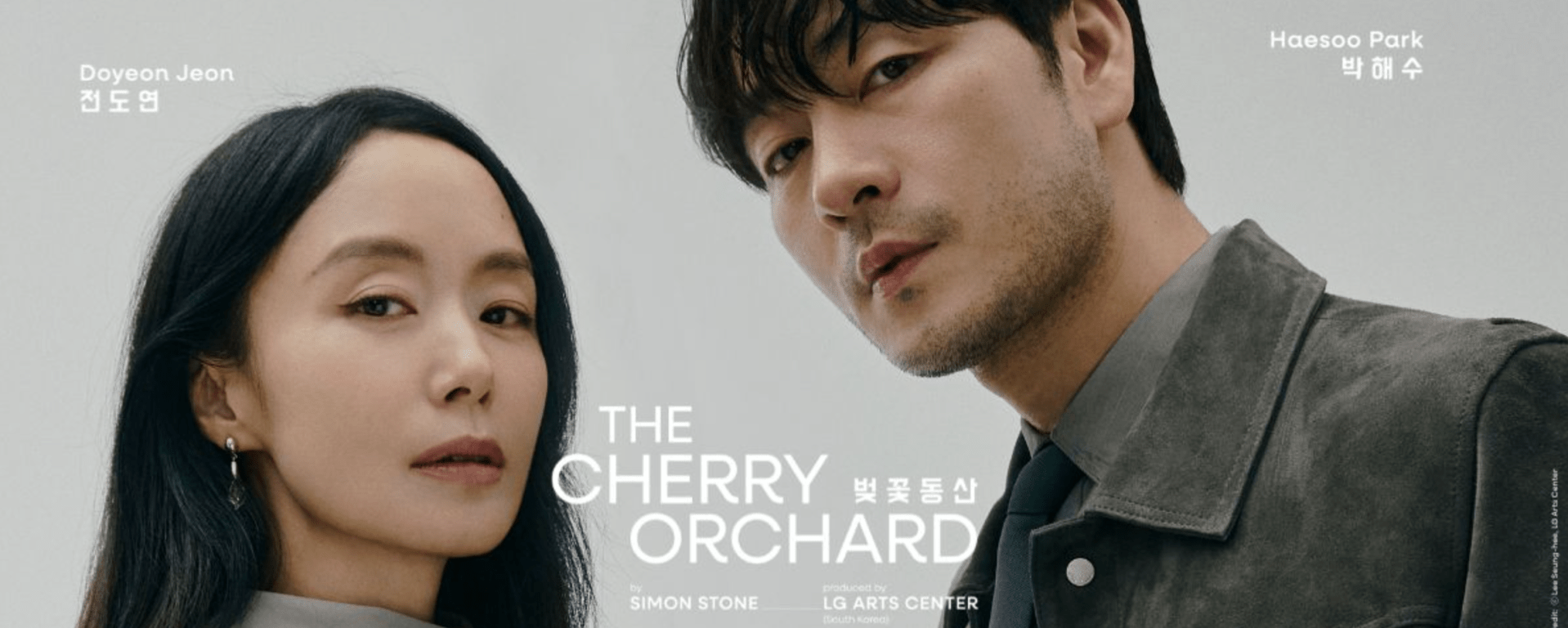
Premiering to sold-out audiences in June 2024, Stone’s Korean-language adaptation of The Cherry Orchard reimagined Chekhov’s final play for a city that knows something about seismic change. It marked the return of South Korean cinema icon Doyeon Jeon to the stage after nearly three decades, in the role of Doyoung Song, a woman returning to a Seoul she no longer recognises, where her family’s once-thriving business teeters on collapse and her childhood home faces repossession.
Now, the production makes its international debut this November at the Esplanade Theatre in Singapore, following critical acclaim for its Seoul run, lauded as a production both startlingly local and profoundly universal.

When Stone first encountered Chekhov’s The Cherry Orchard as a young director in Melbourne, he saw not a fragile period piece but a blueprint for reinvention. His 2013 Australian staging hinted at his future direction: restless, unafraid of reinvention, but still tethered to the emotional realism that defines Chekhov. “That Melbourne production was good,” he says wryly, “but it still felt like a period piece, with the costumes, the old money, the servants, all that context about mercantile classes and revolution that every programme note tells you to care about. It didn’t feel free yet.”
Freedom. That’s the word that keeps resurfacing as Stone speaks. His career has been one long exercise in liberating classics from reverence: his Medea recast as a domestic tragedy in the modern city; his Yerma stripped of its Andalusian setting to become a psychological portrait of middle-class desperation. What he looks for in Chekhov, he says, is not history but heartbeat.

“You need to extract Chekhov from his 19th-century frame,” he explains. “Because what he was really doing, what was revolutionary, was realism itself. Before him, theatre was about kings and queens, princes and battles. Within a century, suddenly, audiences were watching people like themselves, in living rooms, in gardens, worrying about money and love. It was an artistic revolution. And when we treat Chekhov like a holy relic, we forget that he was once a sledgehammer to audience expectations.”
That, Stone insists, is why he keeps returning to Chekhov’s plays. “They were set in the present, and mine are too,” he says. “I think I could do Chekhov for the rest of my life and career, and I’d still always be able to find new ways to set him in the now.”

If The Cherry Orchard marks the end of Chekhov’s world, Stone saw in it a mirror of ours. “This was the first of his plays where he said, ‘An era is over.’ The orchard is being cut down, the aristocracy is no longer in charge, and a new wind is blowing,” he says. “Look at the world right now, and you’ll see how we’re in that moment again. There are huge geopolitical shifts happening. The order that felt permanent when I was growing up in the 80s and 90s, the sense that America and the Western world would always be the unchallenged superpowers, that’s gone. Asia is now at the centre of that shift.”
And for Stone, there was no better vantage point than South Korea. “It’s one of the few places where you can actually see turbocharged change,” he says. “You have these old, powerful families, the Chaebols, who’ve dominated the country for generations, and now you have a rising middle class, self-made entrepreneurs, and a younger generation that refuses to defer to authority. That tension is pure Chekhov. It’s the sound of an old world dying.”
In that context, setting The Cherry Orchard in Seoul made emotional and political sense. The story of a family paralysed by nostalgia suddenly became a story about modern Korea, a nation both proud of its past and propelled, almost violently, into the future. “I’m fascinated by how younger Koreans are taking their leaders to account,” Stone says. “You see it in politics, in the workplace, even in street protests, this refusal to let the old rules stand. It’s exactly what Chekhov was writing about: generations looking at one another and saying, ‘You’ve failed us.’”

Working in Korea was, for Stone, both challenge and revelation. Despite his reputation as an international director – his productions have appeared in Zurich, Paris, London, and Amsterdam, he felt a surprising kinship with the Korean creative environment. “The difference between Swiss and American culture is more massive than between Australian and Korean,” he says, laughing. “I grew up in Sydney and Melbourne, where Asian culture is woven into daily life. So I didn’t feel alien at all. What mattered was listening, receiving, and finding my way through the culture, not assuming it was exotic or unknowable.”
That open-mindedness extends to the smallest details. “In Korea, for instance, alcohol is a big part of social and business life,” he notes. “When I told my Korean colleagues that I don’t drink, they were horrified, like, how do you live without it? But it’s not just about drinking, it’s about respect, about how people connect. You start to understand that when you stop judging and start learning why those customs exist. Every culture has its obsessions and red lines. You just have to stay flexible.”

The visual world of the production carries that same dialogue between cultures. For the set, Stone collaborated with Seoul-based architectural designer Saul Kim, whose speculative, often impossible buildings have made him an Instagram phenomenon. “I’d been following him online for years, he makes these incredible architectural anomalies, buildings that could never exist in real life but are formally fascinating,” Stone says. “I was a huge fan, so I asked him to design the set, and somehow he said yes.”
The collaboration turned out to be one of the most rewarding of Stone’s career. “It was extraordinary. I had this Korean architect designing for me, and all the props were Korean too. There was this constant conversation about what was Korean and what wasn’t. The aesthetic feels familiar if you’ve seen my other work, but it’s also inherently Korean, a fusion that feels alive. Korean and Japanese architecture have always inspired me, that minimalism, that attention to material and space — it all fit perfectly into this story.”
At the centre of it all stands Doyeon Jeon, whose return to the stage became a cultural event in Korea. Known for her award-winning film work, Jeon brings an emotional precision and restraint that anchors the play’s restless energy. She is joined by Haesoo Park, best known internationally for his role in Squid Game, as well as an ensemble of leading Korean actors. Together, they form a living portrait of change, a family, a city, and a society caught in transition.
When Stone reflects on what The Cherry Orchard means today, he circles back to that opening thought, that Chekhov’s world was never really about Russia at all. The orchard is just a metaphor, for beauty, for memory, for everything we can’t bear to lose.“ He was writing about the moment when people realise the world is changing faster than they can keep up,” he concludes. “That’s a story we all recognise, whether you’re in Seoul, Sydney, or Singapore.”
Photo Credit: Studio AL, LG Arts Center
The Cherry Orchard runs from 7th to 9th November at the Esplanade Theatre. Tickets available here
 Bakchormeeboy