
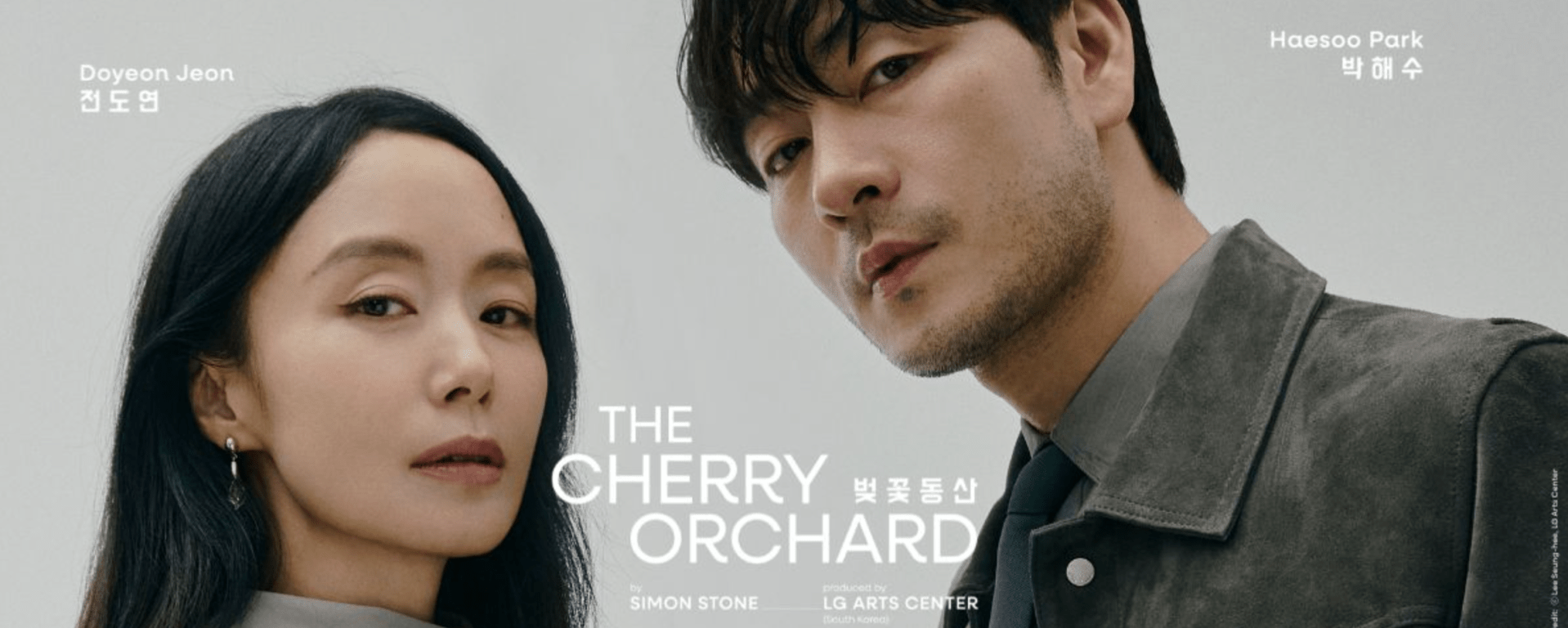

Chekhov’s final play gets adapted in the form of a modern K-drama, anchored by a stellar cast led by the impeccable Doyeon Jeon.
In Simon Stone’s The Cherry Orchard, Chekhov’s final play finds a new home and new angles to its heartbreak, as it navigates the quiet violence of time and the cruelty of progress against he sleek, ever-changing skyline of modern Korea. In Stone’s Korean reinterpretation, co-commissioned by LG Arts Center and the Adelaide Festival, that change becomes thunderous. Set in Seoul, where the speed of development can erase entire generations overnight, Stone’s production reframes Chekhov’s final play as a story of national transformation and personal ruin.
What overwhelms first is the house. Saul Kim’s set design rises like a vertical city: glass, stairs, steel, and space layered in full view. Every room visible, every secret exposed. You can watch three layers of conversation happening at once, like channels switching inside a single consciousness. It’s astonishing to look at, yet suffocating in its perfection. The architecture itself seems to accuse everyone who lives in it.
Doyoung Song, played by the indomitable Doyeon Jeon, returns home after years abroad to find Seoul unrecognisable, and her family slipping into financial ruin. Jeon’s performance is extraordinary, a study in quiet disintegration. She moves through the glass house as if it’s already lost to her, carrying both guilt and exhaustion. When she stares out the window at the skyline, there’s a sense of displacement so sharp it feels physical. The city she built her life around has outgrown her.

Around her, the house buzzes with life that’s already falling apart. Her brother Jaeyoung (Sangkyu Son) speaks in endless loops about a vinyl record player, as though repetition could slow down time. Her daughters embody two extremes of generational tension: Hyunsook (Moon Choi), brittle, devout, desperate for affection; and Haena (Jihye Lee), educated in America, fluent in irony, convinced she understands everything because she’s studied meaning itself.
And circling them all are the others: the servants, the lovers, the interlopers, reflecting the same hierarchies in miniature. Doona (Yurim Park), the maid, is sharp, self-aware, and trapped. Yebin (Sejun Lee), the chauffeur with squeaky shoes, wears his love like a wound. Benjamin (Juwon Lee), Doyoung’s assistant, smiles too easily. Their relationships play out like a farce on the edge of collapse. When Hyunsook explodes, furious that the maid dares to eat at the same table, the laughter in the theatre is uneasy, recognition caught in the throat.
Doosik (Haesoo Park, of Squid Game fame), the self-made man who grew up poor and became rich, is the play’s most unsettling figure. He’s all logic and efficiency, advising Doyoung to sell the house before its value drops. He calls it strategy; it sounds like betrayal. Yet his reasoning is impossible to dismiss. He represents the new Seoul: ambitious, practical, unromantic, and watching him beside Doyoung feels like witnessing two centuries negotiate their divorce.

The first half of the play feels like dusk slowly gathering. James Farncombe’s lighting moves from golden to ashen as if measuring the temperature of failure. There’s a moment where Donglim (Yunho Nam), the late son’s tutor, speaks with Doosik about capitalism; “The rich get richer, but what about the poor?”, and both men face the sunset. They’re framed in beauty but trapped in futility. Every gesture in this production carries that contradiction: grace balanced on the edge of decay. The sound design by Youngkyu Jang deepens this unease. Yebin takes out a guitar and sings “I Hurt Myself Today.” It’s disarmingly literal, yet somehow perfect. The song ripples through the set like a confession none of them can make aloud.
After intermission, the house transforms. Dirty artificial snow covers the floor; silver balloons hang for Haena’s birthday; laughter feels like a performance of normality. Mel Page’s costumes sag slightly now, becoming elegance frayed by time. The atmosphere is sour, heavy with whiskey and disappointment. When Haena screens her film and asks her mother for feedback, Doyoung answers without hesitation: “It’s morbid. Who the fuck would want to watch it?” The cruelty is breathtaking, but so is its truth.
Desperation takes over. Haena seduces Donglim, who becomes the unwitting vessel for everyone’s unmet longing. Doona flirts with Benjamin while Yebin drinks himself toward humiliation. The tension fractures upward and downward across Saul Kim’s multi-level stage, every floor vibrating with a different kind of collapse.Then the most devastating moment arrives. Doyoung, drunk and broken, kisses her daughter’s lover, also her dead son’s former tutor. The theatre goes silent. The gesture is wrong in every way, yet entirely human. It’s what loneliness looks like when pride no longer protects it.

The ending comes not as tragedy but as exhaustion. Doosik announces that he has “saved” the family business, by buying it himself. The company, the house, the name, all his. He promises to demolish everything and build a resort. His success feels like an erasure of everything that came before. Blowdryers roar across the stage, scattering the fake snow until it resembles ash. The furniture vanishes. The house becomes empty space, stripped of history.
Outside, workers protest. Inside, Doosik uncorks vintage 1989 Dom Pérignon to celebrate. It’s grotesque and sincere at once. Jaeyoung sits hollow-eyed; Doona stands alone; Yebin accepts his demotion back to driver. Cousin Youngho (Byunghoon Yoo) tries to make a drunken speech about “the miracles of our country,” and the words collapse under their own irony. Amid the wreckage, Hyunsook decides to walk the Camino de Santiago “to reflect,” she says, a line that sounds both hopeful and absurd. Doosik’s final words to her: “You have a soft soul. Don’t let it harden.” This lands with unexpected tenderness. For a moment, even he seems human again.
Then Doyoung is left alone. She walks through the bare rooms, saying farewell to the cherry trees outside, to her daughters, to the life that’s disintegrated around her. Her silence is the final monologue. The lights fade, and the sound of bulldozers replaces applause. Seoul continues to build over its ghosts.

Every element of the production works in disciplined harmony. Stone’s direction is exacting but generous. He lets his actors breathe within a framework of astonishing control. The result is both grand and intimate, a work that demands attention and rewards it with insight. Jeon’s Doyoung is mesmerising, fragile yet proud, her every silence filled with meaning. Park’s Doosik is equally riveting, his measured calm masking the cruelty of capitalism.
The ensemble, from Moon Choi’s aching Hyunsook to Jihye Lee’s volatile Haena and Yurim Park’s radiant Doona, deliver performances of rare precision. James Farncombe’s lighting and Youngkyu Jang’s sound design heighten every emotion without sentimentality; Mel Page’s costumes subtly trace the family’s descent from privilege to decay. Saul Kim’s monumental set, part sculpture, part social metaphor, remains one of the most impressive stage constructions in recent memory, and as a whole, rebuilds and takes Chekhov’s classic to new heights.
In all, we are left on an interpretive and reflective ending note, thinking on life, loss, industrialisation, and the ever-changing landscape of Seoul, itself a clear parallel to other fast-industrialised metropolises such as Singapore. Simon Stone’s The Cherry Orchard is extraordinary: layered, demanding, and utterly alive. The audience must work to listen, to follow, to absorb every moment, but the reward is immense.
It’s a story about family legacy, ego, guilt, and the illusion of progress, where the Song family’s blindness to change mirrors our own collective unwillingness to face the consequences of ambition and loss. Life, in all its messiness, is at the centre of this piece. A masterpiece of direction, design, and performance, and also intellectually rigorous, emotionally devastating, and meticulously realised. It is not content to merely move us; it challenges us to look harder, at what we have built, what we have lost, and what, in the end, will replace us.
Photo Credit: Studio AL, LG Arts Center
The Cherry Orchard ran from 7th to 9th November at the Esplanade Theatre. More information available here
Production Credits
| Cast Doyeon Jeon, Haesoo Park, Sangkyu Son, Moon Choi, Jihye Lee, Yunho Nam, Byunghoon Yoo, Yurim Park, Sejun Lee, Juwon Lee Written and Directed by Simon Stone Executive Producer Tency H.J. Lee Producer:Min K. Shin Associate Creative Producer Wouter Van Ransbeek Associate Director Hayoun Sim Dramaturg & Script Translator Danbi Yi Set Designer Saul Kim Costume and Associate Set Designer Mel Page Lighting Designer James Farncombe Music and Sound Designer Youngkyu Jang Hair & Make-up Designer Jiyoung Baek Produced by LG Arts Center Co-commissioned by Adelaide Festival Touring Team Touring Producer Ju Kim Technical Director Kyoungjun Eo Tour Manager Chloe Chung Assistant Director Yumin Oh Stage Manager Gyeonggeun Song Head Carpenter Hunseop Lee Set Builders Byungro An, Dongjun Lee, Dongkyu Kim Lighting Supervisor Hankyoung Ryu Lighting Practical Junhyun Lee Sound Supervisor Junseok Eom Sound Playback Seongbeom Oh Sound RF Wonshim Kim Prop Supervisor Jungsuk Im Costume Supervisor Seree Cho Hair & Make-up Yiyoon Lim, Eunhye Jo |
 Bakchormeeboy