
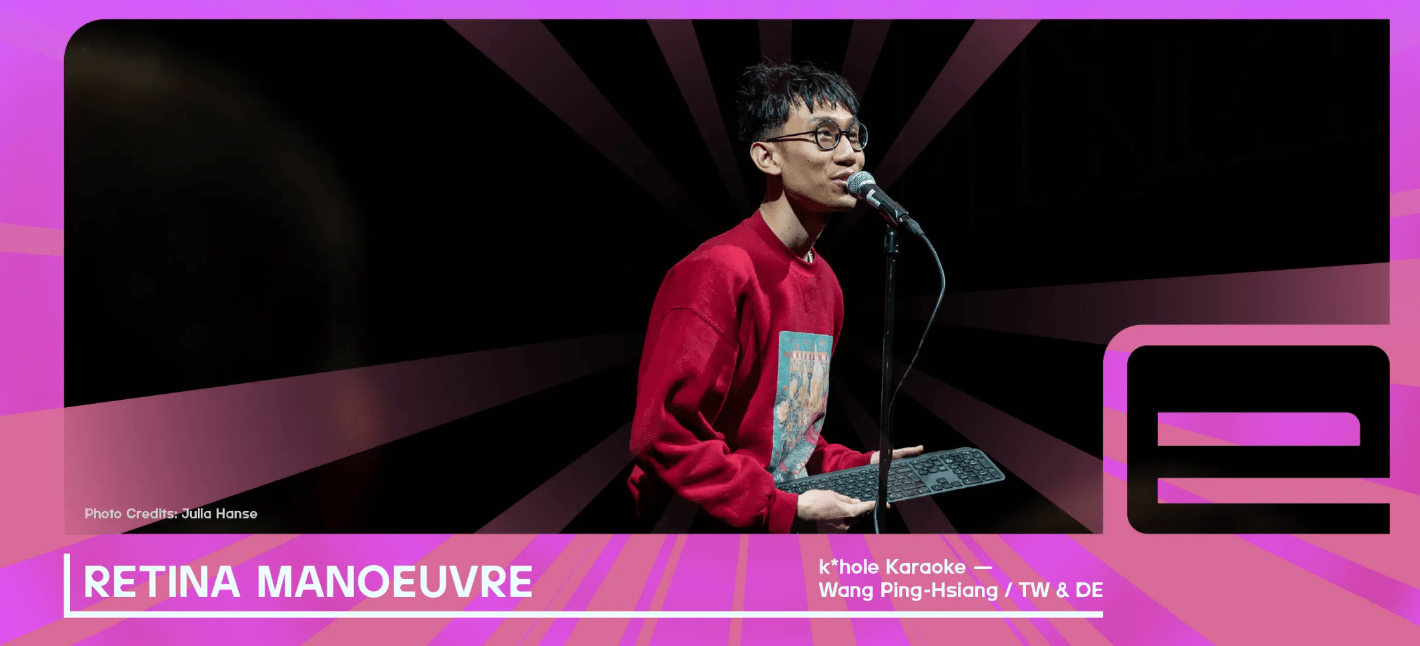
When audiences first encountered Retina Manoeuvre in its early work-in-progress, few could have guessed that the performance would later tour Europe, gathering deeply personal responses from audiences who recognised themselves, despite having no connection to Taiwan at all.
The project began far from the solo, autobiographical form it eventually took. Taiwanese artist and creator Ping-Hsiang Wang recalls that the original proposal involved three performers and a larger creative team during an early residency in Taiwan. “We proposed it, but it didn’t get funded,” he says. “Without the budget, I had to rethink everything. I decided to turn it into something more personal, because that was the only sustainable way to continue.”

That shift required not only a new structure but a new name. The title, Retina Manoeuvre, emerged during this transitional period. “I liked the image of an eye, and I was thinking about military topics,” he explains. “These two things don’t seem directly related, and I wanted that. The audience shouldn’t expect how the story will unfold. There are interruptions, detours, montage, irrelevant elements that, together, create a sensory experience and a bigger meaning.” The title, he says, became a form of bait, “something sharp, with action.”
One incident brought clarity. In August 2022, U.S. politician Nancy Pelosi visited Taiwan, escalating cross-Strait tensions. Wang remembers the night vividly. “I was bartending at a gallery opening,” he says. “Everything was elegant, cocktails, fashionable people. And the entire time, I felt terrified. I didn’t know if a war would start that night. The absurdity of being surrounded by art while feeling fear in my body, that was when I knew the work had to deal with this situation.”

But he resisted turning the performance into political persuasion. “I don’t like theatre that lectures,” he says. “If the topic is serious, do you also have to be serious? I think you should loosen people’s hearts first. You start from a human perspective. If the audience knows me, they feel the topic through me.”
This tension, marketed as a lecture performance about his personal life, yet rejecting the lecture, became one of the work’s defining paradoxes. “I really dislike theatre that assumes the artist is more intelligent than the audience,” he says. “I don’t think I am here to ‘teach’ anyone. My story is then used as ‘bait’. The real topic is violence and nationality, and how nationalism grows when people feel threatened. I don’t have answers. The work is a thinking process before the war takes place.”

Wang completed mandatory military service at 21, though he did not think much of it at the time. “I thought of it as responsibility, or wasting a year of life,” he says. “When we did shooting exercises, I didn’t imagine shooting a person, it was just cardboard. Training to me, was just building muscles. I didn’t think any deeper about it.”
But as friends and relatives began receiving new call-ups, sometimes months after completing their mandatory stints, memories resurfaced, and changed. “It reawakened something. Violence can be stored in the body. Now I’m researching about Hei Xiong Xue Yuan, literally ‘the Academy of the Black Bear’, which teaches civilians what to do during invasion. It’s fascinating and eerie to compare it with what I learned in the military. Modern war is different, and the techniques don’t apply.”

This embodied memory is central to the work, even when unstated. Taiwanese audiences feel it instinctively; European audiences need context. Singapore, he notes, sits somewhere in between. “I’m looking forward to showing it in Singapore,” he says. “There are similarities, mandatory service, fear of being drawn into conflict, a delicate political position. These feelings are beyond words.”
One of the most recognisable elements of the performance is Alicia Keys’ iconic song Girl on Fire. It began as instinct, but slowly revealed meaning. “All my recent works feature a pop diva: Mariah Carey, A-Mei, someone like that,” he says. “During Covid-19 in Germany, there was curfew and so much anti-Asian hate. Friends and I ended up secretly meeting to sing karaoke, and it was so nostalgic and comforting. ‘Girl on Fire’ was one of those songs that felt empowering, and it worked as well, because everyone knows the chorus and can sing along.”

But Wang is precise about how the song functions theatrically. “It’s a commercial, cheesy melody, a very produced emotion – that’s not a bad thing, and it’s perfectly fine to enjoy that. But I also wanted to create a moment that feels too much, where the audience laughs because it’s a guilty pleasure. But when they hear it again at the end, they can’t laugh anymore. The meaning has changed through the performance. They are listening through a new lens.”
This shift, where cheesiness becomes unbearable, irony becomes sincerity, mirrors the show’s structure. Memory, too, changes tone when repeated. What the performance communicates is the looming threat of conflict. Wang is skeptical of nationalism and is horrified at imagining himself killing others. He dislikes documentary theatre but has made one. He mocks pop melodrama but deploys it masterfully. He rejects lecturing but performs in a format called a lecture.

These are contradictions that fuel the work, and force the audience into rethinking that which seems innocuous. He summarises the work through a metaphor developed with his dramaturg: “At first, the audience sees an interesting person getting on a train. Then they watch a trainwreck that has nothing to do with them. But when they know who is inside, everything changes.”
This, he suggests, is how international audiences relate to Taiwan—and perhaps to any distant crisis. “This war is not their war. But witnessing violence makes them reflect on how stupid nationalism and power are. Why do we think some people deserve to die? War keeps happening, even though everyone knows it’s ridiculous. I want the audience to see how cruel and stupid it is.”
Retina Manoeuvre plays from 16th to 17th January 2026 at Practice Space. Tickets available here
Singapore Fringe Festival 2026 runs from 15th to 25th January 2026. Tickets and more information available here
Support the Fringe by donating to The Necessary Stage here
 Bakchormeeboy