
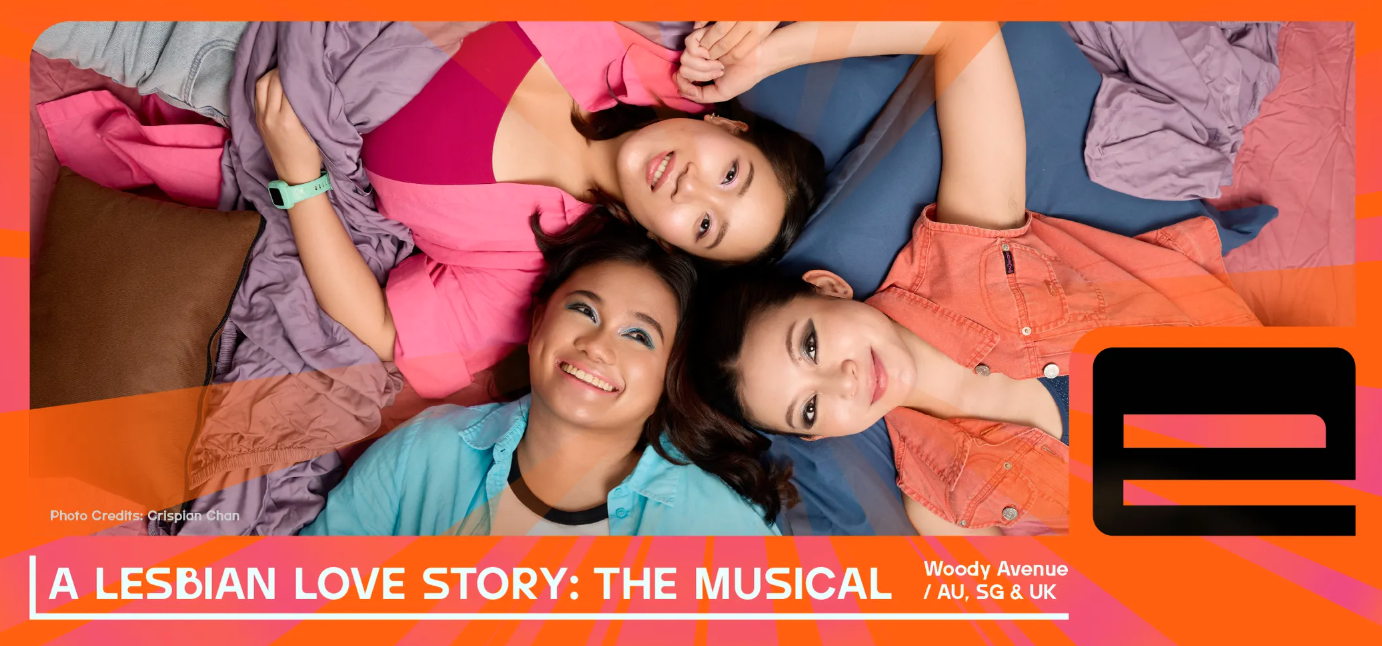
When theatre-makers Rosie McGowan and Kluane Saunders first started writing a musical about a woman trying to create the happiest lesbian love story ever put on stage, they didn’t realise they were also building a company. “The idea for the production came first and the company came after,” Rosie laughs. “A lot of people asked who was the company behind it, and we thought, oh, this is exciting, this could be the start of a lot more things.”
That’s how Woody Avenue, now a multicultural, queer, female-led company led by Rosie and Kluane, came into being. Their inaugural work, A Lesbian Love Story: The Musical, follows Charlie, a woman fed up with the lack of joyful queer stories. She decides she’s going to write the ultimate antidote: “the happiest, shiniest, most magical love story the world has ever seen. “And the queerest! But her real life keeps interfering with her masterpiece,” Rosie explains.

The result is a show that is both self-aware and deeply sincere, exploring how the stories we want to tell collide with the lives we’re actually living. As Kluane puts it, “Humans are complex and nuanced and complicated, and the themes come to life via the story. We didn’t set out to write an issue-based play. The focus is the fun and playfulness, and the interesting complex issues that arise out of it.”
From the beginning, the pair resisted the expectation that queer stories must be tragic, tortured, or politically positioned. “There will be some drama along the way, as much as we tried to keep it light,” Rosie says. “But it is a happy story that’s also about love. And what is a love story? Can it be about friendship alongside the romantic? We’re promising you a positive ending that’s also very powerful.”

This choice felt quietly radical. “We realised we don’t have shows about lesbian love stories that end positively, or even about lesbians, period,” Rosie reflects. “The importance of that hit us on so many levels. The community response was all excitement, like it was something they were hungry for. And well, I wanted it as well.”
Rosie’s awareness of that scarcity comes from lived memory. “When you live in a society which rarely has spaces queerness and otherness to openly exist in joy, it’s hard for it to spread across the rest of the country,” she says. “Historically, so many countries have criminalised queer communities, and coming from the top, once you say something is bad, it almost gives the green light to portray them in media as bad. That took years to change, and there are many conservative countries where we’ve yet to see it even begin to change.”

She recalls the moment representation became real. “I remember being in university when EastEnders finally had a queer character in the early to mid-2000s, not long ago at all, and it was such a moment. Now there’s a lot more rqueer epresentation in the UK, though still a lot more queer male stories, and less lesbian-focused content. And it doesn’t have to be cases where they’re main characters, we just want queer characters who’re there, who live their lives. That’s why with this show, we were firm in wanting it to be a love story that just happens to involve lesbians.”
Even in their own writing, awareness keeps evolving. “We realised we’d written a ‘gay best friend’ trope without noticing. It’s so insidious. Since then we’ve built a character that’s more rounded and real. We need to see all the queer people represented,” says Rosie.

The show’s musical language is as layered as its themes. “We’ve been told we write with a Latin flavour because we love those beats,” says Kluane. “It’s very referential—some pop, some rock. It reflects how many styles can be used together, and we make a few references to older musical theatre too. A lot of it is thanks to our composer Henry Allen, who helped make it all come together so cohesively.”
“Not to mention, there’s a killer theme song; in fact, we literally started the whole musical based on the hook that Kluane came up with and that was the trigger for turning it into a musical!” adds Rosie.

During the R&D phase, auditions were held in both London and Singapore, and the differences were striking. “We specifically asked for queer performers aged 30–40,” Rosie explains. “We got far fewer auditions in Singapore, and the auditionees were a lot younger. I wonder if people our age hesitate to identify as queer or a queer artist because of stigma, pigeonholing, or conservative companies.”
In contrast, younger performers showed ease and openness. “People in their early 20s these days are so comfortable being queer. It’s fantastic. They can just audition without thinking too much about it; it’s part of who they are and no big deal. But auditionees in their 30s and up on the other hand, might be considering how they’ll be viewed when they take on the role. The world has changed a lot in such a short span of time.”

Cast chemistry was what sealed the final choices. “It was a real tough time choosing actors, because they were all so talented,” says Kluane. “We needed people who could be funny, who understand the style of comedy we’ve written, who can get a joke to land in a way we’ve never seen before. We really lucked into our wonderful performers, they really click with each other and we can’t wait to get into the rehearsal room.”

The final cast features Coco Wang Ling, Melissa May Garcia, Natalie Yeap, and Mitchell Fang. And after years of co-creating, Rosie and Kluane have developed a shared directing rhythm they’re sure is a recipe for success. “We’re best friends and very sympatico,” Kluane says. “At the forefront is care and communication. We’ll communicate who’s leading which aspect each day so the room knows who to turn to. An open safe space is a productive rehearsal space, where they can trust and collaborate.”
“We’ve also brought on intimacy director Rayann Condy, and talking to her has been so eye-opening. Even things you don’t think about, like how close two people are to each other, need care,” Rosie says. “When we ran the show in London, a cast member said it was one of the safest rehearsal rooms she’d ever been in. That was exactly what we wanted. Safety lets people access the playful parts of themselves, which brings out the best in this show.”

The London workshop audiences were a surprisingly diverse mix: queer women, queer men, straight audiences, even a curious 16-year-old theatre-goer. “It’s important that everybody sees this,” Rosie says. “These stories happen in all communities and I believe everybody, beyond just queer people, should see it.”
The title itself became a declarative, out, loud and proud statement. “We knew it could alienate people,” Rosie admits. “But it was important to have the word ‘LESBIAN’ in the title. People go, wow, it’s at the Esplanade Theatre Studio? They can’t believe it’s on a big stage in Singapore and not some back-alley bootleg show. The Straits Times had to use the title, and seeing the word ‘lesbian’ in the national broadsheet like it’s no big deal, that’s exactly how it should be.”

Rosie’s long-term wish is simple: “I’d love to see more queer representation not just in theatre, but in everyday life, casual, no big deal. More trans, queer, butch, femme performers. Characters who just talk about their girlfriend. I want queer people integrated into the everyday.”
Kluane echoes the sentiment: “Anytime a TV character has a queer partner at home and it’s not a plot point, I’m happy. That’s what we want across all forms of art—written into stories as normal.”
Photo Credit: Crispian Chan
A Lesbian Love Story: The Musical plays from 15th to 17th January 2026 at the Esplanade Theatre Studio. Tickets available here
Singapore Fringe Festival 2026 runs from 15th to 25th January 2026. Tickets and more information available here
Support the Fringe by donating to The Necessary Stage here
 Bakchormeeboy
One thought on “Singapore Fringe Festival 2026: An Interview with Woody Avenue on normalising queerness and representing love in ‘A Lesbian Love Story: The Musical’”