
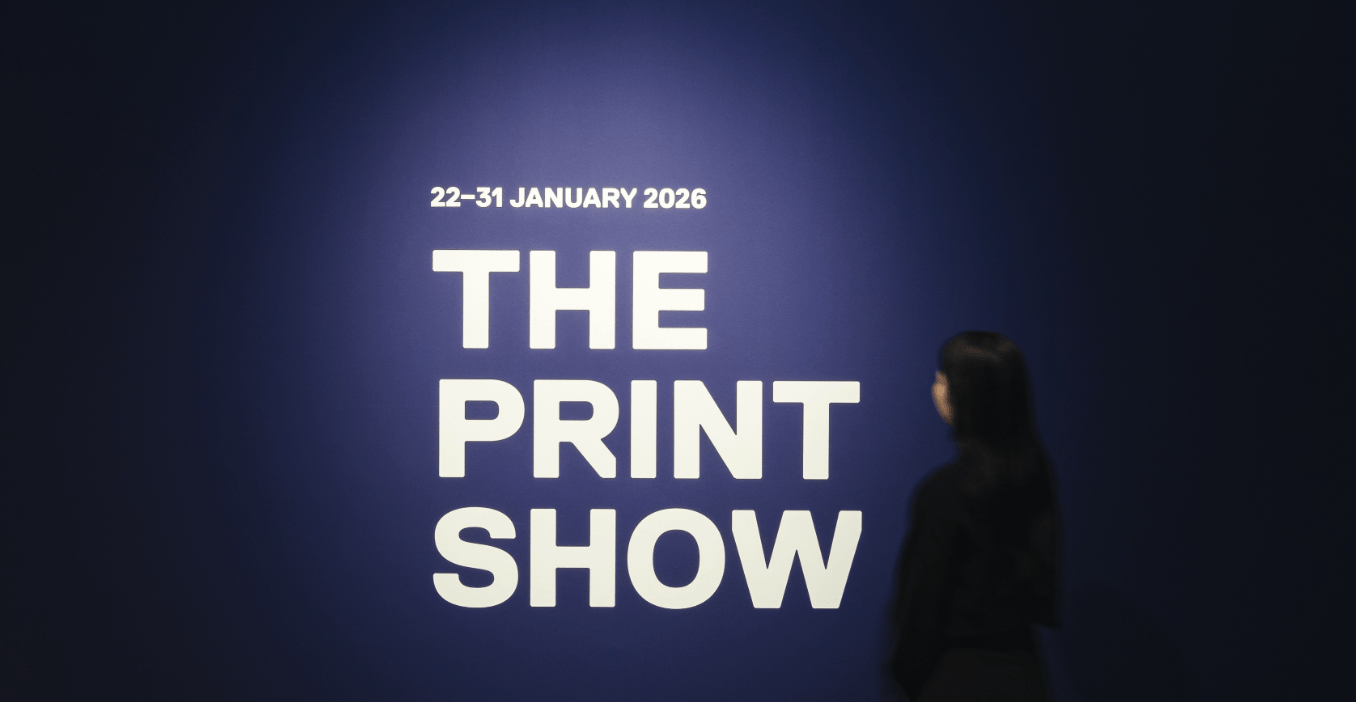

If printmaking still carries the reputation of being secondary, thought of as editions locked behind glass, conceptually subordinate to painting or sculpture, STPI’s The Print Show & Symposium Singapore 2026 makes a deliberate case for its relevance now. Launched during Singapore Art Week, the initiative positions print not as a supporting medium but as a central, adaptive force within contemporary culture: materially rigorous, politically charged, and structurally open.
Hosted at STPI’s riverside space at Robertson Quay, The Print Show brings together works by 27 internationally recognised artists, from Jeff Koons, Louise Bourgeois, David Hockney, Yayoi Kusama, and Takashi Murakami, to Tacita Dean, Chris Ofili, Julie Mehretu, Do Ho Suh, and Rirkrit Tiravanija, alongside significant regional voices such as Kim Lim, Dinh Q. Lê, Hilmi Johandi, and Natee Utarit. Supported by leading international publishers and galleries, the exhibition is free to the public—an important gesture in a project so invested in access, circulation, and multiplicity.

Rather than advancing a single curatorial thesis, the exhibition unfolds as a series of groupings that emerge from the works themselves. This is not a survey, nor an attempt to map printmaking historically or geographically. The show began from a pragmatic point of entry: concrete proposals from collaborating galleries and publishers. From there, the curatorial work became one of editing; placing works together where affinities surfaced, allowing conversations to form without forcing coherence.
That process is reflected in the exhibition’s spatial experience. Moving through the galleries, viewers encounter a rhythm that is notably non-linear. Rooms feel discrete rather than seamlessly connected; moments of visual density are followed by pause, even a sense of exit, before another cluster begins. This stop–start quality may initially feel counterintuitive, but it quickly reads as intentional. Rather than insisting on narrative flow, the exhibition accepts fragmentation as a condition of both printmaking and contemporary viewing.

Here, curation operates as a layer rather than a directive. The exhibition does not attempt to “tell a story” or resolve its own contradictions. Instead, it aims to present works in ways that are more engaging than neutral display, allowing prints to stand independently while letting shared space produce meaning. A Jeff Koons print suggested by Two Palms might sit productively alongside works associated with Cristea Roberts, not because of a predetermined theme, but because something formal, conceptual, or tonal begins to resonate once the works are seen together.
This approach also acknowledges the exhibition’s commercial reality. The Print Show is a selling exhibition, built from consignments, and the works are available for acquisition. Yet it deliberately resists the format of an art fair. The emphasis is not on density or spectacle, but on pacing and encounter. The curatorial layer is not there to obscure the market, but to create a more considered and pleasurable space in which works can be seen (and potentially sold) without collapsing into inventory.

In doing so, the exhibition foregrounds one of printmaking’s core tensions: its position between democratic access and market circulation. Prints are, by nature, reproducible and collaborative, yet they remain materially specific, technically complex, and deeply nuanced. At STPI, and within many of the workshops involved, such as BORCH Editions and Crown Point Press, printmaking is treated not merely as reproduction, but as something greater: a site of originality, experimentation, and process. Authorship is often shared between artist and printmaker, quietly challenging the mythology of the singular artistic hand.
These ideas surface repeatedly across the galleries. In one striking moment, a monumental print by Julie Mehretu faces a more intimate work by Irfan Hendrian. Both engage layered abstraction and material accumulation, yet their political registers diverge: Mehretu responds to external crises, abstracting imagery from anti-immigration protests in the United States, while Hendrian turns inward, tracing suppressed Chinese identity in Java under Indonesia’s New Order regime. The pairing does not flatten these differences; instead, it allows the personal and the geopolitical to occupy the same space without hierarchy.

If the exhibition is about looking, the accompanying symposium is about thinking and questioning. Titled The Politics of Print: elephant in the room, the two-day programme brings together artists, curators, museum directors, publishers, and market leaders to confront issues that printmaking discourse has often sidestepped. Among these are the tendency to decontextualise prints as purely aesthetic objects, and the persistent biases that privilege Euro-American print histories over those of Asia and the Global South.
The symposium positions print within a much longer lineage of circulation and communication: from artist journals and collaborative publications to contemporary memes, reposts, NFTs, and digital image economies. Rather than framing digital media as a rupture, the programme situates it within print’s historical logic—where images move quickly, accrue political force, and challenge ideas of originality, value, and authorship. The speed and immateriality of digital circulation, in turn, casts print’s tactility and process into sharper relief.

Importantly, the symposium embraces friction. Performative debates such as Crit Club foreground disagreement rather than consensus, staging discussions around NFTs, value, and reproduction as live, contested exchanges. The aim is not academic closure, but productive risk—acknowledging that the arts are uniquely positioned to synthesise ideas across disciplines without the constraints of formal scholarship.
Together with the launch of Print Screen, STPI’s new editorial platform, The Print Show & Symposium Singapore signals an expansion of the institution’s role. While STPI remains deeply committed to its residency model and technical excellence, this initiative strengthens its position across multiple verticals: production, exhibition, discourse, publishing, and the market. Collaboration—long central to printmaking itself—becomes the guiding institutional logic.

The exhibition as a whole acts as a recalibration of how STPI engages the wider world of print. By working with external galleries, inviting diverse speakers, commissioning critical writing, and leaning into print’s accessible promise, the institution positions itself as a convenor within a global ecosystem rather than a self-contained centre.
The Print Show & Symposium Singapore 2026 does not resolve the contradictions it raises and it does not need to. Its success lies in its openness: its willingness to allow diversity, disjunction, and dialogue to coexist. In doing so, it reflects printmaking itself; iterative, collaborative, resistant to singular narratives, and continually finding new ways to reproduce meaning in the world.
Photo Credits: The Print Show 2026, Installation view. Image courtesy of STPI, Singapore.
The Print Show & Symposium Singapore 2026 runs from 22nd to 31st January 2026 at STPI, Robertson Quay & Mohamed Sultan Road. The exhibition is free, while ticket sot the symposium can be purchased from SISTIC
 Bakchormeeboy