

A storm of memory, art and family marks the beginning of Pangdemonium’s final season.
Pangdemonium opens its 2026 season with Force Majeure, a quietly devastating meditation on art, family and the fragile structures that hold both together. Written by Stephanie Street and directed by Tracie Pang, the play reimagines Chekhov’s Three Sisters within a contemporary Southeast Asian context, where artists find themselves negotiating not just personal ambitions but also political realities, financial precarity and the emotional inheritance of family.

The premise is deceptively simple and follows Chekhov’s original structure. Three sisters, Irene, Mary and Leah, find themselves suspended between past and future, caught in lives that seem both comfortable and quietly unfulfilled. Around them orbit their brother Andrew, a restless and increasingly fragile presence, and a shifting circle of lovers, spouses and opportunists who pass through the family home. Andrew’s wife Nat, whose constant need for validation keeps him perpetually on edge, contrasts sharply with Vic, the polished and calculating director of a newly announced arts centre whose arrival brings both opportunity and suspicion.

Meanwhile Irene finds herself drawn to Theo, a charismatic yet deeply insecure man who tries desperately to impress those around him, even as his self-absorption alienates the very people he longs to please. Mary, trapped in a loveless marriage, develops a clandestine connection with Vic that exists in uneasy tension with her public life. Ken, another man drifting through the household’s orbit, presents a quieter mirror to Theo, someone whose gentleness and kindness mask an inability to give his partner the emotional fulfilment she longs for.

Together these characters form a web of relationships held together by habit and quiet disappointment. Visitors arrive bearing gifts, love affairs blossom and fracture, and ambitions simmer beneath polite conversation. Yet as the seasons pass and external pressures mount, the family must confront an uncomfortable truth: the lives they imagined for themselves may never materialise, and the world that once nurtured their creativity may no longer exist.

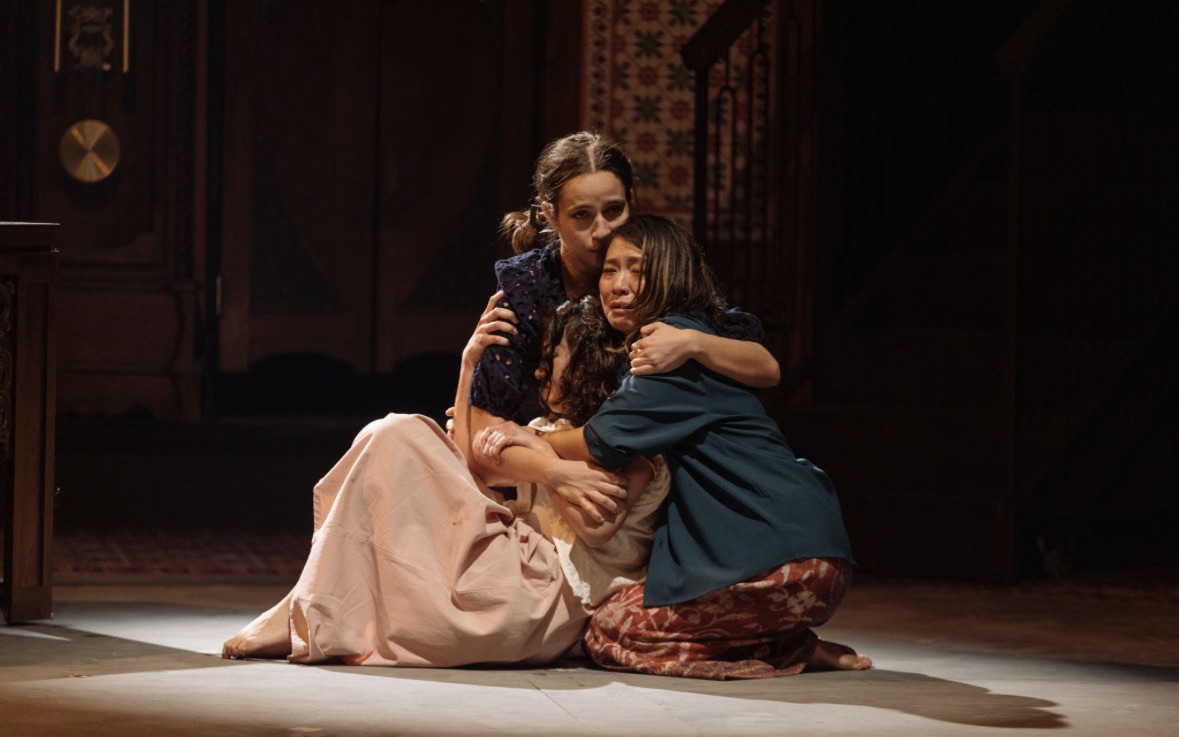
From its opening moments, the production establishes a powerful visual language. Set designer Eucien Chia creates a distinctly Asian living space that feels at once intimate and symbolic, allowing the family home to serve not only as a domestic environment but also as a container of memory and unresolved emotion. There is great care that has gone into the set’s construction, utilising intricate, ornate salvaged vintage wooden furniture, screens and custom-designed wrought iron work, transforming over the course of the play to represent the gradually deteriorating bungalow, mirroring the decline of the family’s relationships, and the artiste’s declining career.
The staging unfolds almost musically, with characters entering gradually until the stage feels populated by the rhythms of a household: conversations overlapping and songs emerging organically from the flow of dialogue. There is a distinct sense of communal storytelling, as though the audience has stumbled upon a gathering around a fire, where music and memory blur into one another. It evokes the loose, reflective atmosphere of Americana folk traditions, a tonal palette that resonates strongly with the musical texture of the evening.

Music is woven throughout the production with remarkable sensitivity. Sound designer Jing Ng allows the actors’ live performances on guitar and piano to function as emotional punctuation marks, moments where characters reveal something they cannot articulate in words. The genre itself, folk-inflected, melancholic and intimate, lends the production a warm, almost campfire-like quality that draws the audience closer to the characters’ inner worlds. In these musical interludes, the play breathes differently: conversations soften, tensions briefly dissolve, and we are reminded that these characters are artists first and foremost.

Lighting designer James Tan complements this atmosphere with an evolving palette that mirrors the emotional climate of the play. Storms crackle through the narrative both literally and metaphorically, punctuated by flashes of thunder that reverberate through the theatre. These disturbances feel less like technical effects and more like emotional punctuation, visual reminders that beneath the polite rhythms of family life, something volatile is building.

Leonard Augustine Choo’s costumes quietly reinforce the production’s character work. Stylish yet carefully considered, the costumes reflect each character’s inner life, from dour restraint to flashes of hope in colour and pattern. The variations in silhouette and texture also help distinguish roles in a production where several actors play multiple characters, subtly signalling shifts in personality and emotional age.

Benjamin Chow’s dual roles as Theo and Ken create one of the production’s most intriguing theatrical through-lines. Both men struggle, in different ways, with the impossibility of satisfying the women they love. Theo is flamboyant, narcissistic and endlessly eager to impress, the kind of man who tries so hard to be admired that he never quite manages to be understood. Ken, by contrast, carries himself with a gentler humility, yet his kindness ultimately proves just as insufficient in meeting Mary’s deeper emotional needs.

By casting the same actor in both roles, Pang draws attention to a recurring pattern within the play’s relationships: the quiet tragedy of people who desperately want to be loved yet cannot become what their partners truly need. The dual casting creates a subtle sense of haunting, as though these characters are echoes of one another across different relationships. It becomes a quiet theatrical puzzle for the audience to follow, inviting us to recognise the recurring patterns of longing, disappointment and desire that ripple through the play’s intertwined lives.

Then the storm breaks. John, the family patriarch suffers a fatal heart attack following relentless interrogation from journalists, his death leaving the siblings to navigate their grief alongside the unresolved expectations he leaves behind. In the wake of his passing, the sisters begin to reflect on the lives they once imagined. The tone shifts perceptibly: what once felt like a household sustained by habit now feels haunted by absence. Yet even in mourning, the production avoids melodrama. Pang’s direction favours emotional restraint, allowing small gestures, a shared glance, a quiet pause, to carry the weight of grief.

Street’s script excels at revealing character through intimate domestic interactions. We are introduced to the sisters’ distinct personalities through the rhythms of everyday life: the way they receive visitors, exchange gifts and negotiate relationships. Selma Alkaff brings grounded emotional intelligence to Leah, anchoring the family with quiet steadiness, while Inch Chua’s Mary carries an undercurrent of restless longing. Rebecca Ashley Dass’s Irene emerges as perhaps the most fragile of the three, her inner turmoil gradually surfacing as the narrative unfolds.
Around them, the supporting characters form a constellation of desires and anxieties. Benjamin Kheng’s Andrew moves through the household with uneasy energy, while Ebi Shankara’s Uncle Charles provides both warmth and an undercurrent of tension as the family’s elder figure.

The play’s meta-theatrical instincts surface early in a striking scene in which the family patriarch appears to take questions from the audience. Yet the questions come not from actual spectators but from characters embedded within the play itself. Harrison and Chow shift between their multiple roles with impressive fluidity, subtly altering posture, rhythm and emotional register as they move between characters.
Andrew, portrayed with quiet complexity by Kheng, becomes the emotional barometer of the household. His relationship with Nat is marked by exhaustion rather than affection; he seems permanently caught between trying to please her and retreating into himself. As the narrative progresses, his struggles with depression become increasingly visible, culminating in a moment that quietly shatters the emotional balance of the play.

Moments of humour surface unexpectedly through the awkward choreography of social interaction. Gifts are exchanged, sketch pencils wrapped in leather, books passed around the room, and these small acts of generosity become revealing emotional signals. When Irene sketches a portrait, leaning close to her subject, the air seems to thicken with unspoken attraction. Pang understands that theatre often thrives in these micro-moments where desire, embarrassment and vulnerability intersect.
As time passes, the outside world intrudes more aggressively upon the family’s insulated space. A new arts centre is announced, bringing with it promises of opportunity but also hints of competition and bureaucratic oversight. Vic arrives carrying memories of the family patriarch and ambitions of her own, further complicating the network of relationships unfolding within the house.

Benjamin Chow’s Theo becomes a particularly compelling presence during these sequences, delivering long, seemingly rambling speeches that gradually reveal the character’s deeper frustrations. There is a tension in his performance between bravado and insecurity; the sense of someone desperately trying to paint a convincing picture of success while privately doubting his place in the world.
Meanwhile, the play touches lightly but pointedly on contemporary anxieties. Characters joke uneasily about the arrival of “robots” and technological disruption, an offhand remark that echoes broader fears about automation and artificial intelligence replacing human creativity. The moment lands with surprising resonance, reinforcing the play’s central question: what happens to artists when the world no longer values what they create?

By the time Halloween arrives, the emotional landscape has shifted dramatically. Characters appear in costumes, including a striking nod to Edvard Munch’s The Scream, and the theatricality of the evening takes on a darker tone. Theo’s insecurity becomes particularly visible during this sequence. Dressed flamboyantly and eager to entertain, he performs confidence with almost painful intensity, as though applause might fill the quiet emptiness beneath it. When he later stands alone with a pumpkin and knife, the image becomes quietly unsettling; not for violence, but for vulnerability.

As time passes, the emotional gravity deepens further. A devastating flood strikes nearby communities, a reminder that the family’s relative stability is fragile and conditional. Characters return home drenched from rescue efforts, speaking breathlessly about the suffering they have witnessed. For Uncle Charles, a doctor, the trauma is immediate and personal: he recounts the failed attempt to save a young girl, a moment that shakes his professional certainty and emotional resilience.

The production’s emotional crescendo arrives when the arts budget is abruptly slashed. The justification is brutally simple: force majeure. In a single bureaucratic phrase, the entire artistic ecosystem the characters depend on is dismissed as expendable. The line lands like a punch to the chest, encapsulating the precarity that haunts artists everywhere. From this point onward, the play moves inexorably toward tragedy. Long-suppressed tensions erupt, secrets surface and the siblings struggle to support one another without fully understanding the depths of each other’s pain.
Visually, the production closes on an unforgettable image. Three lantern-like structures illuminate towering portraits of the sisters, glowing quietly onstage like ancestral tablets in a traditional household altar. The symbolism is unmistakable: memory, heritage and the invisible threads that bind generations together. Even in its darkest moments, Force Majeure refuses to surrender entirely to despair. In the final scene, the sisters gather together, grief-stricken yet united, drawing strength from the only thing they have left: one another. Music returns softly to the stage, sounding less like performance than survival.

Pang directs with a steady, deeply humane hand, navigating the play’s shifting emotional terrain with quiet confidence. Beneath its storms and tragedies, Force Majeure is ultimately about people who feel strangely displaced within their own lives: “fish out of water at home,” as she writes in the programme, “ceaselessly craving… somewhere ‘over there’.”
Yet the production gently reminds us that meaning is often found not in the elsewhere we imagine, but in the lives we are already living, in the friendships, family and fragile acts of creation that exist “over here”. As the opening production of Pangdemonium’s final season, Force Majeure lands with particular poignancy: a meditation on art, memory and the quiet resilience required to keep making both.
Photo Credit: CRISPI
Force Majeure plays from 6th to 15th March 2026 at the Victoria Theatre. Tickets available here
| Director Tracie Pang Assistant Director Timothy Koh Playwright Stephanie Street Cast Selma Alkaff, Inch Chua, Rebecca Ashley Dass, Benjamin Kheng, Sharda Harrison, Benjamin Chow, Ebi Shankara, Marc Monteiro Set Designer Eucien Chia Lighting Designer James Tan Sound Designer Jing Ng Costume Designer L.A.C |
 Bakchormeeboy