
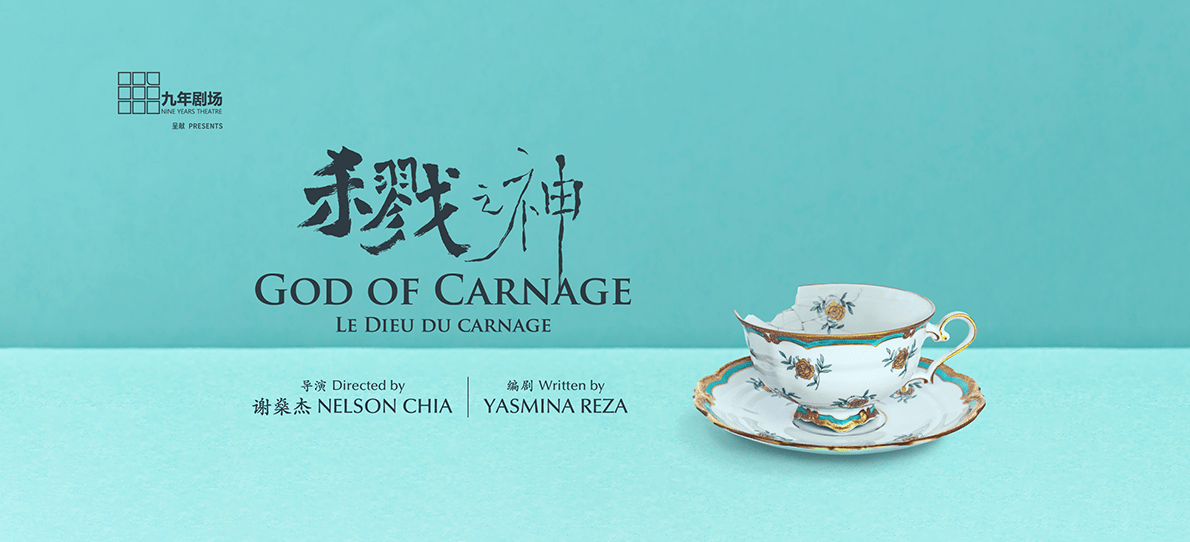
At the start of Yasmina Reza’s God of Carnage, everything looks reasonable. Veronica has prepared food. Michael has arranged the living room. Annette arrives determined to be gracious. Alan, distracted by his phone, still shows up. Four adults sit down to discuss their sons’ playground conflict calmly, civilly, like responsible people should. That the evening collapses into chaos feels less like a shock than a slow, almost inevitable reveal.
This March, Nine Years Theatre presents Reza’s internationally acclaimed dark comedy, directed by NYT co-founder and artistic director Nelson Chia, running from 20 to 29 March at The Ngee Ann Kongsi Theatre @ Funan. Following the sold-out success of Twelve Angry Men, the production arrives at a moment when the company is both emboldened and under pressure.
“This time, I feel very stressed,” Chia admits, without hesitation. “But it’s a good stress. Because after Twelve Angry Men, my own standards changed. I realised there’s so much more I wasn’t aware of before. Now I see more possibilities, and once you see them, you can’t unsee them.”
Returning to Yasmina Reza more than a decade after staging Art in 2014, Chia describes encountering her writing almost anew. “This time, I see a lot more in her text,” he says. “She’s already done so much work in the writing. There are so many nuances, so much space, not just for the director, but for the actors. Every line carries meaning.” Revising the Mandarin translation, Chia resisted over-localising the play, instead adjusting language rhythms and references to suit Singaporean Mandarin usage. “Some references are very French or American, pop culture, movies they don’t land here. So we shifted those. But the emotional truth stays. That cannot change.”
That truth is deceptively simple. Two boys fight. Four parents meet. And in trying desperately to behave, they expose just how fragile that behaviour is. “These are not bad people,” Chia stresses. “They genuinely think they are being reasonable. That’s what makes it uncomfortable. The arguments are calm at first. They are wrapped in culture, education, ethics. But civilised language is often the most brutal.”
From the outset, Chia made one thing clear to the cast. “At the first meeting, I told them: you are very far from these characters,” he recalls. “You are good people. We are controlled people. But these characters have gone out of control. So the work is not about exaggeration. It’s about understanding how and why the mask breaks.”

That mask is what Veronica Goh clings to most fiercely. Played by Mia Chee, Veronica is articulate, principled, morally assured, a woman who never doubts that she is acting correctly. “She really believes she’s doing the right thing,” Chee says. “She doesn’t see herself as aggressive at all. She doesn’t think she’s attacking anyone.” That certainty, Chee explains, is the engine of the character. “If you play her as someone who knows she’s wrong, the whole thing collapses. She must believe she’s correct. Otherwise none of her actions make sense.”
What makes the role challenging is not emotional excess but restraint. “You can’t let her spiral too early,” Chee says. “She’s very contained. Very sure of herself. And that kind of certainty is actually very rigid.” The exhaustion, she notes, is mental rather than cathartic. “It’s not indulgent. You’re constantly holding the line.” What unsettles her most, however, is how recognisable that rigidity feels. “Everyone has had moments where they’re convinced they’re on the moral high ground. That’s what people will recognise, and that’s uncomfortable.”
If Veronica is anchored by moral conviction, her husband Michael initially positions himself as its counterweight. Tay Kong Hui describes Michael as someone who equates calmness with superiority. “He thinks that because he’s not emotional, he’s the better person,” Kong Hui says. “He prides himself on being reasonable.” But that restraint comes at a cost. “He’s swallowing a lot. And when you keep swallowing things, it doesn’t disappear. It just waits.”
Coming straight off the physically and emotionally punishing Twelve Angry Men, Kong Hui approaches this role differently. “I’m not interested in playing the explosion,” he says. “I’m interested in what he suppresses before that.” Michael’s unraveling is not sudden. “It’s accumulated. By the time he loses control, he’s already lost it many times internally.”
Offstage, that control extends to how Kong Hui manages himself. “Taking care of oneself is the actor’s responsibility,” he says simply. Recovering from a broken toe during rehearsals only sharpened that awareness. “Everything comes down to maintaining your physicality and vocal condition so you’re ready to accept whatever the role demands.”
Across from the Gohs sit Annette and Alan Lee, outsiders in someone else’s home, carrying their own anxieties. For Oon Shu An, Annette is defined almost entirely by effort. “She’s trying very hard to be polite,” Oon says. “To be understanding. To not make things worse.” That effort, she adds, often goes unnoticed. “She’s managing the situation, managing her emotions, managing everyone else’s comfort.”
Annette’s unraveling is gradual rather than explosive. “It’s not one big thing that pushes her over,” Oon explains. “It’s the accumulation of small dismissals.” Working professionally in Mandarin, a language she is less accustomed to performing in than English, added another layer of vulnerability. “Sometimes I stop and ask what a word really implies,” she says. “Then I realise — oh, this word is very sharp. It sounds polite, but it hurts.”
Rehearsals, Oon notes, were intense but unusually supportive. “We have very heated discussions about the play,” she says. “Then we break, eat snacks, laugh, and come back to wrestle with the material again.” That rhythm, she believes, mirrors the play itself. “It’s like oil and water thrown together and told to have a conversation. There’s no middle ground, and that’s what’s exciting.”
Alan, meanwhile, operates on a different frequency entirely. Played by Cavin Soh, he is phone-bound, distracted, seemingly disengaged. “People think he doesn’t care,” Soh says. “But I don’t see him that way.” Instead, he views Alan’s detachment as defensive. “He believes logic will protect him. If he stays rational, if he stays busy, then nothing can touch him.”
Coming from television, Soh was candid about his initial fear. “I was very stressed,” he admits. “I kept thinking, how am I going to remember everything? How do I sustain this for the whole show?” What surprised him was the discipline theatre demanded. “You cannot waste words. Every line has a purpose.” That control, he adds, is where Alan’s cruelty lies. “It’s very clean. Very intellectual. And that can be very violent.”
As a four-hander, God of Carnage offers no escape. Everyone is on stage almost the entire time. “It’s exhausting,” Soh says plainly. “But it’s also a very good training ground.” The chemistry, Kong Hui adds, depends on trust. “If you don’t feel safe with your director or your fellow actors, progress becomes very painful. Here, the space is safe. That’s why we can push.”
That pushing leads to moments audiences are unlikely to forget. Chee points to the instant when all four characters finally drop their masks. “It might be just a split second,” she says. “But that moment of truth, when nobody is pretending anymore that’s very powerful.” Soh recalls a scene where alliances flip violently. “One minute they’re laughing together, drinking, defending each other,” he says. “The next minute, it’s chaos. It’s very cruel. And very true.”
For Kong Hui, the infamous hamster scene carries a different weight. “In many productions, audiences laugh,” he says. “But here, Shu An looked at me like I was a devil.” He laughs, slightly nervously. “I might be the most hated person in this play.”

For Chia, these reactions are the point. “They don’t become bad people,” he says. “They reveal who they already are.” That revelation implicates the audience too. “We all think we are civil. We all think we are reasonable. And the play asks: under pressure, how true is that?”
That refusal to soften edges mirrors where Nine Years Theatre finds itself today. After more than a decade of work, and a landmark year in 2025, the company is slowing down its local output in 2026 while touring internationally, including bringing Waiting for Audience to the prestigious Avignon Fringe Festival in July. “We have two strands now,” Chia explains. “Original work, and transcreation. Both are important. We need to tell our own stories. But we also need to hear how other people tell theirs.” Going abroad, Mia Chee adds, sharpens identity. “When people from other places can resonate with what you do, you recognise yourself better.”
Yet God of Carnage remains firmly domestic. It is set in a living room. It is about parenting, marriage, ego, and control. It is about people who believe they are reasonable, discovering how thin that belief can be. “I don’t expect audiences to remember the plot,” Chia says. “They won’t remember every line. They may not even remember us.” He pauses. “But maybe one day, when they’re arguing with someone they love, something clicks. They remember they’ve seen this before.”
That, for Chia, is the real work of theatre. “Most art is not about changing you immediately. It’s about seeding. It’s a long game.” God of Carnage then plants its seed ruthlessly: through laughter that curdles, civility that fractures, and a mirror that refuses to look away. And as Nine Years Theatre enters its next chapter, more demanding, more confident, more unafraid. It invites audiences to sit in the discomfort, to laugh, then hesitate, and to ask, long after the lights go out: When we insist we are being civil, what, exactly, are we trying to protect?
Photos Courtesy of Nine Years Theatre
God of Carnage plays from 20th to 29th March 2026 at The Ngee Ann Kongsi Theatre @ Wild Rice, Funan. Tickets available from SISTIC
 Bakchormeeboy