
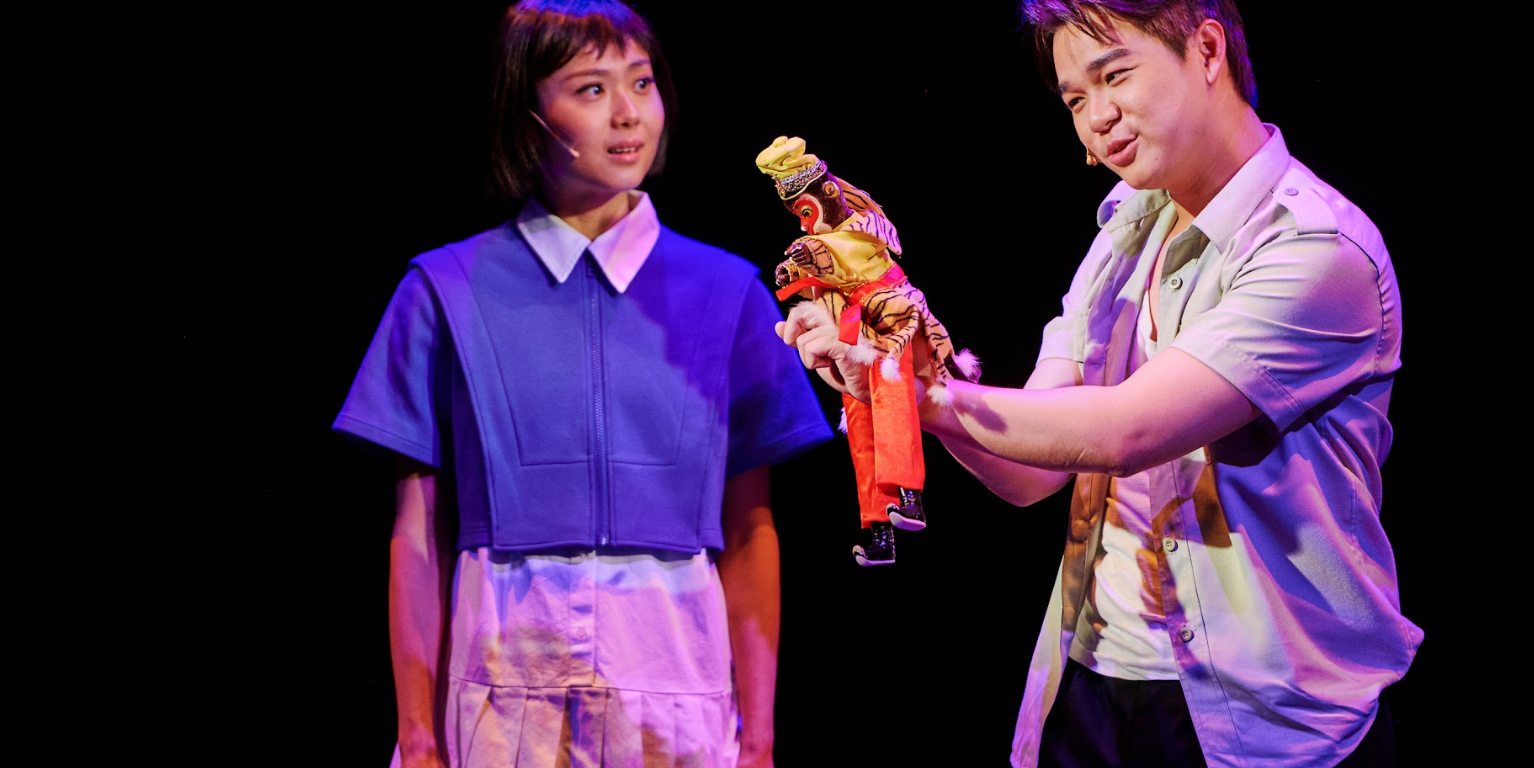

This definitive Singaporean Chinese musical reckons with the impossible decision between dreams and duty, and more crucially, what it costs to choose your own life in Singapore.
First written and staged in 1990 by the late theatre doyen Kuo Pao Kun with The Theatre Practice (Practice), Lao Jiu was a script that was always meant to evolve. Originally a stage play, its eventual transformation into a musical in 2005, under the direction of Kuo Pao Kun’s daughter Kuo Jian Hong, marked the beginning of a long process of refinement. With each subsequent iteration in 2012, 2017, and now 2026, the production has grown more assured in form and more piercing in its inquiry. This latest version is perhaps its most definitive yet, going beyond merely revisiting the text to elevate it through a culmination of artistic voices that now feels complete.

Brought back once again to the Drama Centre Theatre by Practice as one of their signature works, with the script adapted by Liu Xiaoyi (himself a former Lao Jiu in 2005), Lao Jiu: The Musical follows the titular ninth child and only son in a family of daughters, poised on the edge of academic success, his future seemingly preordained. Yet his passion lies in the fragile, fading art of traditional Chinese hand puppetry. The tension between these two paths: security versus art, obligation versus selfhood, forms the central narrative of the musical. What unfolds is not just a personal dilemma, but a microcosm of a greater systemic one. In a society where meritocracy is both promise and pressure, where education is positioned as the singular path to dignity and success, Lao Jiu becomes a conduit for Singaporean audiences. Through him, the musical articulates a collective anxiety: the quiet, often unspoken cost of living up to expectations that were never ours to begin with.

This is where the production reveals its quiet radicalism. It does not frame Lao Jiu’s choice as a mere triumph of individual rebellion, but as a question directed outward towards family, towards society, towards us. Why must such a choice exist at all, in a system that demands a child justify his own dreams? These ideas find their most potent expression through the score. With lyrics by Xiaohan and music by Eric Ng, the songs are deceptively fluid, often dialogue-like, emerging from actual lines into melody, at times unfolding like dramatic monologues. Layered with metaphor and analogy, they flow with remarkable ease, never straining for profundity, allowing complex ideas to emerge organically through language that feels at once accessible and deeply intentional. It is a musical written for a general audience, but never dumbs it down; it assumes intelligence, invites interpretation, and rewards emotional attentiveness.

Under Kuo Jian Hong’s direction, the production achieves a remarkable balance between spectacle and sincerity. Her directorial signature lies in an assured control of scale, never allowing grand spectacle to overwhelm the emotional throughline, but instead using it to sharpen and clarify it. Nowhere is this more evident than in its massive ensemble, arguably one of the strongest and largest assembled on a Singapore stage in recent years. Going beyond a supporting cast, the ensemble forms a living, breathing organism, one that pulses with rhythm, precision, and an almost instinctive sense of unity. The eight sisters and their partners could easily blur into indistinct archetypes, but here, each is sharply defined, bursting with personality through costume, gesture, voice, and presence. Their introductory sequence is a triumph of staging—fast-paced, musically tight, and character-rich, establishing an entire family ecosystem in a matter of minutes.

Choreographer Seong Hui Xuan’s work pushes them even further, demanding not just synchronicity but stamina and versatility. In Eat Eat Eat, they overwhelm Lao Jiu with love expressed through excess, transforming a familiar cultural gesture into something both comedic and quietly suffocating. At one point, Lao Jiu is physically lifted and allows himself to fall backwards, suspended between care and control, a striking image of a life held up by many, yet never fully his own. In Battlefield, they morph into students locked in academic warfare, their movements sharp and almost militaristic. Elsewhere, they lift, toss, chant, pray, and harmonise, shifting seamlessly between roles and emotional registers. What is most impressive is not just their technical precision, but their responsiveness to one another; every cue is caught, every beat shared. It is ensemble work in its truest sense: collaborative, generous, and utterly in sync. A tremendous amount of credit must also go to music director Julian Wong, whose arrangements give the ensemble room to both soar and settle, building a sonic landscape that supports their scale and cohesion.

At the centre of it all is lead Amsden Huang’s Lao Jiu, a breakout performance that firmly marks him as one of the most promising new leading men to emerge on the local musical theatre stage. While known as a singer-songwriter, Huang enters as a relative newcomer to theatre, yet carries the immense responsibility of anchoring the production with remarkable assurance. There is a natural openness to him, an unforced sincerity that makes Lao Jiu immediately believable as both dutiful son and quietly conflicted dreamer. Vocally, he is clear and controlled, but it is his emotional progression that proves most compelling. In Revelation, we begin to see the cracks form, his internal struggle surfacing with a newfound intensity. By the time he reaches I Am Lao Jiu, Huang delivers not just a declaration, but a transformation as we see him grounded, resolute, and fully realised.

If Huang provides the spine, Ang Xiao Ting’s Junior Horse emerges as one of the production’s emotional cores. In what becomes an unexpectedly standout performance distinct from her previous roles onstage, she brings a depth and vulnerability that lingers long after her scenes end. Her Junior Horse is not defined by rivalry, but by quiet recognition of their shared circumstance and paths already chosen for them. In Two of Us, she navigates a delicate emotional arc, her voice soft yet searching, gradually giving way to a heartbreaking clarity. By the time of their final farewell, it is Xiao Ting who delivers one of the production’s most affecting moments, her restraint giving way just enough to reveal the cost of acceptance. It is a performance of remarkable control and emotional intelligence.

Wysom Wong’s Senior Horse arrives as a formidable presence, embodying the very ideology Lao Jiu resists. His commanding physicality and resonant vocals in Wild Horse establish him as a figure of dominance and control, yet there is an underlying logic to his rigidity. This is a man who has succeeded within the system and sees no reason to question it—a stark contrast to Lao Jiu’s uncertainty and idealism. In this way, he becomes less a caricature of villainy and more a personification of systemic force: a world defined by strength, order, and victory, set against Lao Jiu’s belief in softness, imagination, and creation.

There is also a profound sense of continuity embedded within the casting. Sugie Phua, an actor who once embodied Lao Jiu in both 2012 and 2017, now instead returns as Father. His performance is layered and deeply human, capturing the contradictions of a parent who loves fiercely yet expresses it through pressure and expectation. His use of dialect grounds the character in lived reality, lending authenticity and texture, while his emotional journey in Life Companion reveals a softer, more reflective side. Having played both son and father, there is an innate maturity and understanding within this performance, inhabiting both his character’s frustrations and his eventual growth with nuance.

Opposite him, Yeo Lyle’s Shi Fu stands as a quiet pillar of wisdom and restraint. Where Father is forceful, Shi Fu is measured; where one demands, the other invites. Lyle brings a gentle gravitas to the role, his presence never overpowering yet always felt. There is a stillness to his performance that speaks volumes, particularly as age and frailty begin to show. In Man to Man, his exchange with Father becomes one of the production’s most sincere and grounded moments—two men, shaped by different beliefs, finally meeting in understanding. Lyle also embodies a fading lineage, a keeper of traditional arts whose quiet influence ultimately shapes Lao Jiu’s path.

Visually and musically, the production is no less assured. Under Julian Wong’s musical direction, the live band lends richness and dynamism to the score, while MAX.TAN’s costumes and Genevieve Peck’s lighting design shape a world that is both grounded and expressive. Chen Szu-feng’s set, though understated, remains efficient and functional, allowing the performers and choreography to take centre stage. And in a show whose narrative revolves primarily around puppets, Bright Ong’s puppetry indeed becomes the soul of the production, an articulation of everything Lao Jiu is fighting to preserve. The climactic Battle of the Greats between Lao Jiu and Senior Horse is nothing short of breathtaking, weaving together multiple puppetry forms into a sequence that is as intellectually resonant as it is emotionally overwhelming. It is here that the musical’s central conflict finds its clearest expression: not just a clash of individuals, but of ideologies: force versus softness, domination versus creation.

Nine years on from its previous staging, Lao Jiu: The Musical returns in 2026 not merely as a revival, but as a reckoning. What lingers long after the curtain falls is not just its story, but the questions it leaves behind about the paths we have taken, the dreams we have set aside, and the systems that shaped those decisions. It also remains immensely joyous and alive, brimming with humour, rhythm, and theatricality, finding delight in movement, music, and the sheer act of performance. It is this balance, the work of an entire village of creatives, that makes its emotional impact all the more profound: that a work so entertaining can also cut so deeply.

This is, ultimately, a deeply Singaporean legacy work, in its setting, its language, and its concerns, its tensions, and its truths. It is steeped in the contradictions of Singaporean identity, where filial piety contends with individual desire, where language itself carries hierarchy, and where the arts must constantly justify their own existence. It understands us, perhaps more than we are willing to admit. What stands on stage today is not just the realisation of Kuo Pao Kun’s dream, but its continuation, carried forward by a new generation of artists. In so doing, Practice have created something rare: a musical that asks, with clarity and conviction, what we are willing to sacrifice, and what really should matter in a world so fixated on a narrow definition of ‘success’.
Photo Credit: The Theatre Practice
Lao Jiu: The Musical plays from 2nd to 19th April 2026 at the Drama Centre Theatre. Tickets and more information available here
Production Credits
| Original Work By Kuo Pao Kun Director Kuo Jian Hong Lyricist Xiaohan Composer Eric Ng Script Structure George Chan, Kuo Jian Hong Script Adaptation Liu Xiaoyi Cast Amsden Huang, Yeo Lyle, Sugie Phua, Katherine Tang, Wysom Wong, Ang Xiao Ting, Isabella Chiam, Hang Qian Chou, Jodi Chan, Tan Shou Chen, Abby Lai Ka Hei, Juni Goh, Jean Seizure, Marcus Elliot Cheong, Tan Rui Shan, Edward Choy, Angel Mermairina, Joel Gay Han, Claris Tan, Felix Lim, Cheryl Ho, chong shen hao, Ng Mun Poh, Sofia Amanda Marina Cahyadi, Felicia Lin, Yeow Haau Yeng, Ngim Juo Yue Dorothy, Oh Cheng En, Tan Peng Boon Band Julian Wong (Conductor & Keyboard 1), Tan Kian Wee ( Keyboard 2), Feri Susanto (Acoustic & Electric Guitar), Din Safari (Electric Bass), Neville Athenasius Ang (Violin), Patrick Ang (Drum & Percussion) Original Arranger (2012) Bang Wenfu Music Director & Co-Arranger Julian Wong Original Choreographer (2012) George Chan Choreographer Seong Hui Xuan Set Designer Szu-Feng Chen Associate Set Designer Lee Bee Bee Scenic Artist Lee Hsiao Wan Props Designer & Set Dresser Rainie C. Lighting Designer Genevieve Peck Sound Designer Shah Tahir Sound Engineer Sandra Tay Costume Designer MAX.TAN Hair Designer Ashley Lim Make-Up Designer Bobbie Ng (The Makeup Room) Puppetry Designer & Director (2012, 2017) Benjamin Ho (Paper Monkey Theatre) Puppet Designer & Director Bright Ong |


One thought on “★★★★★ Theatre Review: Lao Jiu – The Musical 《老九》音乐剧 (2026) by The Theatre Practice”