
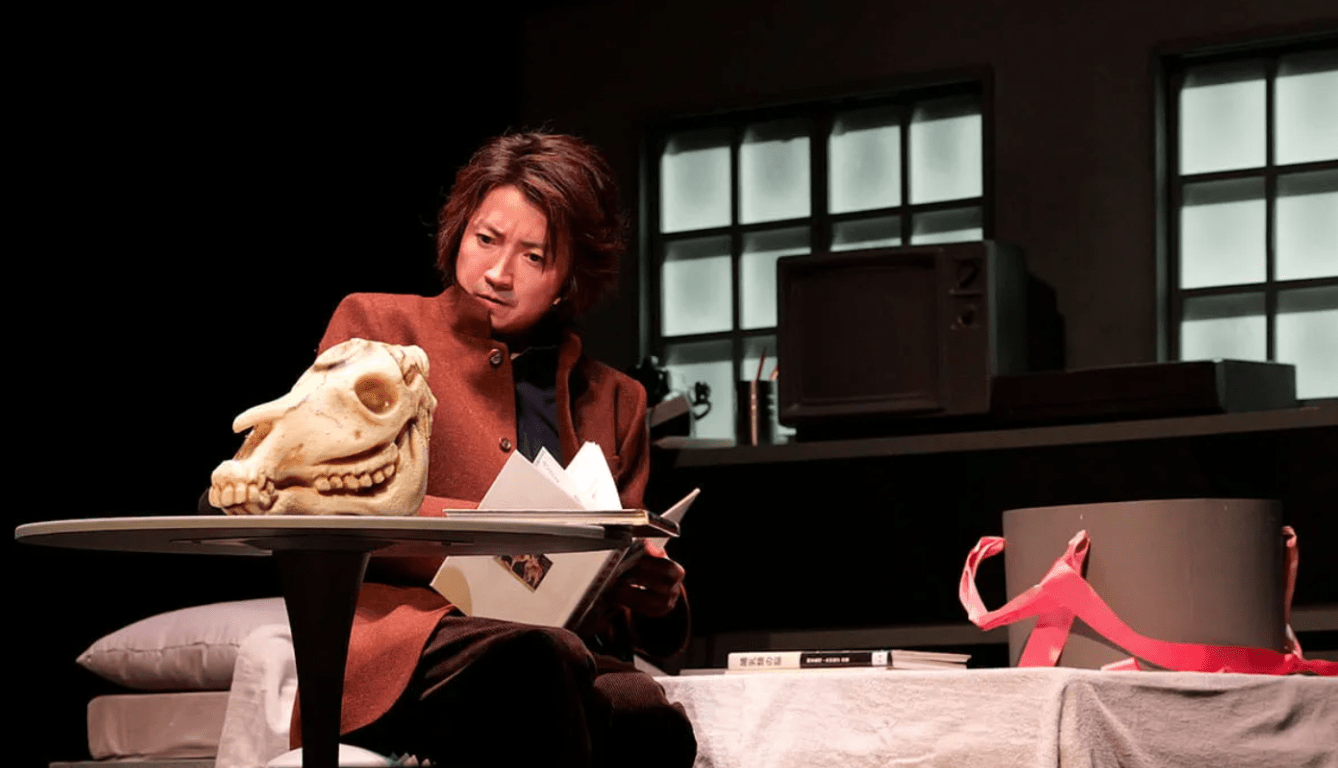

A dream made tangible as Haruki Murakami’s surreal masterpiece comes vividly to life on stage.
Fresh from its world premiere in Tokyo in January, End of the World and Hard-Boiled Wonderland arrives in Singapore with the weight of expectation. Beyond its sheer scale, adapting Haruki Murakami’s writing for the stage has always been a formidable undertaking. His novels are winding, introspective and often resistant to conventional narrative logic, stories that unfold within the subconscious as much as in reality, where meaning is felt rather than explained. Hard-Boiled Wonderland and the End of the World is perhaps one of his most structurally complex works, its dual narratives set in fantastical realms threading together questions of consciousness, identity and memory. To render this theatrically requires not just fidelity to plot, but an imaginative leap, one that can translate interiority into image, rhythm and space without losing the delicate ambiguity that defines Murakami’s voice. In this respect, Philippe Decouflé’s faithful production achieves something quite remarkable: it manages to build a theatrical world onstage expansive enough to contain him.
In the same way as the novel, the story unfolds across two parallel realities, shifting across both narratives from scene to scene. In Hard-Boiled Wonderland, Watashi (Tatsuya Fujiwara) is a “Calcutec”, a human data processor navigating a shadowy, cyberpunk Tokyo where information is currency and danger lurks beneath the surface. Tasked with a mysterious assignment by an eccentric scientist (Narushi Ikeda), his reality begins to fracture as unseen forces close in. In End of the World, Boku (Ryunosuke Shimamura) arrives in a tranquil, walled Town where his shadow is severed from him, and he is assigned to read dreams from unicorn skulls in a quiet, eerie library. As both narratives progress, they begin to echo and refract one another, and the two stories come together, representing two states of the same consciousness, one rational, one dreamlike, gradually converging toward an inevitable reckoning.

From its opening moments, Decouflé makes clear that this is a work driven as much by movement as by narrative. A fantastical horn is sounded, and a surreal procession of unicorns played by dancers in white, horned costumes moving on all fours with stilted forelimbs, sets the stage in a sequence that feels like a dream slipping into form. Choreography is Decouflé’s specialty, and becomes the connective language between the two worlds, replacing traditional scene changes with kinetic transitions. Between major sequences, bodies continue to move: a solo dancer crosses the stage, most memorably Rikubouz, whose “flow”-based movement glides seamlessly across space, collapsing time between scenes. It is a striking reminder that in Murakami’s universe, there are no hard boundaries, only continuous states of being.
Visually, the production is breathtaking. The dual worlds are rendered with immediate clarity: End of the World unfolds in softness, with muted tones, warm amber light, and a perpetual orange dusk that feels suspended in time, while Hard-Boiled Wonderland is all angles and unease, a harsher Tokyo rendered in shadow and steel. Lighting by Yukiko Yoshimoto plays a crucial role here, not only in distinguishing these realms but in shaping their emotional texture. Blackouts are used sparingly but effectively, often giving way instead to dim transitions where figures slip behind the set’s dual ramps, ingeniously designed by K Ishihara, to vanish, transform or re-emerge, adding layers and levels to the stage. These ramps become more than architectural features; they are thresholds, allowing characters to dissolve between worlds as if passing through layers of consciousness.

The multimedia elements further deepen this immersive experience. Video design by Taiki Ueda transforms the stage into a cinematic landscape: a scrolling montage of Tokyo roads as Watashi “drives” with a simple steering wheel, shadow play that merges with animation the live actors respond to, and a vast projection of ocean waves that engulfs the space in sound and motion, designed by Masahiro Inoue. These are not mere embellishments but form the architecture of the world itself, shaping how we perceive time, memory and reality. Surreal elements are abound: mutant ‘Murks’ in spiky, sea-urchin-like forms roll through the sewers, glowing unicorn skulls hover like macabre lanterns, and Shuntaro Miyao’s Shadow moves as a detached, almost spectral phantom, a physical manifestation of the self cleaved in half.
At the centre of this shifting landscape is Tatsuya Fujiwara, whose portrayal of Watashi is unexpectedly disarming. Known for intensity in his screen roles, he instead leans into humour and awkwardness, becoming a more bumbling figure swept up in forces beyond his control. This makes his eventual realisation, that his time is finite, that his world is slipping away, all the more affecting. Around him, the cast embraces the production’s heightened tone: Miu Tomita brings sharp comedic timing to the irrepressible Woman in Pink, matched in eccentricity by Narushi Ikeda’s delightfully unhinged Doctor. Haru Fujita and Shinya Matsuda inject bursts of physical comedy and menace as the Small and Big Guys, their destructive rampage through Watashi’s apartment a moment of chaotic theatrical pleasure. In contrast, Ryunosuke Shimamura’s Boku offers a gentler, more introspective presence, grounding the abstract world of the Town even as it resists emotional clarity in all its mystery.

The dual role of the Librarian/Kanojo (Misato Morita), however, feels more functional than fully realised, a recurring reminder that many of Murakami’s characters exist more as emotional signposts than as fully fleshed individuals. This is where the production’s central tension lies. In remaining so faithful to the source, through the careful adaptation by Ako Takahashi, the work preserves both its richness and its opacity. The narrative can feel dense, even overwhelming, particularly as its sprawling world-building unfolds in a single sitting. There are stretches, especially within End of the World, where the abstraction creates distance rather than connection, and the audience is left drifting rather than anchored. Yet this, too, feels true to Murakami: a deliberate refusal of neat resolution, an insistence on atmosphere over clarity.
For all its elusiveness, the production ultimately manages finds its emotional centre. As the two narratives converge, what emerges is a story of parallel worlds that reveals a poignant meditation on choice, on whether to remain within a constructed reality or to step beyond it, however uncertain that may be. The ending, poised between resistance and acceptance, recognising that identity and circumstance is not fixed, but something we must claim for ourselves, even within systems that seek to define us. It is here that the production lingers, with both a spectacular finale in a flurry of snow and dancers, and in feeling, shouted out by Fujiwara as resistance against the blizzard.
There is something genuinely moving about witnessing Murakami realised at this scale and realised so well. It is rare not only because of the technical demands, but because of the sensitivity required to hold onto ambiguity without collapsing into incoherence. Decouflé’s production does not resolve every question, nor does it always sustain its momentum. But it creates something perhaps more valuable: a space to drift, to wonder, and to feel, and to witness in all its beauty. Like the novel itself, it is best experienced not as a linear narrative, but as a state of mind, one that stays with you long after the lights fade.
Photo Credit: Takahiro Watanabe
End of the World and Hard-boiled Wonderland plays from 3rd to 5th April 2026 at the Esplanade Theatre. Tickets and more information available here
Production Credits
| Based on the novel by Haruki Murakami Directed and Choreographed by Philippe Decouflé Adapted for the stage by Ako Takahashi Cast Tatsuya Fujiwara, Misato Morita, Shuntaro Miyao, Miu Tomita, Kiita Komagine, Ryunosuke Shimamura, Haru Fujita, Shinya Matsuda, Narushi Ikeda, Moeko Uematsu, Yuuka Okamoto, Mizuki Tomioka, Junpei Hamada, Erika Hara, Miki Furusawa, Nana Horikawa, Reo Yamada, Yuya Yoshizaki, Rikubouz Music Umitaro Abe Set Designer K Ishihara Lighting Designer Yukiko Yoshimoto Sound Designer Masahiro Inoue Video Designer Taiki Ueda Costume Designer Ayako Maeda Hair & Make-up Designer Naoki Kamada Associate Director Maiko Tanaka Associate Choreographer Ryu Suzuki Associate Set Designer Sayako Makino Assistant Director Noriko Kawai Stage Manager Kazutaka Mori Production Manager Yasumasa Hirai Production Supervisor Yuichiro Kanai |
 Bakchormeeboy