
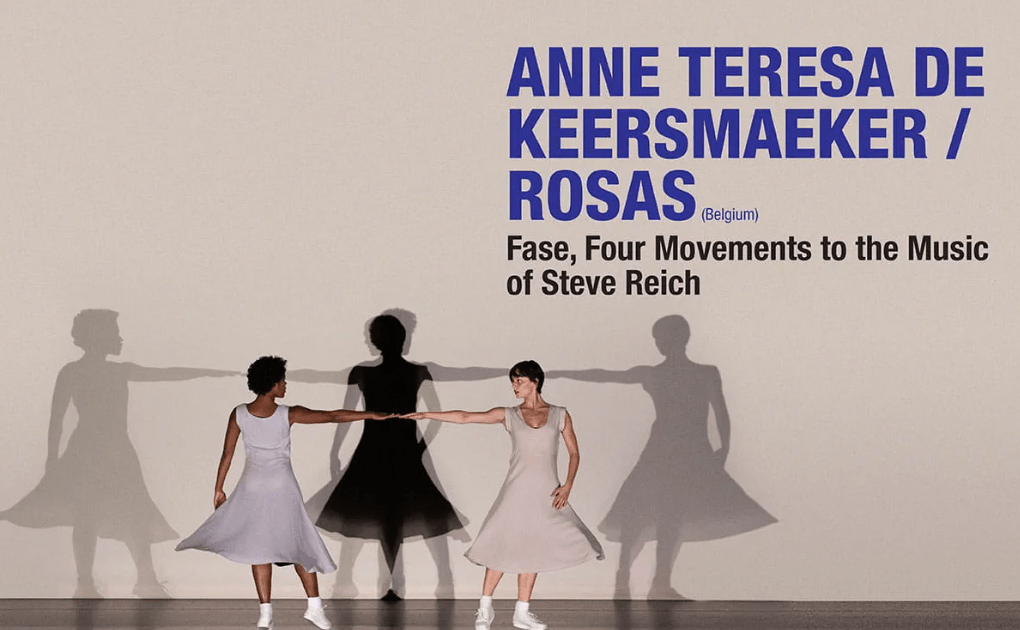
When Anne Teresa De Keersmaeker created Fase, Four Movements to the Music of Steve Reich in the spring of 1982, she was starting, quite deliberately, at the beginning. “I wanted to develop my own choreographic writing,” she recalls. Trained in classical ballet (“a very strictly codified language”), she chose instead “to go step by step, literally one movement at a time,” trusting an emerging intuition about how she wanted to move.
That shift coincided with her encounter with the music of Steve Reich. After a period studying in New York, she returned “with the music in my pocket,” and began what she describes as “a kind of deal with the music”, a direct, physical response to its internal logic. “Like village music, where people start to dance,” she says, “there is something intrinsic in it.” From this, she built a vocabulary grounded in simple procedures: “accumulation, substitution of movement,” and the linking of choreography to mathematical variations.

Fase is built around the idea of phase shifting: patterns repeating, gradually slipping out of sync, accelerating and decelerating, producing new relationships over time. “Movement by movement,” she explains, “simple principles, but with the goal of attaining clarity and complexity.” The work unfolds with almost architectural precision, yet its foundations are organic. “Since the beginning, I became obsessed with circles, spirals, and ellipses,” she says. “They are everywhere in nature, in the cosmos, in sunflowers, in shells, in tornadoes.” These recurring forms shape not only the choreography, but its underlying philosophy: a sense of return that is never quite repetition.
More than forty years on, Fase continues to live through the bodies of different dancers, even as De Keersmaeker herself still performs parts of it. Passing the work on raises enduring questions: “What is the sovereignty of choreographic writing? What is the impact of the dancer?” The structure, she notes, is “tight and formal,” almost like “a machine you put on the road and then it goes.” And yet, within that rigour lies a charged and unstable space. Quoting a jazz principle, she reflects: “There is no freedom in freedom, only freedom in structure.”

For De Keersmaeker, structure is not a limitation but a condition for presence. “It’s like a roadmap,” she says, “where I can fully be in the immediacy of performance.” Within this framework, something more elusive emerges in the “betweens and the betwixt,” as she puts it. She describes herself as “a romantic person,” drawn to the tension between opposites: “extreme structure, something objective, mathematical,” alongside a body that is “engraved with human experience.” In this interplay between American minimalism and European expressionism, between system and sensation, “the oppositions resolve themselves.”
This dynamic becomes especially palpable in the experience of looping. “It is very close to being in a trance,” she says, invoking practices found across cultures and histories. But it is not a loss of control. Rather, it is “rigour embodied”, a state of flow that is shared with the audience “without losing yourself, without going out of your immediate self-consciousness.” For the performer, it is “a very strange but exciting place to be.”

Despite its conceptual depth, Fase remains disarmingly accessible. “The movements are quite simple,” she notes, “not technically virtuosic.” This simplicity creates an unexpected connection: “People recognise themselves in it.” Audiences sometimes leave the theatre and try the movements for themselves, “because there is a possibility, there is access.” Whether encountered on stage or in a museum setting, where proximity shifts perception, the work invites identification rather than distance. “The desire to recognise the self in it, that is quite nice.”
For De Keersmaeker, the work resists fixed interpretation. “It’s more of an experience rather than meaning,” she says. Instead, it offers “different time and space experiences,” grounded in duration, repetition, and attention. In a contemporary landscape shaped by speed and fragmentation, Fase proposes something else: “slow processes and detailed looking.” It asks whether we can still perceive and take pleasure in subtle difference, in what is “always the same and always different.”

Looping, in this sense, extends beyond composition into a way of understanding the world. “It can have a healing aspect,” she reflects, like “seasons, routines, and the idea of something that goes on and on.” She returns again to the circle: “the most democratic form,” where every point is equidistant from the centre. But she is equally drawn to spirals and figure eights, forms that suggest both return and transformation, “opening and closing, always coming back in a different way.”
Through these patterns, Fase generates a continuous flow of energy, structured, evolving, and potentially endless. “It can go on,” she says, “like a little piece of eternity.” And for the duration of the performance, held between repetition and change, that is precisely what it becomes, holding you in a trance-like state.
Photo Credit: Anne Van Aerschot
Fase, Four Movements to the Music of Steve Reich plays from 23rd to 25th April 2026 at the Singtel Waterfront Theatre. Tickets available here
 Bakchormeeboy