
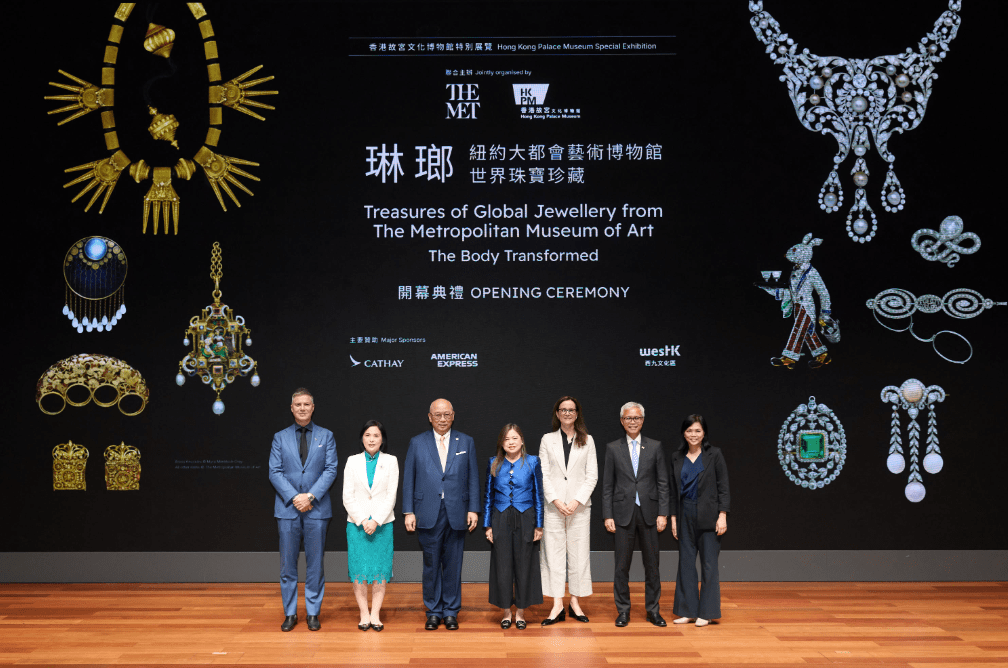
HONG KONG – In Hong Kong this spring, jewellery is no longer just something to wear—it becomes a language of memory, myth, and identity. At the heart of the city’s cultural landscape, the Hong Kong Palace Museum has unveiled “Treasures of Global Jewellery from The Metropolitan Museum of Art: The Body Transformed”, a landmark exhibition that feels as much like a sensory journey as it does a museum visit.
Co-presented with the Metropolitan Museum of Art, the show marks the first time the institution’s encyclopaedic jewellery collection has travelled abroad in a major way—and Hong Kong is its first stop. Running from April to October 2026, it brings together around 200 extraordinary pieces spanning 4,000 years of human adornment, tracing how civilizations across five continents have used jewellery to define beauty, power, spirituality, and self-expression.
At its core, The Body Transformed is about connection. Across ancient Egypt, imperial courts, Indigenous American cultures, and contemporary design studios, jewellery appears again and again as a shared instinct: to decorate, to signify, to communicate.
The exhibition opens with the idea of the “adorned body,” where pieces are displayed in dialogue with the human form. Gold rings once worn by Egyptian royalty sit alongside delicate French Art Nouveau creations, reminding visitors that across time and geography, jewellery has always moved with the body—never separate from it.
Curated as five thematic worlds, the exhibition reads like a narrative of human experience:
The Divine Body explores jewellery as a bridge to the sacred. Ancient gold ornaments from the Americas and Asia suggest that adornment was never purely decorative—it was protective, spiritual, and often believed to carry divine power.
The Regal Body steps into courts and palaces, where tiaras, brooches, and ceremonial jewels once signified authority. One highlight—a transformable European tiara from the 19th century—now invites visitors into a playful modern twist: an augmented reality experience that allows them to “try on” history.
The Transcendent Body moves into belief systems and ritual. Here, Byzantine necklaces and devotional ornaments reveal how jewellery has long been used as a quiet conversation between human beings and the unseen world.
The Alluring Body turns toward fashion, desire, and reinvention. Pieces by houses such as Cartier, Schiaparelli, and Alexander McQueen sit alongside surrealist and avant-garde works, challenging traditional ideas of femininity and beauty. Jewellery here becomes expressive, even subversive—less about status, more about storytelling.
Finally, The Resplendent Body celebrates craftsmanship itself. From intricate Qing dynasty feather inlay to experimental late-20th-century design, this section feels like a love letter to material, technique, and imagination.
Walking through the galleries feels less like a traditional museum visit and more like stepping into a high-fashion editorial spread. One room glows in gold—from flooring to walls—transforming jewellery into an immersive environment rather than isolated objects.
The exhibition’s artistic direction, led by internationally acclaimed Hong Kong designer and artist Alan Chan, amplifies this effect. His visual language—clean, symbolic, and quietly theatrical—turns display cases into moments of revelation rather than distance.
Throughout the show, technology plays a subtle but impactful role. Visitors encounter augmented reality stations that allow them to virtually wear selected pieces, blurring the line between observer and participant. Elsewhere, interactive quizzes match visitors with objects from the collection, turning curatorial interpretation into personal discovery.
The exhibition also reflects something larger about Hong Kong itself: its identity as a meeting point between East and West, tradition and innovation. According to organisers, the collaboration between the Hong Kong Palace Museum and the Metropolitan Museum of Art underscores the city’s role as a global cultural hub—one where international institutions can reframe their collections for new audiences.
This positioning is echoed in the museum’s recent programming, which has included exhibitions on French fashion, ancient gold, silk history, and global jewellery traditions. Together, they form a consistent narrative: Hong Kong is not just hosting culture—it is actively shaping how it is experienced.
Support from major partners including Cathay and American Express further highlights how deeply embedded the city’s luxury, travel, and lifestyle sectors are in its cultural ecosystem.
The exhibition is presented under the broader governance of the West Kowloon Cultural District Authority, reinforcing West Kowloon’s ambition to position the district as a global destination for contemporary culture.
What makes The Body Transformed resonate beyond the museum walls is its underlying idea: jewellery is not about objects alone, but about people. A gold headdress from pre-Columbian Colombia sits near ancient Egyptian ceremonial adornments, not as comparisons, but as echoes. A 1950s surrealist brooch speaks to modern experimentation just as strongly as a Qing dynasty hair ornament speaks to craftsmanship and ritual.
Across all these pieces, one message quietly persists—humans have always used adornment to understand themselves.
In a city known for its skyline, speed, and commerce, the exhibition offers a rare pause: a chance to consider the intimate scale of human history. Jewellery, often seen as luxury or accessory, becomes here something more essential—an archive of emotion, belief, and aspiration worn on the body.
As visitors move through glittering galleries from April to October 2026, they are not just observing history. They are stepping into a continuum of people who, across thousands of years, have asked the same question in different ways: how do we want to be seen? At the Hong Kong Palace Museum, the answer sparkles—in gold, in stone, in glass, and in light.
More information available here

