
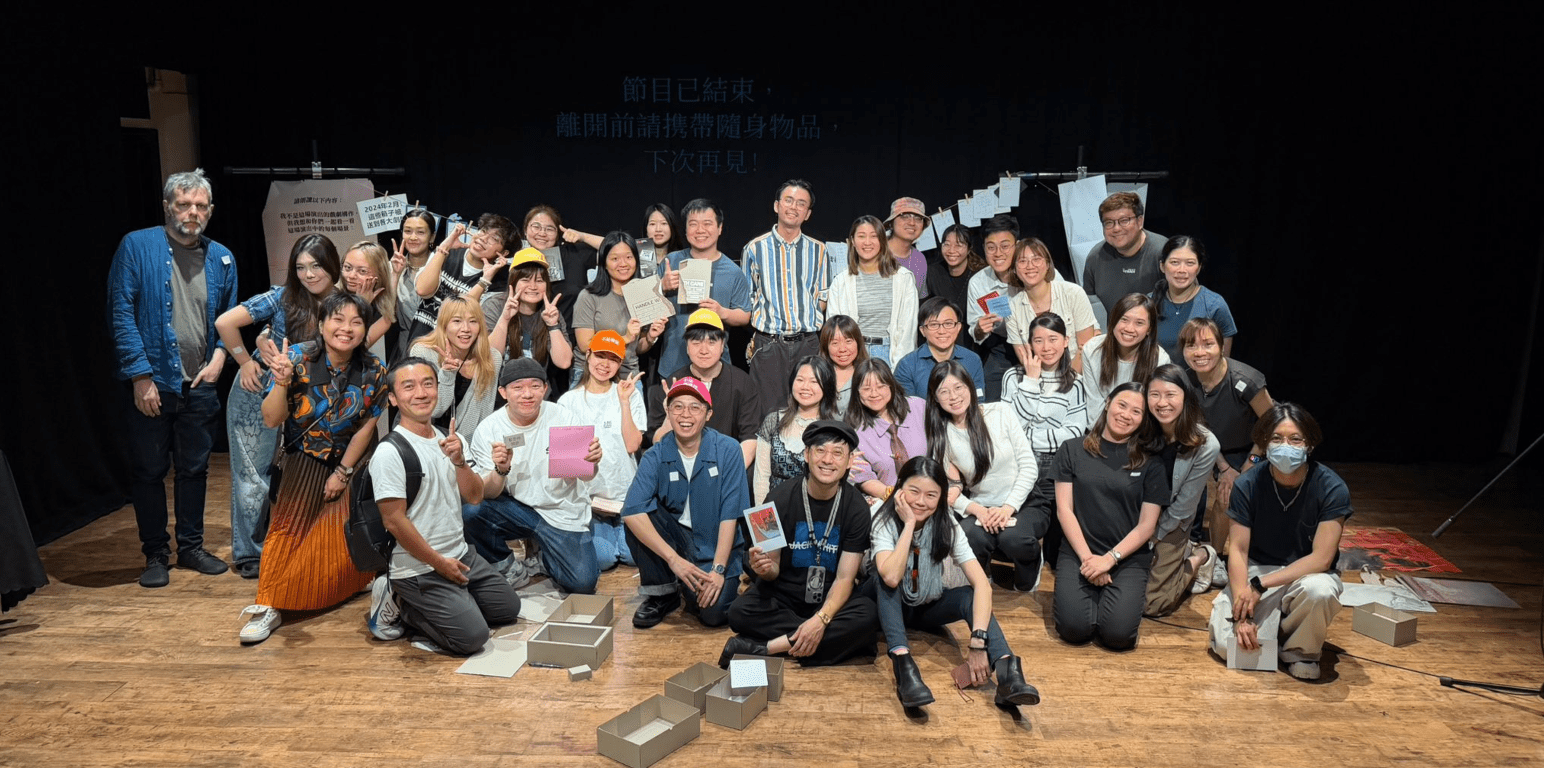

A tiny theatrical miracle is experienced as you forge memories with complete strangers under an hour.
HONG KONG – Belgian avant-garde theatre company Ontroerend Goed has long built a reputation for dismantling what theatre is supposed to be. With Handle with Care, they take that idea to its most radical extreme: there are no actors, no technicians, just a box, a stage, and an audience. And yet, somehow, it becomes one of the most human experiences you can have in a theatre.
The premise sees a box is placed at the centre of the stage. The audience sits, waiting. Then one brave person stands up, opens it, and the performance begins. From there, everything unfolds through a series of instructions, objects and prompts. There is no script, no narrative imposed from above. Instead, the story emerges organically from the people in the room.

What follows is something quietly bewildering. At first, there is hesitation. Forty strangers (save for the few you may have come with) sit together, unsure of what is expected. But all it takes is that first person, the one who opens the box, to set everything in motion. From there, the responsibility passes from hand to hand. One instruction leads to another, drawing different people in, inviting participation, nudging the group forward.
Before long, the boundary between audience and performer dissolves completely. You find yourself on stage speaking, listening, responding. And then, almost without noticing when it happened, you are talking to these strangers, sharing names, answering questions, writing down fragments of your own thoughts and stories. What began as a room of individuals slowly reshapes itself into something collective.

There are moments unexpected and unplanned that give you goosebumps. Small gestures of trust. Instances of quiet vulnerability. A shared willingness to participate, to be present, to take care of one another within the space.
That idea of “care” sits at the heart of the work. As the creators have suggested, the title is not just about handling a physical box, but about how we handle each other. And in this temporary, self-made community, there is a striking absence of judgement. People respond as they are, tentative, open, playful, introspective, and that is enough.
Language, too, becomes something fluid. It could divide a group like this, but here it often does the opposite. Meaning is carried just as much through body language, tone, and attention. Even when words falter, understanding persists. In that sense, the performance quietly transcends language, revealing how much of connection lies beyond it.

Structurally, the experience is almost game-like, where you are required to open this, then that, pass it on, invite someone else in. But within these simple mechanics lies something far more complex: the unpredictable chemistry of human beings. No two performances can ever be the same, because no two groups of people are the same. The emotions, the energy, the personalities in the room shape everything.
That unpredictability is precisely the point. For an hour, you are not watching a story but building one together. Not polished or rehearsed, but immediate and fragile, existing only in that moment. And when it ends, it ends completely. Nothing is replicated. Nothing is performed again.
And amazingly, something lingers. In the aftermath, people don’t immediately rush out, but they stay and they talk. They take photos together, with group shots, small clusters, even pictures of the objects left behind on stage. Strangers, who an hour ago shared nothing, now carry a sense of having experienced something together. Something small, perhaps, but meaningful.

It’s rare to leave a theatre feeling like you’ve genuinely met people, and Handle with Care gently insists that connection is still possible, where even in a room of strangers, something real can emerge if we allow it to. In a world increasingly mediated by screens and distance, this analogue, collective experience feels almost radical in its simplicity.
It doesn’t try to tell you what to feel. It simply creates the conditions for feeling to happen. That is perhaps what makes it so affecting, where for one hour, in one room, with one group of people, you create something that belongs only to you, an irreplaceable experience that becomes a memory to cherish.
Hong Kong Arts Festival 2026 ran from 27th February to 29th March 2026. For more information about the Hong Kong Arts Festival, visit hk.artsfestival.org.
Production Credits
| Concept & Creation Alexander Devriendt, Karolien De Bleser, Samir Veen, Leonore Spee, Charlotte De Bruyne Design Nick Mattan, Edouard Devriendt Photography Ans Brys, Joëlle Desmet Production Team Lynn Van den Bergh, Leda Decleyre, Willie-Marie Hermans, Hannes Pieters Production Ontroerend Goed With the support of the Flemish Community, the city of Ghent, the Tax Shelter measures of the Belgian federal government & Cronos Inves |


2 thoughts on “★★★★★ Theatre Review: Handle with Care by Ontroerend Goed (HKAF 2026)”