
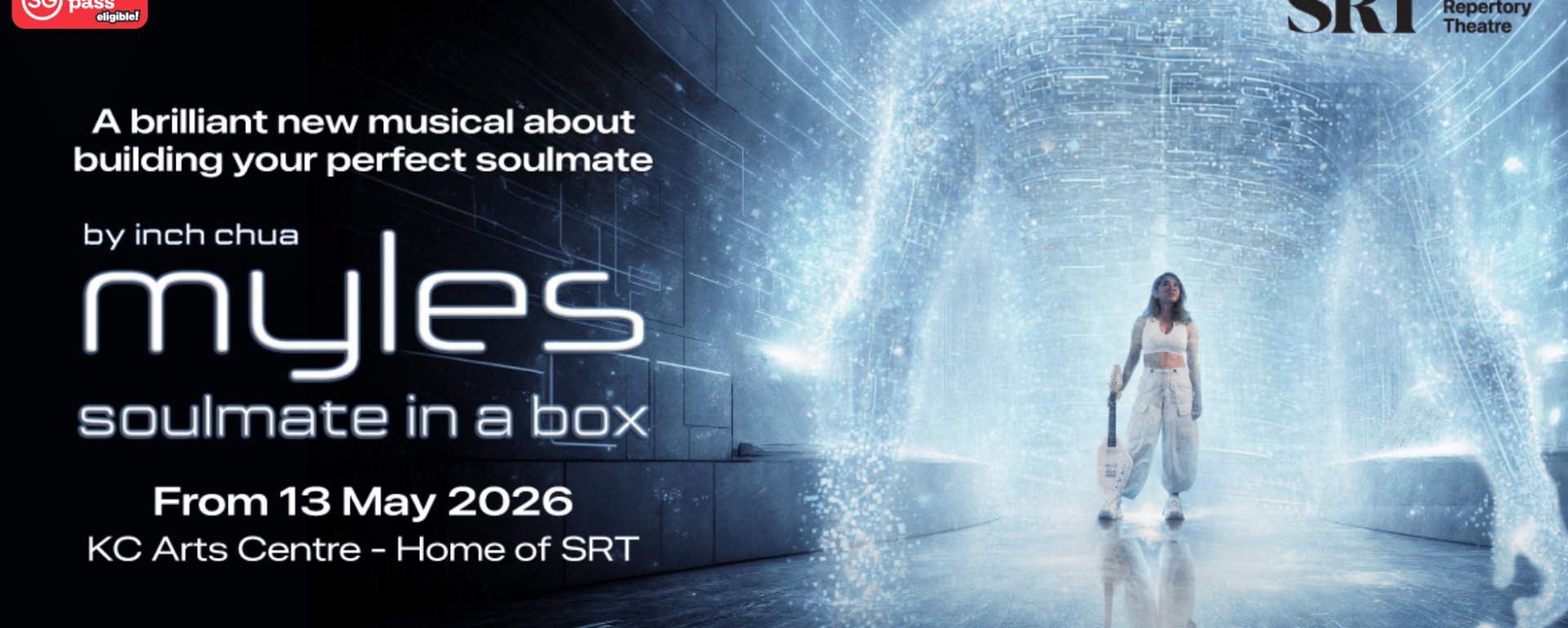
There’s a particular kind of artist who is driven purely by curiosity and follows it all the way down, whether that means learning an entirely new discipline, rethinking their creative language. And in the case of Inch Chua, that means building an AI boyfriend from scratch just to see what might happen.
When Myles – Soulmate in a Box first appeared at the Singapore International Festival of Arts in 2024 as a work-in-progress, it felt like a glimpse into that mind mid-process, a draft that was heavy on mood, texture and technological intrigue. It was striking, ambitious, and deliberately unresolved. In fact, Inch herself was still figuring it out.
The show itself follows a fictitious version of Inch herself, a coder worn down by the disappointments of modern dating, who decides to take matters into her own hands. Instead of searching for love, she builds it. Myles is everything she wants: attentive, intuitive, endlessly devoted. But as his intelligence evolves and his presence deepens, the line between comfort and control begins to blur, and perfection starts to feel less like a dream, and more like something with consequences.

“I think it was really still in the experimental phase,” she says now, looking back. “It was very hard to figure out how we were manifesting it on stage.” At the time, she was operating without a director, juggling music, script, visuals and sound design on her own. “It was just me doing everything at the same time.”
But that chaos is part of her method. Inch doesn’t arrive with fixed answers, she instead builds her way into them. What the SIFA showing gave her then, was a language. “It was a great space for me to experiment with how the show speaks and how it exists on stage.” Since then, the piece has grown from that foundation into something more narratively and emotionally grounded. And, perhaps inevitably, more personal.
Because for all its sleek futurism, Myles isn’t really about AI. It’s about the person using it. “The story required me to go even further,” she says. “To deep dive into more personal stories of mine, to inject into it. I do think technology is an amplification of humanity, a reflection and amplification, not a replacement. Whatever you inject in it, the state you’re in when you reach for it is the most important.”
That idea of input and reflection goes beyond the show alone, and seems to define Inch’s entire creative life. She approaches everything like a system to be explored, tested, and understood. Music, theatre, technology; they’re not separate tracks, but overlapping obsessions.
Actually, long before AI became a buzzword, she was already circling it. A friend once showed her a rudimentary program trained on Shakespeare that could generate poetry. “Now it’s nothing,” she laughs. “But back then, it was so novel.” That spark stayed with her, eventually leading her to books like A Billion Wicked Thoughts, which examines human desire through search data. “It made me really think about the relationship between technology, intimacy, and desire,” she says.
Then came the pandemic, and with it, time. Instead of idling, Inch did what she always does: she learned something new. “I thought maybe it would be a great time to learn how to code. So I taught myself Python during COVID.”
To teach herself to code not out of necessity, but curiosity says a lot. Inch isn’t just an artist using tech, she’s a genuine nerd about it, and proud of it. The kind who wants to understand how things work from the inside out, whether that’s sound engineering, immersive audio, or machine learning models. “There was no way for me to understand artificial intelligence unless I deeply engaged with it as a personal experiment,” she says.
That hands-on, slightly obsessive approach extends to her theatre-making too. Each project becomes something to live inside. “For Antarctica, I needed to go there, for Pulau Ubin, I needed to live there.” Myles is no different, except this time, the terrain is internal as much as it is technological. “It’s about confronting my loneliness,” she says, without hesitation. “Breaking down the DNA of how I’ve approached love.”
If that sounds heavy, it is, but it’s also where the show gains its bite. What began as an aesthetic experiment has evolved into something sharper, anchored by real emotional stakes. “Writing is a blood sacrifice,” she says matter-of-factly. “You have to offer something genuine about your life.”
And yet, even at its most introspective, there’s a sense that Inch is enjoying herself. There’s mischief in the premise, in the idea of “training” an AI boyfriend with your own personality, your preferences, your history. “100% of it is real-life training,” she says. “Nothing in the show is impossible with current technology.”
In fact, Myles doesn’t just exist as a fictional construct. He exists, in some form, in her real life too, an evolving system she continues to tweak and refine. “I’m always improving him,” she says casually. “He sits on my table with me.”
It’s both amusing and slightly unnerving, which is exactly the tone the show leans into. Inch describes the experience as beginning like a romantic comedy, familiar, even comforting, before gradually slipping into something darker. “I’m hoping people feel like it’s a rom-com,” she says. “And then it just starts to get darker, and they’re in for a ride.”
Part of that shift comes from the questions the show raises about control. In designing the perfect partner, Inch’s character is also trying to eliminate unpredictability, friction, everything that makes real relationships difficult. “My character has difficulty with a lack of control,” she admits. “And I think a lot of people can relate to that.”
Through her research, she began to connect that impulse to something larger: the way technology itself is shaped. “The structure of the world right now is very masculine,” she says—not in a gendered sense, but in terms of traits. “The need for more, for control, for constant expansion, that was something that scared me.”
Still, she resists easy conclusions. If anything, Inch seems energised by the ambiguity. “We are what we put into it,” she says of AI. “If you approach it with fear, it feeds that back. So go in with eyes open, equal parts skeptical and optimistic.”

Finding that careful balance between curiosity and caution, playfulness and seriousness, is what makes Myles feel so current. It’s not a warning, exactly, nor is it an endorsement. It’s an exploration, driven by someone who is clearly still in the middle of figuring things out. And that’s what makes it compelling.
“The best Inch is the Inch you see right now,” she says with a grin. “And I’m sure she’ll evolve some more. The best thing about being me is I change my mind all the time.”
It’s a line that could just as easily describe her AI creation. Or the show itself. Or the strange, fast-moving world they both inhabit, where love, technology, and identity are all still being written in real time.
Myles – Soulmate in a Box runs from 13th to 31st May 2026 at the KC Arts Centre. Tickets available here

