
Finding the shape of yearning through deconstructing a city and all the lives and stories within it.
What does it mean to belong, and what happens if that belonging is tied to a place that exists only in memory, imagination, or longing? Pulau Rindu, directed by Tan Shou Chen and presented as part of the NAFA Industry Project by Nanyang Academy of Fine Arts and Emergency Stairs, reaches for these questions with ambition, assembling a mosaic of moments that circle around identity, memory, and the idea of the city itself.
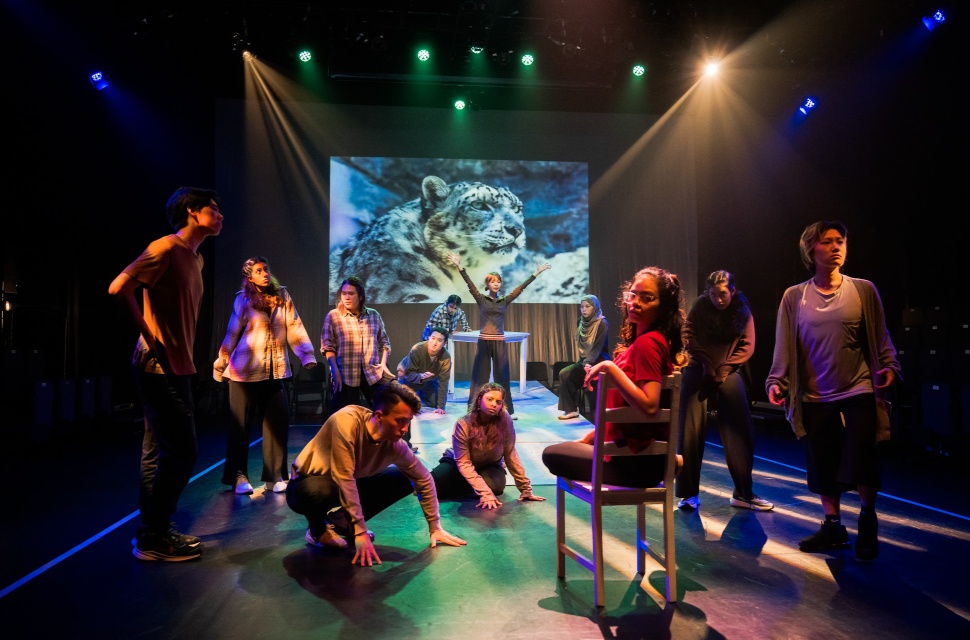
Framed loosely through a mythic opening, where a leader or king figure asking where, exactly, we are, the work situates itself in a kind of in-between space from the start. The stage, configured as a thrust with a white desk and chair atop an inclined slope, takes on multiple meanings: a platform, a hill, a site to gather and to declare. From here, the ensemble begins building their “city,” prioritising stories over narrative continuity, fragments of small, shifting scenes that attempt to hold together personal histories, multicultural identities, and inherited memory.
Inspired by Italo Calvino’s Invisible Cities, the production leans into abstraction, asking not what a city literally is, but what it feels like. Most of these allude heavily or directly reference Singapore, in its rhythms, its shared references, its tensions and its locales. But the piece sometimes stretches beyond its grasp, reaching into broader reflections on ideal cities and their relationship with war and displacement. In these moments, the work risks losing its footing, and the further it moves from the specificity of lived experience, the more diffused it becomes.

Where Pulau Rindu resonates most strongly is in its more personal, grounded scenes. Recollections of a trip to Yogyakarta, as three performers sit around and talk, for instance, land with a sense of intimacy and introspection that feels genuinely earned. These moments allow the performers to speak plainly, without the weight of theatrical “performance,” and it is here that the work breathes. This trip is echoed again later on, when the ensemble comes together to talk about anxieties over being a theatre student and their own struggles with self-worth and mental health, though this is subverted somewhat by how all of them perform Beyonce’s iconic Single Ladies choreography, completely anachronistic with their generation and recency, when referencing a dance taught in Jogja.
Individually, certain performers manage to carve out distinct presences. Zorian Seah stands out for the grounded confidence of his delivery, particularly in his final monologue, where his voice feels anchored in something personal rather than performed. Julien Kerk, with an androgynous vocal and physical quality, brings a compelling fluidity to their roles, moving between vulnerability and transformation, especially in moments dealing with desire, heartbreak, and later, when they play a wartime grandmother, allowing what would have been a naturalistic role to become more surreal. These glimpses suggest performers in the process of discovering where their strengths lie, and to watch for as they grow and enter the industry.
The ensemble as a whole occasionally feels caught between modes of performance and sincerity. There is a tendency, particularly in more declarative or politically charged passages, for delivery to slip into a heightened “stage” register that distances rather than draws in. When the work touches on larger issues, such as war, ethnic conflict, global displacement, it can feel as though it is reaching beyond its immediate, lived vocabulary, diluting the impact of what might otherwise be more sharply observed.

As a student production, this tension between sincerity and performativity becomes especially visible.There are sequences of choreographed movement, most notably a lengthy, physically-strenuous scenes where they all skip and jump constantly, that feel more imposed than embodied. While they gesture toward shared cultural memory (perhaps echoing the Great Singapore Workout), they occasionally lack the precision or commitment needed to fully land, leaving the performers visibly strained when they collapse without a corresponding dramatic or symbolic payoff in their breathing. Similarly, some of the more stylised or comedic monologues, like an extended reflection involving a snow leopard, struggle under the weight of delivery, revealing the difficulty of navigating tone and control. It is often only when the ensemble manages to drop the heightened physicality and “stage” accents, a different kind of clarity emerges, one rooted in sincerity rather than forced presentation.
But there are also flashes where everything aligns. A club scene stands out for its atmosphere, brought to life through tubthumping rave beats, and dynamic lighting by Emanorwatty Saleh that transforms the stage into something pulsing and alive, while the ensemble let go of everything, disappearing into the moment. All this, while Mohamed Khalifah’s character agonizes over the strange limbo between faith and sexuality, as he is asked by his same-sex date to attend evening prayers, a ritual he’s long left behind, heightening the drama of the anecdote. Elsewhere, Meng Jiaoyang’s soundscape sees immersive snatches of city noise, birdsong and traffic, and we can swear for a moment we’re outdoors – sometimes it is these non-verbal cues that speak more than the dialogue itself. What keeps it anchored is how Pulau Rindu carries a clear sense of intent. It is, at heart, a work about theatre-making as much as it is about cities, a process of excavation, of assembling fragments, of testing what stories matter and how they can be told.

Under the guidance of such a project, we are privy to a transition from student to practitioner, in a space where experimentation is not only allowed, but necessary. If the piece feels sprawling, it is perhaps because its scope and ambition is sometimes too wide. But within that sprawl are moments of honesty that point toward something more focused, more precise, and ultimately more affecting. When the performers speak from a place of lived experience, rather than from the idea of what theatre should look or sound like, the work finds its centre.
Pulau Rindu may not fully cohere, but it reveals a group of young artists in the midst of figuring out what they want to say, and how they want to say it. In that process of searching, of yearning, it reflects the very idea embedded in its name: a longing not just for place, but for voice, form, and meaning. The final image, where the ensemble gathers into a writhing, collective mass, is particularly striking, a fleeting embodiment of Italo Calvino’s vision of cities as living accumulations of bodies, memories, and movement. As soft light slowly settles over them, the work arrives at a thought – that the city extends beyond fixed identities of race or religion, existing instead as a shifting spectrum of lived experiences. When the lights finally crawl to a fade, it feels less like an ending than a return, to something interior, unresolved, and still in the process of becoming.
Photo credit: Memphis West Pictures/Joe Nair
Pulau Rindu played from 30th April to 3rd May 2026 at the NAFA Studio Theatre. More information available here
Production Credits
| Director Tan Shou Chen Artistic Director/Producer Liu Xiaoyi Co-Producer/Graphic Designer Huang Suhuai Production Manager Victoria Anna Wong Stage Managers Voon Yueqi Lighting Designer Emanorwatty Saleh Sound Designer Meng Jiaoyang (Intern) Multimedia Design Assistant Zhu Xuanru (Intern) Project Coordinator Ho Yan Xi (Intern) Production Assistant Nurul Hanna Daud Performers Athirah, Xueya, Gio, Jovan Chiang, Julien Kerk, Mohamed Khalifah, Soumya, Nisha Kaur, Khalisa Khairullah, Priyanka, Ruqaiyah, Zorian Seah |

