
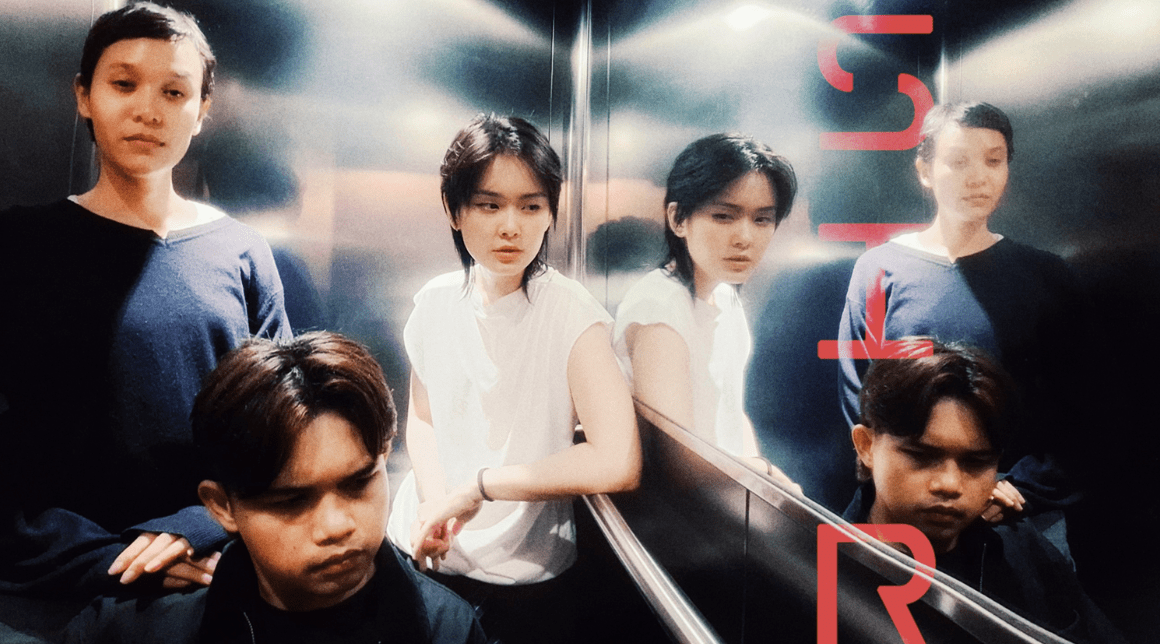

Ridhwan Saidi crafts a haunting, cosmic space drama about androids to remind us what it means to be human.
Ridhwan Saidi’s Teater Normcore: Odisi Romansa begins with surveillance. Before the theatre fully settles into darkness, before language and philosophy take over the stage, a grainy video emerges onscreen like recovered memory. Through the detached gaze of a CCTV camera, we follow a man and woman wandering through city streets while they were still human. The framing is observational, almost intrusive, quietly evoking the unease of being watched while simultaneously preserving intimacy. They laugh. They roam. They exist in the ordinary rhythms of life. Around them, the soundscape hums with astonishing detail: crickets, distant traffic, the rustle of trees, the pulse of the city bleeding into the wilderness. It feels as though we are suspended somewhere between the jungle and an urban dreamscape, lost in memory alongside them.

The production’s premise is deceptively simple yet emotionally expansive. Set in a future where humanity has vanished entirely, Odisi Romansa follows two androids, Z-001 and Y-002, who inherit fragments of memory left behind by their human creators. Existing within a lonely server facility while drifting further apart across the cosmos, the androids attempt to reconstruct what it means to feel, to remember, and ultimately to be human. One journeys toward the ancient gravitational core of the Milky Way while the other searches for refuge beyond Earth, their separation stretching across impossible distances and timelines. What emerges is less a conventional science-fiction narrative than an existential meditation on longing, memory, and the terrifying vastness of time itself.

What makes the opening so effective is how natural it feels. Ridhwan resists theatrical exaggeration, instead allowing silence, pacing, and environmental sound to shape the emotional atmosphere. When the couple pauses to take a selfie, the scene suddenly falls quiet. Skin touches skin. The camera lingers. The videography becomes unexpectedly tender and graphic at once, capturing closeness in a way that feels deeply human. Then, almost abruptly, the production pivots. The world as we know it is gone. Humanity has vanished. In their place remain two androids attempting to reconstruct the meaning of human existence from fragments of memory and archived feeling.

From there, Odisi Romansa unfolds as both a science-fiction odyssey and an existential meditation. The androids are not emotionless machines in the conventional sense. Instead, they exist in a liminal emotional state, constantly circling around the idea of feeling without ever fully understanding it. One is optimistic, yearning toward connection and warmth; the other is more pessimistic, uncertain whether existence itself carries meaning. Their conversations become philosophical without losing emotional texture. At one point, an android remarks that unlike humans, “we do not sleep and we do not wear masks,” a deceptively simple line that lands with startling force. In a play obsessed with what separates humans from machines, it is often the smallest observations that resonate the loudest.

The writing itself remains one of the production’s greatest strengths. Ridhwan has always possessed an instinct for poetic language, but here the dialogue feels especially expansive, almost cosmic in its reach. “I am the sea and you are the sun,” one android says, and the line hangs beautifully in the darkness. The production understands that poetry is not merely decorative—it becomes architecture. The words themselves build the emotional universe of the play. Questions surrounding memory, longing, and grief ripple through the script continuously. Is the androids’ desire for connection simply another form of battery consumption? Is love just another system sustaining survival? Can remembrance itself become a way of meeting someone again?

Visually, the production slowly transforms into something breathtaking. Midway through the play, as a countdown begins and an unexpectedly upbeat track pulses through the theatre, the stage opens up with remarkable effect. A screen lifts to reveal an immense wide space that suddenly captures the terrifying beauty of outer space. It is one of the production’s most striking moments. The stage expands into the cosmos itself, leaving the androids floating toward the Milky Way while screens and projections transform the theatre into the interior of a drifting spacecraft. Ridhwan avoids relying on sheer spectacle; instead, the scenography creates atmosphere and scale through suggestion, light, and rhythm. The effect is immersive without becoming overwhelming.

What follows is perhaps the play’s strongest section: a meditation on time and distance in the digital age. “The farther you are from Earth, the longer the messages take to reach us,” one character says, a line that immediately reframes communication as something fragile and terrifying. A photograph of Uranus, sent across galaxies, takes 45 days to arrive. A video message becomes outdated the moment it is received. Emotion no longer exists in real time; by the time love reaches another person, it has already become memory. The play handles these ideas with remarkable emotional clarity. Even as it explores futuristic concepts like firmware updates and machine learning, its anxieties feel deeply contemporary. One android urges another to update his system, insisting the new software will solve everything, while another warning arrives later telling him not to trust the update at all. Conflict erupts between “purist” androids and more humanised ones, and suddenly the language of technology begins to mirror the language of ideology, war, and radicalisation. Gunshots, screams, and cries echo through the theatre in one particularly chilling sequence, sounding painfully familiar to modern ears.

Yet even at its most philosophical, Odisi Romansa never loses sight of emotional intimacy. The production continually returns to the memory of sensation; the warmth of an embrace, the slowness of handwritten words, the ache of waiting. One of the play’s most affecting ideas emerges when the android realises that sending a video message across space means the emotion attached to it can never truly be immediate. By the time it arrives, it belongs to the past. The production asks repeatedly: how do humans survive the burden of memory? How do we continue carrying love once it has already ended?

The latter half of the play becomes increasingly abstract and surreal, though not always entirely coherent. As one android approaches a supermassive black hole and eventually encounters a towering cosmic entity resembling a dragon, the production plunges fully into metaphysical territory. A distorted computer voice begins interrogating the android’s growing humanity, referencing religious and philosophical narratives such as Al-Khidr and Abraham. These sections occasionally risk becoming overly opaque, but they remain visually compelling. Giant puppetry, distorted faces, fragmented projections, and collapsing bodies transform the stage into the inside of a dying consciousness. When the android finally asks for his memories to be erased, the entire room seems to collapse alongside him, as though the audience itself has been trapped inside his fading mind.

Still, the production ultimately finds its emotional grounding again in its final moments. After all the chaos and cosmic destruction, silence returns. A lone girl sits with a pen and notebook, preparing to write. Around her, a new world quietly emerges: sunlight, plants, possibility. It is here that Odisi Romansa arrives at its most profound insight. In a future dominated by technology and total archival memory, the act of physically writing something down becomes radical again. Writing slows thought. It fills the empty spaces of life. It records history not to rewrite it, but to understand it.

As the final soundscape settles over the theatre, earthly, reflective, almost mournful, Odisi Romansa leaves behind less a conclusion than a feeling. Ridhwan Saidi has long excelled at bringing together theatre, film, literature, music, and visual installation into a singular experience, but this production feels especially close to his purest artistic form. It is ambitious without becoming self-important, emotionally resonant without collapsing into sentimentality, and visually daring while remaining deeply human at its core.

More than anything, Teater Normcore: Odisi Romansa understands that science fiction has never really been about the future. It has always been about the present, our fears, our loneliness, our dependence on technology, and our desperate attempts to preserve warmth in a world increasingly shaped by distance. By the end of this short odyssey through memory and oblivion, the play quietly returns us to Earth with renewed awareness of what it means to be alive.
Photo Credit: Moka Mocha Ink
Teater Normcore: Odisi Romansa runs from 8th to 17th May 2026 at Black Box, Damansara Performing Arts Centre (DPAC). Tickets are available via CloudJoi
 Bakchormeeboy