
This May, Richard Koh Fine Art (Singapore) presents the body improper, the first solo exhibition by Siew Guang Hong with the gallery. Bringing together 19 works across expanded photography, sculptural print, and performance, the exhibition unfolds as a sustained investigation into the body not as a fixed biological unit, but as something continually assembled, destabilised, and re-projected through ecological and conceptual systems.
Across the exhibition, the body is stretched, fragmented, and reconstituted into forms that oscillate between recognition and estrangement. Drawing from biological structures, animal morphology, and performative gesture, Guang Hong reconfigures the human figure into mutable states, where anatomy becomes surface, organism, and image simultaneously.

Central to this project is a persistent question: what does it mean for a body to be “proper” at all? For Guang Hong, this question is not abstract. It is rooted in both lived experience and artistic positioning. “When I started thinking about where I wanted to place myself in Singapore’s art scene, especially as a gay artist wanting to work within a queer context, I was asking: what hasn’t been done as much, and where can I find myself in it?” he muses.
Rather than turning to familiar frameworks of identity representation, he turns instead to biology, specifically, its unstable boundaries between species, classification, and perception. “I think one of the reasons I started going into biology is because I was interested in what I could make my practice become,” he says. “And queer ecology was one of those avenues.”
What emerges is a structural analogy to nature: bodies as ecosystems, identities as shifting assemblages, and perception as an unstable act of categorisation. Guang Hong’s interest in ecological thinking begins early, shaped by encounters with animals that destabilised how he understood relations itself. “Growing up, I was always super interested in animals. There were moments where experiences with animals changed how I understood other people,” he says.

These encounters emerged through moments of discomfort, curiosity, and ethical ambiguity. “I was in a seafood restaurant and saw crabs in a tank. I started thinking, what would happen if I ate the mummy crab? That kind of thought made me start seeing animals as queer objects.”
In this framing, “queer” is not simply a reference to sexuality, but a mode of relational instability where categories of life, agency, and perception fail to hold neatly. “We see dogs and cats and think, oh, they’re like us. But other animals are not treated the same way. That made me think about how society decides who gets recognised as having feeling, and who doesn’t,” he explains.
This logic extends into the visual language of the body improper, where human body fragments are reassembled into forms that resemble insects, marine life, or botanical systems, only to be revealed, upon closer inspection, as constructed from the artist’s own body.

Works such as orchid: courting and second birth operate through a deliberate strategy of misrecognition. From a distance, they appear to depict non-human organisms; up close, they collapse back into fragmented images of hands, feet, and bodily surfaces.
For Guang Hong, this oscillation is not simply visual play, but a critique of how knowledge itself is structured. “There’s a post-colonial critique there. A lot of these animals were first catalogued through colonial systems such as taxonomy, classification, and documentation. Even today, there’s still this urge to fully define and understand everything.”
The work then resists this urge by destabilising the very legibility of its subjects. “When the work looks like scientific imagery but turns out to be something else, it disrupts the idea that bodies can be neatly categorised.” But alongside this historical critique sits another layer that is deeply personal and queer. “There’s also a queer register, like straight acting. The idea of appearing one way in order to survive.”
This logic is further elaborated through his reading of botanical mimicry and sexual ambiguity in nature. “Orchid fronting is about how the orchid appears female to attract insects, but its etymology is actually linked to testicles. So it becomes this strange crossing of appearing female but being male.” The tension between appearance and essence becomes a recurring structural principle in his work. “It’s the unholy marriage of things that are supposed to be separate.”

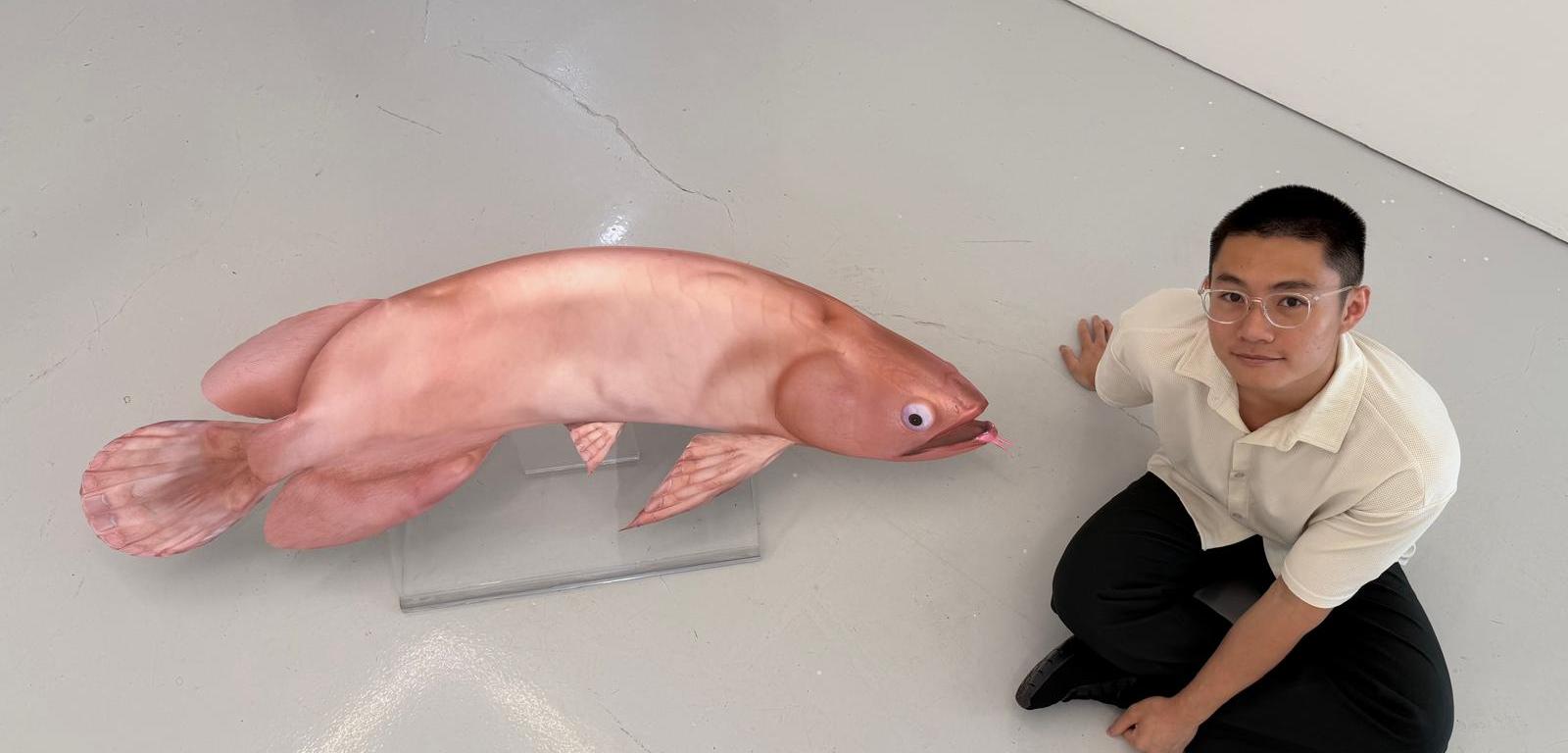
While Guang Hong’s practice often reads as theoretical, it is deeply anchored in autobiographical reference. His works frequently emerge from personal histories involving specific animals and familial memory. “My subject matter is very tied to autobiography. There are works in the exhibition that come directly from animals that were part of my life.”
He offers concrete examples that ground the exhibition’s conceptual density in lived experience. “There’s an arowana work because my father kept arowana when I was growing up. There’s a frog work because that was the first animal I ever released into the wild.”

These autobiographical fragments are not illustrative; they function as nodes within a larger ecological system of meaning. “The concepts tie that autobiography to how people are positioned politically. I don’t think it can be split evenly. It’s always mixed.”
This refusal of separation extends to authorship itself. For the body improper, Guang Hong deliberately shifts part of his theoretical articulation into narrative form through collaboration with writer Moses Tan. “When I wrote for another show, I deliberately moved away from theory. I knew what my practice usually feels like, and I wanted this one to be different,” he says. “I asked Moses Tan to write it because he writes autotheoretically; he uses stories, and the works themselves are ultimately autobiographical.”
The result is a layered structure of interpretation: theory embedded within story, and story functioning as another entry point into theory. “When people go through the exhibition materials, they still see the theoretical underpinnings, but the primary text is more narrative-driven.”

What the body improper truly wants to do is craft a sustained interrogation of what counts as “natural” in the construction of bodies and identities. “It’s not about body image. It’s about what we think a body is supposed to be.”
This question originates from childhood experiences of normativity, particularly surrounding queerness. “Growing up queer, I kept asking: is this natural or not natural? Why is it weird for people to be gay?” That question expands outward into a broader critique of how social systems regulate difference. “A lot of my work comes from that idea of what is natural or what is not natural, and who gets to decide that.”
Within the body improper, bodies are not presented as coherent entities, but as unstable configurations subject to fragmentation and reassembly. “The body is always split, fragmented, reassembled. It’s about how ideas of ‘properness’ are used to control difference.”

Guang Hong’s practice moves fluidly between image and object, refusing to stabilise either category. The exhibition’s expanded photographic works exist alongside sculptural prints and durational performance, each informing the other. “My work is concept-driven, but images are intuitive for me because of how we consume the world now through screens, constantly.”
Yet objects introduce another register of meaning: physicality, possession, and circulation. “Objects are about commodity. Things you can hold, bring back.” Still, he resists any strict separation between the two. “I don’t think there’s a pure conceptual or material practice anymore. They inform each other.”

Instead, he frames his practice through the idea of contingency where meaning shifts depending on context, relation, and encounter. “One of the main strategies I use is contingency. Contemporary art today is not self-contained anymore, and its meaning and significance depends on context, on who is looking, on when it is seen.”
This includes the presence or absence of the artist himself. “The work can exist differently depending on whether people know me or not. It can be singular, or it can become something else in relation.”
But he is careful not to position intimacy with the artist as a requirement for understanding. “It’s not that people lose out if they don’t know me. The work still stands on its own. But it can also expand when more context is present,” he says. “Many parts make the whole. But each part still exists as a part.”

Performance in Guang Hong’s practice is where these conceptual tensions become physically immediate. In works such as Medusan Pink, the artist uses chroma key suits in public spaces to oscillate between visibility and disappearance. “Performance is immediate, people see the body, but they don’t always know what it’s doing. So they interpret it differently.”
Visibility, rather than being empowering, becomes unstable and politically loaded. “Visibility is supposed to be positive today. But it also freezes identity in place.” This ambiguity opens multiple readings, where it could be seen as exposure, concealment, and/or endurance. “People might see it as hiding, or as exposure, or as survival. It depends on their own experience.”

His durational works extend this into sustained bodily labour. One such piece, i have gone, involves repeated gestures of presence and erasure. “Across six hours, I stick the phrase ‘I am here’ around the gallery, while another performer removes it.”
The work becomes cyclical rather than accumulative. “It’s about how queer bodies constantly have to reassert their existence. The ‘I’ and the ‘here’ are always being negotiated. There’s queer fatigue. The constant need to survive in spaces that are not structured for you.”
Even disappearance becomes part of survival logic. “When the stickers are removed, it’s also about disappearance and about not being captured in official narratives.”

Across the body improper and earlier works such as in leaking fishtank last year, duration becomes a method of revealing hidden structures of labour and attention. “When you repeat something long enough, you notice things happening in your body: pain, drifting, exhaustion.”
These bodily shifts mirror broader social conditions. “These are the same things people go through every day, but don’t always notice.” Audience reception is also part of the work’s conceptual field. “People don’t watch durational performances fully. That reflects how attention works now.”
And this absence becomes politically resonant: “It also reflects how we fail to pay attention to people who are left out.”

Ultimately, the body improper is structured not as a sequence of individual works, but as an interdependent system. “Everything exists in ecology. The works are placed in relation to each other. Size, distance, positioning, all of it matters. The body isn’t self-sustaining. It relies on an ecology of things.”
This ecological thinking extends to interpretation itself. “The meaning is often uncertainty. Certainty is often false, or even violent.” Instead, the exhibition proposes an alternative epistemology, one that allows for partial knowledge, relational understanding, and non-totalising perception. “You don’t need to fully know everything to live with it.”
Photos courtesy of the artist
the body improper runs from 16th May to 13th June 2026 at Richard Koh Fine Arts. More information available here

