
A distinctly Singaporean fable about about faith and modern spirituality that buries its strongest ideas beneath flat humour and an ending that feels rushed.
Few recent local productions have started with a premise as immediately striking as Toy Factory’s Master White Dragon: an ah beng mistaken for the reincarnation of a temple deity, caught between street hustling, spiritual performance and a journalist intent on exposing him as a fraud. Set in the real-life Sembawang Temple, the play positions itself as a broad comedy rooted in folklore and modern chaos, but it opens onto richer terrain, with Chinese spirituality, mediated belief, and the contradictions of contemporary Singaporean identity thrown into the mix.
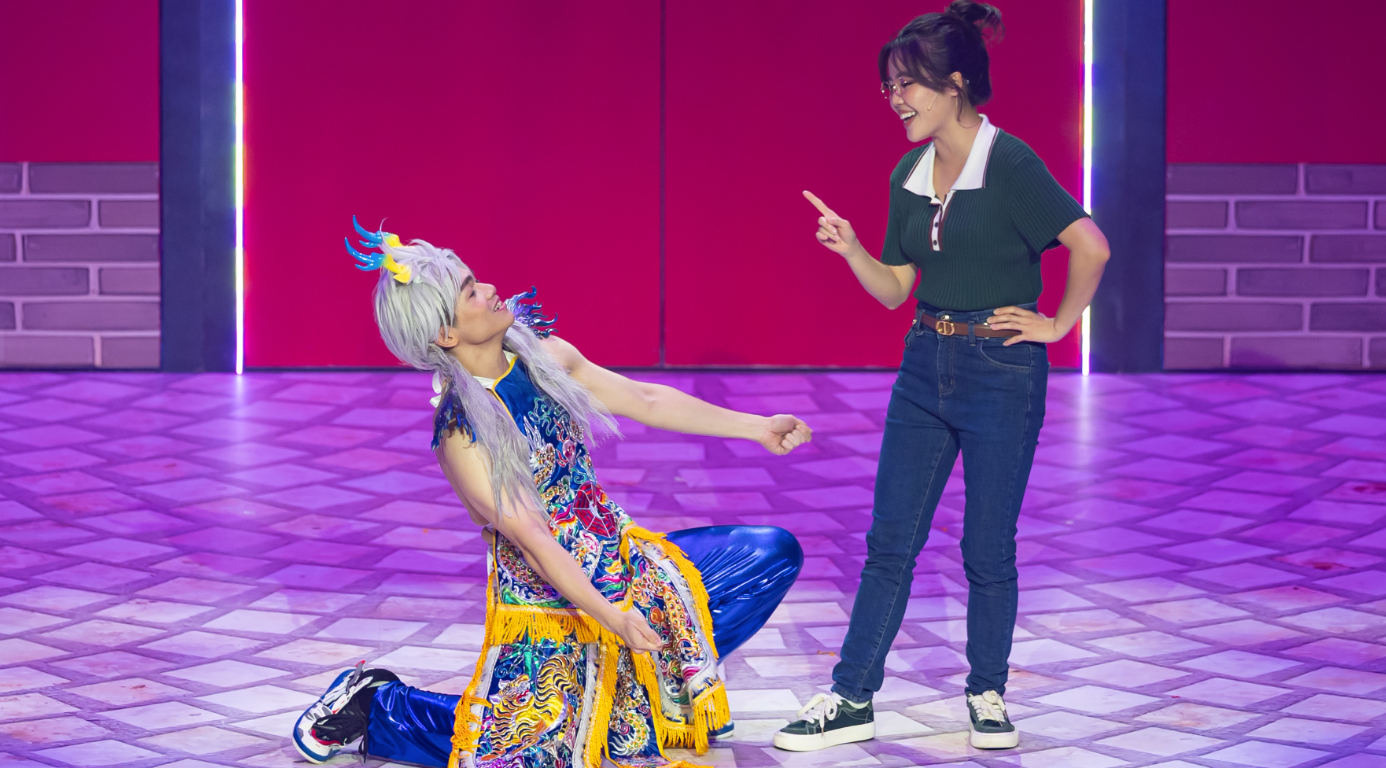
Directed by Goh Boon Teck and written by Titus Hutch Jr., the story follows Ding Zai (Zhuang Chu Hang), a down-on-his-luck DJ who accidentally becomes the new “White Dragon Prince” after the temple’s previous tang-ki (Benjamin Koh) dies under absurd circumstances. Opposite him is Zhen Zhen (Seah Janice), a journalist determined to expose the temple as fraudulent after her mother’s death reshapes her relationship with faith. What begins as confrontation gradually drifts into uneasy complicity as both are drawn deeper into the lives of the temple’s devotees.

Beneath its surface chaos, the world of Master White Dragon feels distinctly Singaporean, where belief systems, commerce, performance and survival constantly blur. It is in this tension that the production finds its most compelling possibilities, even if it does not always know how to sustain them. In particular, the figure of Ding Zai, someone who is vulgar, opportunistic, yet strangely earnest, feels recognisable in a specifically local way, and the play’s interest in Chinese folk religion gives it a texture rarely explored on Singapore stages.
Unfortunately, the production never fully trusts those ideas enough to sit with them. Instead, the script constantly pushes itself toward crowd-pleasing comedy, stuffing scenes with puns, malapropisms, bad accents, song interludes and exaggerated punchlines that often run themselves into the ground. Almost every emotional beat is immediately undercut by another joke. A sequence where Ding Zai attempts to invoke the dragon spirit stretches from a Monkey God impersonation to Bruce Lee (“Li Xiao Long”) to an extended gag involving ex-Prime Minister Lee Hsien Loong, a joke that perhaps lands once, but is pushed so insistently you groan rather than finding it funny.

This becomes especially frustrating because the production itself is often charming. Lu Tong’s set design evokes a storybook-like version of Singapore, blending images of Sembawang Temple and the iconic Tong Ah Eating House into a tactile environment that feels refreshingly physical in an era dominated by projections. Revolving walls and hidden sections allow scenes to shift fluidly between temple grounds and office interiors, lending the production an old-school theatrical warmth that suits its folkloric tone.
The music, designed by Wilson Tay, similarly leans into recognisable ah beng and karaoke sensibilities, remixing familiar tunes with pounding techno beats in ways that are occasionally ridiculous but undeniably memorable. Ian Wang’s costumes are strongest in how he crafts the elaborate tang-ki attire worn by Ding Zai and the previous White Dragon medium.
Yet the show repeatedly undermines its own production values through deliberately cheap-looking props and overplayed comic staging. Horse races are represented by ensemble members wearing horse masks; and loan sharks appear with a paper pig-head cutout and chains that constantly fall apart. Whether intentionally low budget or not, these choices contribute to a production that often feels desperate to prove how funny it is, even at the expense of emotional or dramatic coherence.

The biggest casualty of this approach is the narrative itself. Despite running close to two hours without intermission, the play feels oddly overcrowded, juggling too many subplots while neglecting the emotional core established at the start. There are compelling story threads scattered throughout, such as a gambling addict searching for the lucky numbers to end his losing streak, a joss-stick seller torn between migration and caregiving, a study mama from China pressuring her daughter toward academic success instead of her dreams of stardom, but the script rarely develops them beyond plot mechanics.
By the final act, the show begins spiralling in multiple directions at once: exposé journalism, attempted suicide, political satire, supernatural visions and an abrupt election campaign all collide in a climax that feels startlingly rushed. Ding Zai’s sudden pivot toward running for political office arrives so late and so abruptly that the ending feels less earned than hastily assembled, as though the production itself is unsure how to conclude the many ideas it introduces. The romance subplot between Ding Zai and Zhen Zhen fares no better, emerging with little emotional grounding and contributing to the sense that the play is constantly moving before its relationships or themes have time to deepen, feeling shoehorned rather than organically crafted.
What keeps the play afloat and cohesive enough is the fantastic cast, who remains committed throughout, and that energy does a great deal to hold the production together. Many performers are relatively new to the industry, several still students, and there is something admirable about the sheer enthusiasm they bring to the stage. Zhuang Chu Hang gives Ding Zai an endearing scrappiness, while Seah Janice balances cynicism and vulnerability effectively as Zhen Zhen. Lumi Wang, as the study mama, is impressive for how ferocious and annoying she can be when suspicious of Ding Zai and the temple, but manages to wring out the emotion when she shares a tender moment with her daughter. Even when the jokes fail, the ensemble’s sincerity keeps the production watchable.

Master White Dragon ultimately is a frustrating watch, not for lack of ideas, but a lack of discipline in holding them. The production is at its strongest when it lingers in ambiguity, when faith is neither mocked nor affirmed, and when its characters are allowed to exist in moral grey zones rather than narrative resolution. Yet it repeatedly retreats into escalation, noise and overstatement instead of trusting that restraint, attempting to present Chinese heritage as ‘accessible’, energetic and recognisably “local” seems to encourage constant stimulation over clarity, and familiarity over deeper narrative focus.
Still, there is something valuable in seeing a large-scale local staging willing to engage with temple culture, language-based humour and everyday Singaporean archetypes without irony or distance. Master White Dragon is powered by undeniable energy and the commitment of its cast, but it never fully resolves whether it wants to interrogate belief, affirm it, or simply mine it for entertainment. In the end, what lingers is the impression of a work that might have been sharper, quieter and more assured if it had more faith and trusted its own ideas a little more.
Photo Credit: Singapore Chinese Cultural Centre
Master White Dragon runs from 9th to 17th May 2026 at the Singapore Chinese Cultural Centre. Tickets available from SISTIC
Cultural Extravaganza 2026 runs from 7th May to 7th June 2026 at the Singapore Chinese Cultural Centre. More information and tickets available here
Production Credits
| Director Goh Boon Teck Playwright Titus Hutch Jr. Cast Zhuang Chu Hang, Seah Janice, Liew Li Ting, Wang Lu Kerr (Lumi), Wayne Lm, Benjamin Koh, Hoe Wei Qi, Wang Bo, Chua Vin Lin, Lin Jing, Zhou Qianhui, Tay Qingxin, Chang Xiya, Mikaela Tan Ke Ni, Yin Isabel Beier, Chen Yanlin, Yu Gina, Chen Junyi, Hai Qin Ilysse Cher, Yang Erica, Li Yuemuzi Set Designer & Props Master Lu Tong Lighting Designer Tai Zi Feng Music Designer Wilson Tay Sound Designer & Sound Engineer Rebecca Tan Costume Designer Ian Wang Hair & Makeup Designer / Team Zennie Cassan, Jaime Tan Jean Zhu, Janet Tan Choreographers Seah Janice, Wang Lu Kerr (Lumi) Production Manager Victoria Ann Wong Stage Manager Gillian Ong Assistant Stage Manager Sharlene Lim Assistant Stage Manager Zai Wardrobe Manager Tan Jia Hui Dresser Rilla Djono Dresser Lynn Chang Script Translator & Surtitles Editor Titus Hutch Jr Surtitles Operator Dawn Lee Programme Booklet Editor Quek Yee Kiat |

