
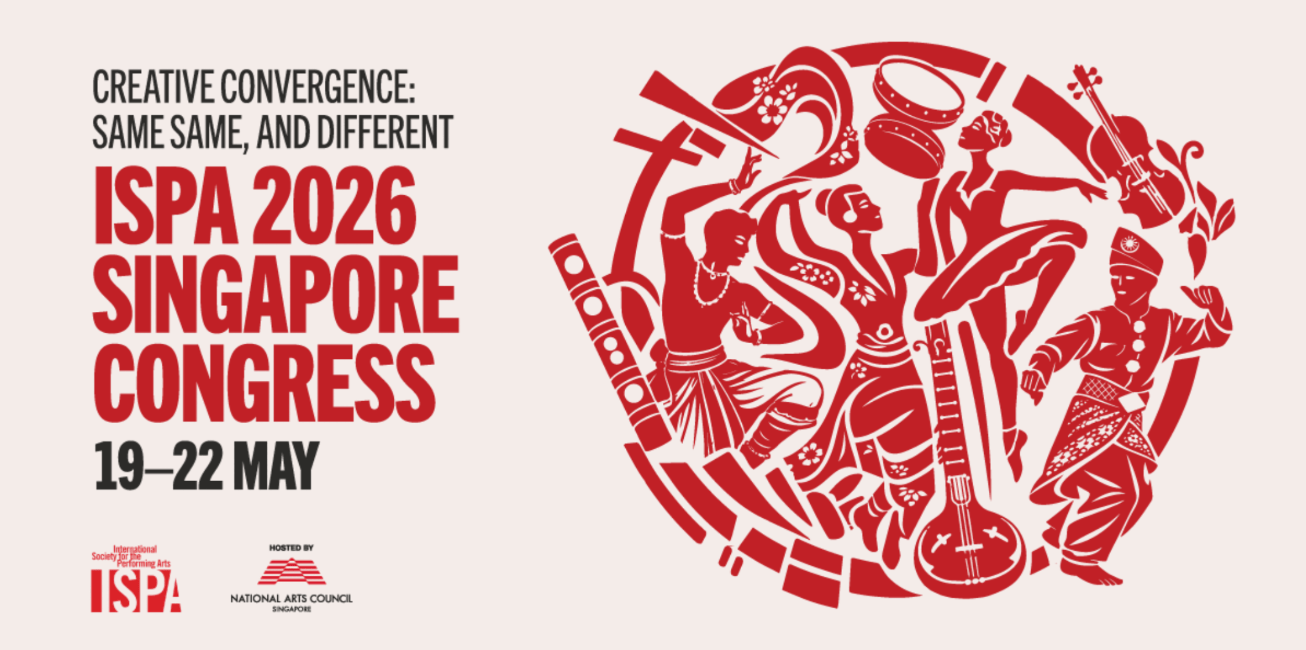

Singapore’s arts scene stepped into the international spotlight this week as more than 400 performing arts leaders from over 40 countries arrived for the International Society for the Performing Arts (ISPA) 2026 Singapore Congress, the first time the global gathering has returned to Southeast Asia in more than two decades.
Held from 19 to 22 May and hosted by the National Arts Council, the Congress brings together artists, policymakers, producers and cultural leaders for four days of dialogue, collaboration and performances across the city.
Opening the Congress at the Esplanade Singtel Waterfront Theatre were President Tharman Shanmugaratnam and Acting Minister for Culture, Community and Youth David Neo, alongside ISPA leaders and Singapore arts representatives.
Themed “Creative Convergence: Same Same, And Different”, the Congress explores how cultures can remain distinct while still finding common ground through artistic exchange, an idea deeply rooted in Southeast Asia’s multicultural identity.
“Singapore’s cultural and creative diversity positions us as a vibrant node for artistic exchange. The arts serve as a bridge and we are proud to convene global performing arts leaders in Singapore for ISPA, where voices converge, and artists collaborate,” said Mrs Elaine Ng, Chief Executive Officer of the National Arts Council.

For Ms Goh Swee Chen, Chair of the National Arts Council, hosting ISPA in Singapore reflects something far larger than a milestone event. “Hosting ISPA in Singapore is more than a milestone; it reflects our conviction that the arts are vital to every global city. Not a nice to have, but a force that shapes our society and powers our creative economy,” she said in her opening address.
Against a backdrop of increasing global division and social fragmentation, many speakers returned to the role the arts can play in rebuilding connection and trust. “The world feels more divided than it has been in a long time. Conversations are harder. Trust is thinner,” Ms Goh observed. “This is where the arts do something quietly wonderful. They give us a way to sit with people we don’t always agree with, to feel something together, to see the person, not the position.”
President Tharman Shanmugaratnam echoed those sentiments in a wide-ranging speech about multiculturalism, identity and the future of artistic collaboration. “The arts play a particularly important role. They allow us to encounter one another not as categories, but as people with histories, emotions, aspirations, and different ways of seeing the world,” he said. “The arts hence both expose us to differences, and allow us to explore what we have in common. ‘Different, but same, same’. They give us the shared experiences that take us to the core of who we are as human beings.”

Throughout the Congress, delegates will experience performances that reflect Singapore’s layered cultural identity and cross-disciplinary experimentation.
Highlights include KRIYA, a collaborative showcase weaving together Chinese, Western and Malay influences; Janji Kita: Echoes of Our Land by Nadi Singapura; and Convergence: Nanyin x Asli by Siong Leng Musical Association, which brings together the vocal traditions of Nanyin and Asli music.
Other featured works include The Long Now by Litmus Jazz Ensemble and choreographer Gin Lam, as well as Bridges in Motion, a Singapore-Malaysia collaboration celebrating artistic diplomacy.
Delegates will also explore Singapore’s arts districts through artist-led Open City walking tours across Goodman Arts Centre, Stamford Arts Centre, the Waterloo Arts Belt, Aliwal Arts Centre and Kampong Gelam.
“Our team has curated a program that showcase the vibrancy of our arts scene,” Ms Goh said. “And do try our chilli crab, messy hands, shared plates, a bit of a workout. It might be the most Singaporean way to get to know someone.”

One of the Congress’ biggest announcements was the launch of the new $20 million Multicultural Arts Programme (MAP) Grant, which opens for applications on 15 July 2026.
Seeded by the President’s Challenge and the Ministry of Culture, Community and Youth, the grant aims to support multicultural artistic works, regional collaborations and ecosystem-building initiatives rooted in Singapore’s identity.
Artists and organisations can apply under two categories:
- Productions, with funding of up to $500,000 for the creation and presentation of multicultural works, including international co-creations.
- Ecosystem Development, offering up to $300,000 for initiatives such as residencies, fellowships, festivals, research projects and incubation labs.
President Tharman described the grant as part of Singapore’s broader effort to actively nurture multiculturalism through the arts. “Multiculturalism has to be actively nurtured,” he said. “The grant will support artists and organisations in deepening traditional art forms and in developing multicultural, intercultural, and cross-cultural works, including through regional collaboration.”
He also spoke about what he described as a “third space” of multiculturalism, where artists from different traditions collaborate, experiment and reshape their practices together. “It is where cultures and artists meet, borrow from each other, and reshape their own practices,” he said. “It is where we spur the development of new rhythms and forms in the creative arts, within and across each of our traditions, in a distinctly Singaporean context.”

The Congress also turns its attention to sustainability, audience engagement and the evolving future of the performing arts sector. Among the featured speakers are Indonesian puppeteer Maria Tri Sulistyani, British artist-technologist Harry Yeff, composer Gabriel Prokofiev and healthcare leader Gan Wee Hoe.
Ahead of the Congress, The Theatre Practice also unveiled its Theatre Green Book — an open-access resource outlining sustainable practices for theatre productions and operations across the sector.
Meanwhile, Singapore artists are being given a platform to pitch new works to global presenters and programmers through the Congress’ “Pitch New Works” showcase, hosted by Singapore Repertory Theatre Artistic Director Gaurav Kripalani.
Selected projects include:
- A Drop in the Ocean by Esplanade – Theatres on the Bay and The Artground
- One Day We’ll Understand by CultureLink Singapore and Chamber Made
- Strangely Familiar 《熟悉的陌生》 by T.H.E Dance Company

Beyond the performances and panel discussions, the Congress reflects Singapore’s broader ambition to become a creative meeting point for the region. “Singapore hopes to catalyse and grow creative exchanges within Southeast Asia,” President Tharman said. “We will provide a node where artists from across the region can meet, experiment, and create works that interweave different genres and influences from diverse traditions.”
As delegates gather over performances, conversations and late-night suppers, the Congress ultimately returns to a simple but powerful idea: that art remains one of the few spaces where difference can still become connection.
“Art doesn’t just reflect the world; it widens it,” Ms Goh said. “I hope these days open up new perspectives for you.”
Photo Credit: National Arts Council
ISPA 2026 Singapore Congress runs from 19th to 22nd May 2026. More information available here

