
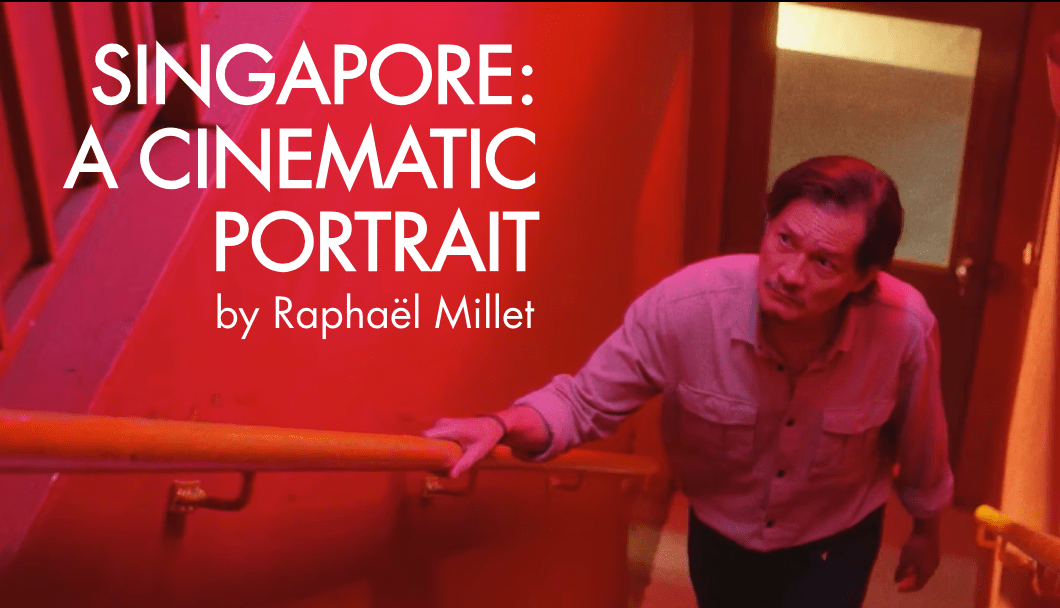

What does a city look like when you trace it not through maps or monuments, but through cinema? A new publication from the Asian Film Archive and film scholar Raphaël Millet offers a striking answer: Singapore, reframed as a living, evolving character across more than a century of film.
Launched on 21 May 2026 at Oldham Theatre, Singapore: A Cinematic Portrait is a richly illustrated journey through 125 years of Singapore as seen, imagined, and reimagined on screen—from early colonial newsreels to contemporary festival films and digital storytelling.

Beyond being a historical account, the book reads like a cultural atlas of memory, mood, and movement, where the city itself becomes the protagonist. “Singapore’s cinema resists singularity,” Millet reflects. “It speaks in many tongues, carries many histories, has many faces, wears many masks and reflects many selves, reminding us that plurality is not an obstacle to identity, but perhaps the very condition of it.”
Spanning 1900 to 2025, the book traces how cinema has both documented and shaped Singapore’s transformation—from imperial trading port to modern global city. Across studio productions, wartime footage, post-independence filmmaking, and today’s digital cinema, the city emerges not as backdrop but as subject.

Millet describes this layered visual history as an accumulation of perspectives rather than a single narrative. “What I want to focus on is the movies that have captured Singapore over the last 30 years or so, focusing on certain themes,” he says. “Rather than a pure chronological approach, I wanted to approach Singapore through concepts: Melancholia Singapura, Nostalgia Singapura, Filming the Singapore Dream, and Filming the Singapore Story.”
These thematic frameworks shape the book’s later chapters, offering a more emotional and interpretive reading of Singapore cinema, one that connects personal memory, national identity, and shifting cultural imagination.

One of the book’s key arcs is the dramatic expansion of Singapore filmmaking over the past three decades. Millet contrasts the present landscape, where local films regularly travel to international festivals—with the scarcity of material available when he first began his research in the early 2000s. “When I first came to Singapore in 2002, I had honestly seen only two movies made here,” he recalls. “Now it’s very different. There are so many movies, and there is a critical mass, which is very different from what you had 20 years before.”
He also points to the changing visibility of Singapore cinema abroad: “You do see Singapore-made movies far more than what you’re used to. In festivals, abroad, internationally—it has really changed.”

This shift, he suggests, is part of what makes the book fundamentally different from his earlier 2006 work, Singapore Cinema. “It is not the same book as what I wrote in 2006. Actually, there’s not a single word from it in my new book.”
Rich archival material sits at the heart of Singapore: A Cinematic Portrait, including posters, handbills, photographs, and restored footage. Among them are rare glimpses of early studio-era productions and rediscovered works that reveal how Singapore has been framed by both local and international filmmakers.

Millet highlights the importance of restoration and archival work, citing films that capture pivotal cultural moments. “It does capture the end of the 1970s in Singapore in a way that is quite amazing,” he says of restored works like Dream of the Red Chamber, which features in the book’s visual landscape.
Across its pages, cinema becomes more than entertainment—it becomes a record of shifting identities, languages, and urban life.

The book’s release is accompanied by a curated film programme, Reel Singapore, running from 8–30 May 2026 at Oldham Theatre. Structured around themes such as History-Memory, Sonic Nation, Rebel Energies, Horrific Fabulations, and Speculative Futures, the programme invites audiences to experience Singapore’s cinematic history alongside the book.
For Millet, the project is deeply personal. Having lived in Singapore for more than two decades, his work moves between scholarship, filmmaking, and lived experience. :I have acquired enough knowledge to try to have a different understanding,” he says. “It’s only my point of view, and it’s meant to start a conversation.”

That sense of openness toward interpretation, contradiction, and multiplicity runs through the book itself. Singapore, as it appears in these pages, is never fixed. It is always becoming. Or as the film scholar puts it simply: cinema does not just show the city; it helps the city see itself.
Singapore: A Cinematic Portrait retails at SGD 75 (incl. GST) and will be available from 21 May 2026 via the Asian Film Archive shop, at Oldham Theatre screenings, and major bookstores islandwide. More information is available at SG Cinematic Portrait.

