

T.H.E toes the line between human and machine in this visually ambitious production, occasionally overwhelmed by technology superseding the very humanity it seeks to explore.
Playing as part of the 2026 Singapore International Festival of Arts, before T.H.E Dance Company’s Strangely Familiar even begins, the world of the performance is already quietly consuming us. The soundscape hums through the theatre with an eerie, dystopian distance, while a levitating cloud hovers stage left, slowly shifting colours as though alive. It is an arresting opening image: mysterious, spiritual and slightly unsettling, immediately setting the tone for a work that constantly hovers between the human and the unreal.

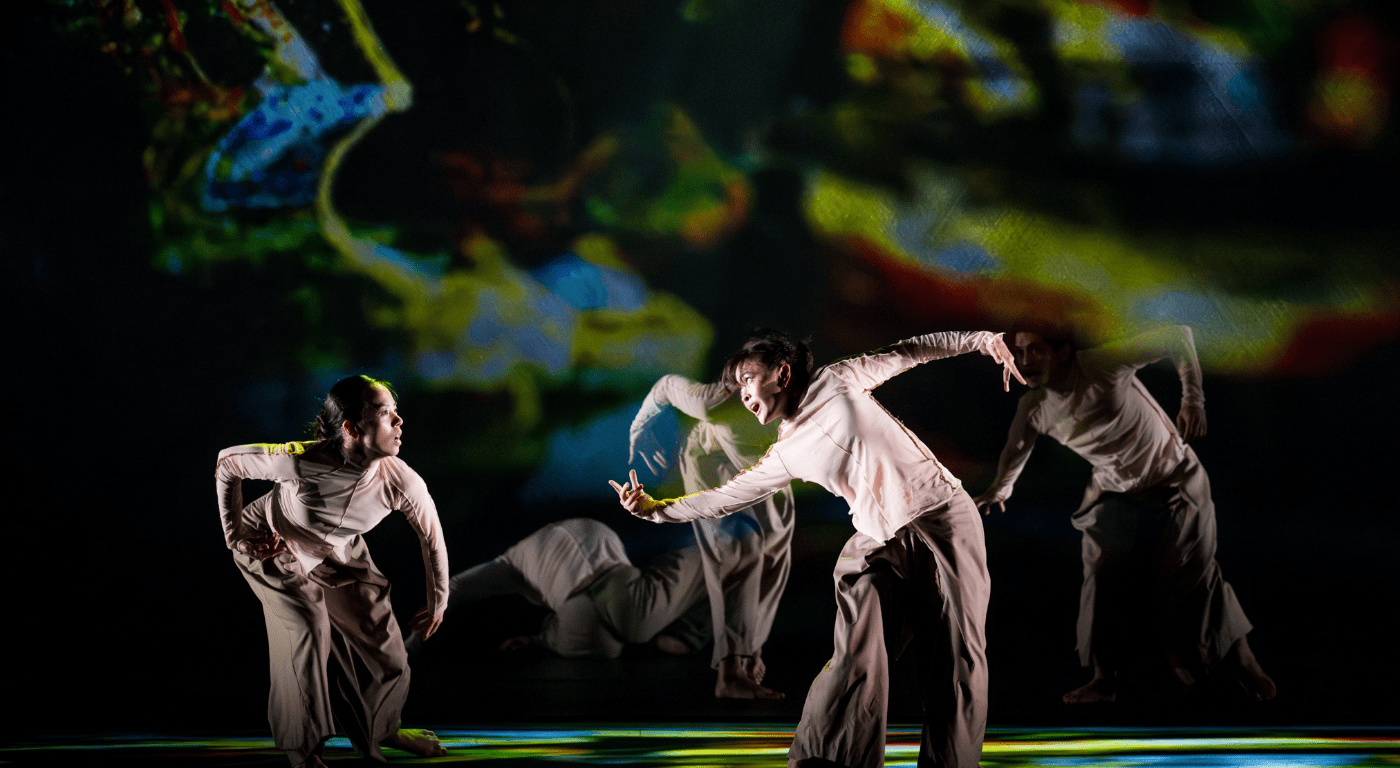
As the performance starts, dancers Fiona Thng, Klievert Jon Mendoza, Chang En, Carmelita Nuelle Buay, and Michail Logothetis Alafragkis emerge clustered at the far back right of the stage. From the outset, the visual language is striking. Through the multimedia design, the dancers seem to leave traces of themselves behind, as though their spirits linger even after the body has moved. The production continually explores the in-between: what is physical, what is spiritual, what is real, and what is technologically constructed. In many ways, this tension becomes the central question of the evening.

There is no denying the ambition of Kuik Swee Boon’s concept. Rooted in T.H.E Dance Company’s HollowBody methodology, Strangely Familiar examines coexistence between humans and technology through movement, immersive visuals and the avatar Agaya, also known as Roo, a digital being inspired by plant life, memory and transformation. The ideas are compelling, and the atmosphere throughout the work remains deeply immersive. Kent Lee’s sound design and music composition, alongside Guo Ningru’s immersive soundscape, create a sonic world that feels haunting and disembodied, almost like we are witnessing a ritual unfolding in another dimension.

Yet despite the strength of the concept and technical execution, the dance itself often feels secondary to the production surrounding it. The visuals, designed by Vividly (Jay Lee and Jay Lei), are undeniably impressive, but they frequently overwhelm the dancers rather than deepen their presence. Too often, the performers are pushed to the back of the stage, swallowed by the scale of the theatre and the enormity of the projections. In comparison to its original, more personal black box presentation in Hong Kong, the larger staging here feels emotionally distancing. The intimacy that this work seems to require is lost within the vastness of the space.

Ironically, the performance becomes most powerful during the rare moments when the technology falls away and the dancers are simply allowed to exist in front of us. There is a scene late into the work where the spotlights finally illuminate the dancers clearly enough for us to see their faces and emotions. For the first time, we glimpse personality rather than silhouette; vulnerability rather than concept. It becomes a reminder that the human body itself is already expressive enough.

Several images linger long after the performance ends. One dancer curled into a foetal position while others gather around him, almost as if healing or resurrecting him, evokes the sense of life coming full circle, of returning to the beginning in order to start again. Elsewhere, the performers move in deeply processional formations, staring towards the light or towards the screen with their backs facing the audience. These choices seem intentional, perhaps reflecting humanity’s fixation with the digital unknown, yet they also reinforce the emotional distance that runs through the work.

This distance becomes especially noticeable whenever the screen dominates the stage action. At one point, the lightbox containing Agaya is moved closer to the audience, presumably to immerse us further into the digital world. However, rather than enhancing the performance, it becomes distracting. There are moments where projected imagery, including microscopic, almost DNA-like visuals takes precedence over the dancers entirely. Even during a compelling trio section, the choreography is repeatedly interrupted by the insistence of the visuals demanding our attention. It raises the question: if the visuals are the true focal point, what role are the dancers ultimately meant to occupy?

Perhaps that is exactly the point of Strangely Familiar, to make us uncomfortable with how technology increasingly overtakes human connection. The work constantly asks us to question coexistence, dependence and identity in a rapidly shifting world. But while the intention is clear, it is a challenge to emotionally connect with the performance itself. The narrative thread feels loose, and the balance between movement and multimedia never fully settles.

Still, there is much to admire in the ambition of the production and the thoughtfulness behind its creation. Kuik Swee Boon and his collaborators have built a visually and sonically rich experience that leaves audiences with much to reflect on. As the lights fade and the dancers regroup one final time, Strangely Familiar lingers less as a dance performance and more as a meditation on humanity’s uncertain relationship with the worlds we create.

At the end of the day, perhaps the title says it best. Strangely Familiar feels like staring at our future and recognising parts of ourselves within it, even if, somewhere along the way, the human connection becomes harder to reach.
Photos Courtesy of The Arts House Group
Strangely Familiar 《熟悉的陌生》played from 22nd to 24th May 2026 at Victoria Theatre. Tickets and more information available here
SIFA 2026 runs from 15th to 30th May 2026. More information and tickets available here
Production Credits
| Concept / Artistic Director Kuik Swee Boon Choreographer Kuik Swee Boon in collaboration with the dance artists Dance Artists Fiona Thng, Klievert Jon Mendoza, Chang En, Carmelita Nuelle Buay, Michail Logothetis Alafragkis Avatar Performer (Motion Capture) & Wagon Operator Priscilla Chan Guest Dance Artist / Original Avatar Performer (Motion Capture) & Avatar Integration Zelia ZZ Tan Lighting Design Adrian Tan Sound Design & Music Composition Kent Lee Immersive Sound Design Guo Ningru Multimedia Content Design Vividly (Jay Lee & Jay Lei) Multimedia System Design Low Wee Cheng (Ctrl Fre@k) Virtual Production & Digital Avatar Integration Phil Pham Avatar Design Tian Zhang Avatar Animator Adrian Lim Virtual Lighting Technical Artist Nick Ng Costume Design & Realisation Cindy Ho Costume Seamstress Linda Lee Wagon Surface Design Development & Realisation Angeline Oei Producer Athelyna Swee Production Manager Cindy Yeong Technical Manager Peter Chi Stage Manager Lee Xinzhi |


One thought on “★★★☆☆ Dance Review: Strangely Familiar《熟悉的陌生》 by T.H.E Dance Company (SIFA 2026)”