
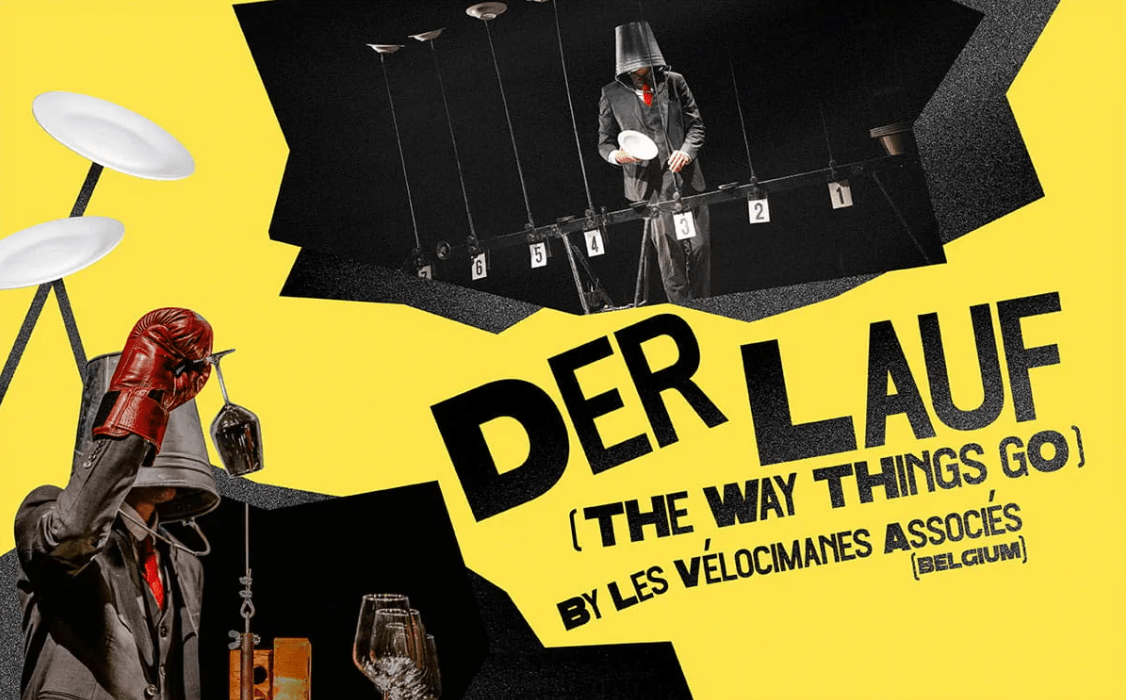
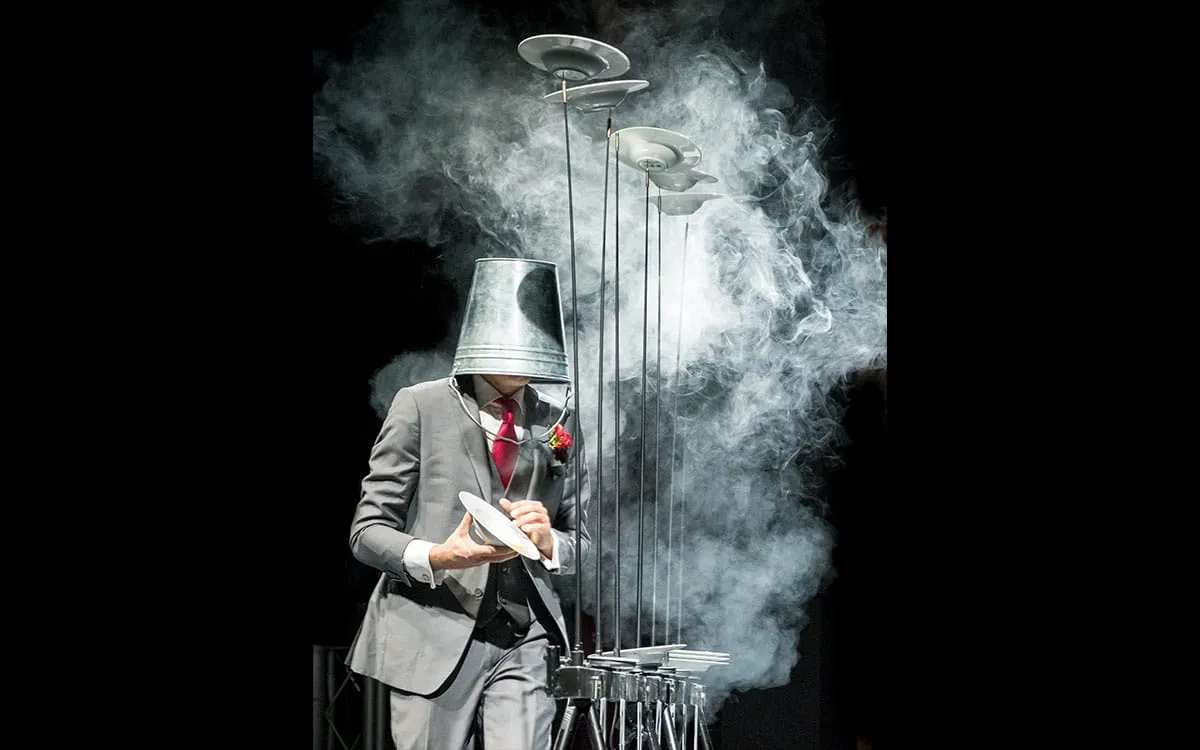
Contemporary circus rarely sits still, but Der Lauf (The Way Things Go) thrives in a state of beautiful collapse. Created by Belgian juggler and performer Guy Waerenburgh, the internationally acclaimed production transforms juggling into something far stranger and more theatrical: part cabaret, part endurance test, part social experiment. Blindfolded performers navigate towering stacks of wine glasses, spinning plates, flying buckets and razor-sharp knives, while the audience becomes an essential part of the action — shouting directions, offering warnings and, occasionally, embracing the chaos. The result is a performance that feels both meticulously crafted and dangerously unpredictable.
Since premiering in 2015, Der Lauf has toured extensively across Europe and beyond, earning praise for its hypnotic blend of absurdity, tension and dark humour. Before bringing the show to Singapore’s Flipside Festival, Waerenburgh spoke to us about the origins of the work, why failure and risk are central to its appeal, and how audiences around the world inevitably shape the performance in unexpected ways.
Bakchormeeboy: Der Lauf (The Way Things Go) feels like a mix of juggling, theatre, cabaret and controlled disaster. Is there a significance to the title? How would you describe the appeal of the show to someone who has never experienced contemporary circus before?
Guy Waerenburgh: The title is a reference to the short film by Fischli and Weiss, Der Lauf der Dinge. In a big industrial space, they create a very long chain reaction with rolling weights, explosions, fire and chemical reactions. It looks very chaotic, but everything happens exactly as it should, without any human intervention.
As a juggler, this looks like a dream world. When you try to throw things and catch them perfectly to music, things tend to go south. More often than not, you find yourself chasing balls all over the floor. In real life, I think it’s a bit the same. Things rarely go as planned, and the human factor creates change and unpredictability. So we wanted to make a juggling show that would be the opposite of Der Lauf der Dinge, where things can go wrong and can change depending on how humans interact with each other. We call it Der Lauf.
Bakchormeeboy: The performance constantly balances precision with unpredictability. What attracts you to creating situations where things can genuinely go wrong on stage? How much control do the performers still have?
Guy: In the show, everyone has a lot of power. The performers could just ignore the audience and keep failing. It is only juggling! The audience as well could choose not to help at all, and then I would be stuck trying to do the tricks on my own. It has happened before! The thing is that, most of the time, people want to help each other out. I love creating situations where that is put into question.
Bakchormeeboy: Blindness and trust seem central to the show, especially with the audience guiding the performers through shouts and reactions. What interested you in building that relationship between performer and audience, and how is that developed during the show?
Guy:At the beginning, the audience doesn’t really know that they are supposed to help me. The situation itself asks for it. There are no instructions given at any moment. It is also important for us that no one is forced to do anything during the show. Nobody is brought on stage to perform with us. If you just want to watch passively, that is completely possible. We try to build the same kind of relationship people have in real life. You can decide to help each other and participate, or you can stay away from others.
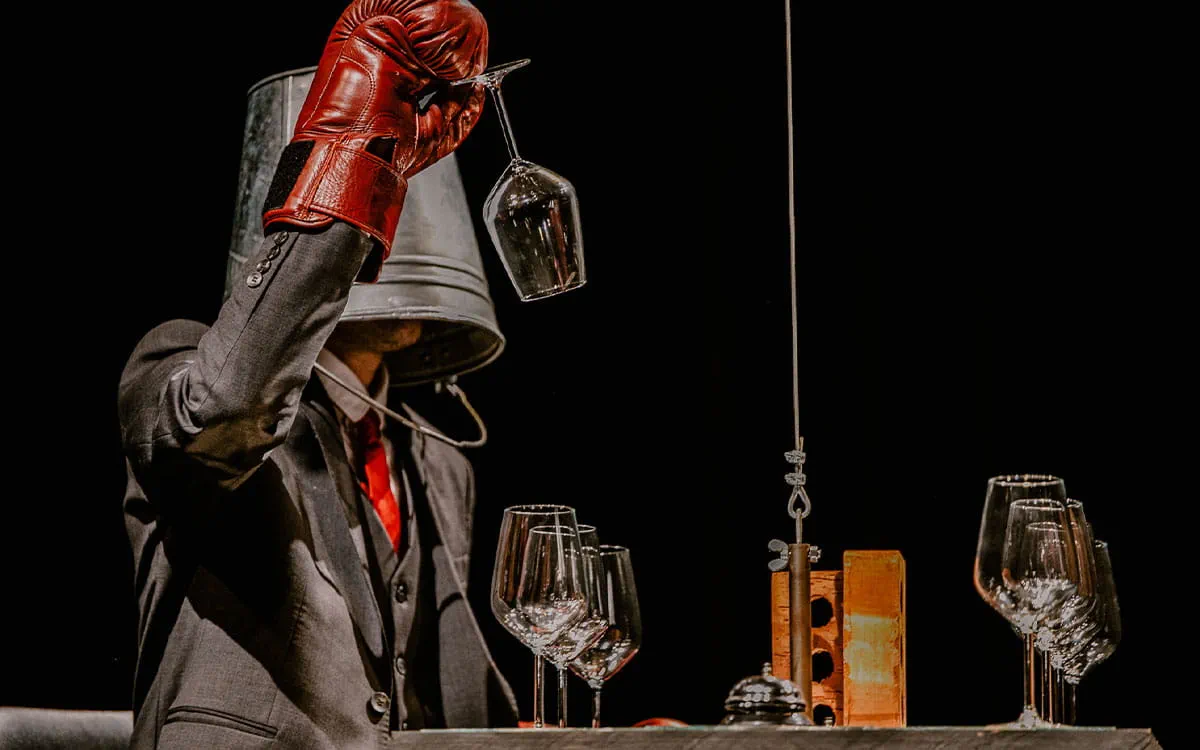
Bakchormeeboy: Many objects in the show, such as wine glasses, plates, buckets and knives, carry a sense of danger or fragility. How do these everyday objects become theatrical characters in Der Lauf?
Guy: We wanted to use objects that represent the fragility of our lives. During the show, we try to build beautiful things together, but they are all destroyed at the end of each routine. Again, we wanted the show to resonate with what happens to all of us. We try to build things in life even though we know they will eventually disappear.
Bakchormeeboy: There is a strong comedic and absurdist energy running through the work, but also moments of tension and suspense. How do you balance humour with risk in your creative process and execution?
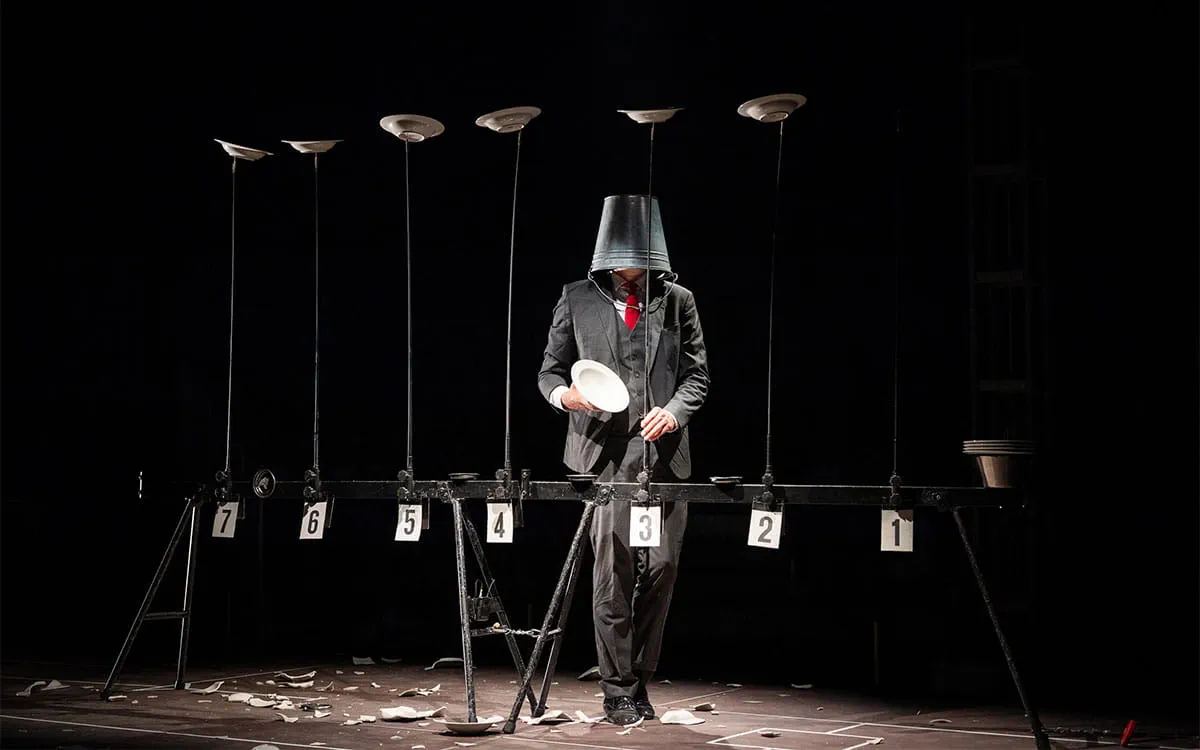
Guy: Humour is very much associated with risk and damage. We laugh when things go wrong and when people get hurt. Laughing is also a good relief strategy for tension. There is a lot of tension in the plate act. Sometimes I perform it outside the show, in a cabaret for instance. Clowns often tell me they are very happy to perform after the plate act, because people have a lot of tension to release, and humour is a good way of doing that.
Bakchormeeboy: You’ve performed internationally for many years, including with Cirque du Soleil in Macau. How has performing around the world shaped the way you create and connect with audiences today?
Guy:Languages and cultures can be quite a challenge when communicating with an audience. The fact that there are very few words in the show, and that it appeals to very basic emotions like fear, empathy, love and solidarity, makes it quite universal, I think.
Bakchormeeboy: Since premiering in 2015, Der Lauf has toured extensively across Europe and internationally. Has the show evolved over time through different audiences and cultures?
Guy:We took a really long time to create the show. There were five years between the first idea and the premiere. The pandemic also didn’t help. So the show changed quite a bit in the beginning. But after a while, it became more about how audiences make the show evolve each time.
Bakchormeeboy: Singapore audiences at Flipside are known for embracing playful and unconventional performances. What are you most excited for them to experience when they enter the chaotic world of Der Lauf?
Guy: The beginning is always the most exciting moment for me, when we get to meet the audience. Will they be loud or concentrated? Playful? Making jokes or being super efficient? Some audiences take a long time to start playing with us. They hesitate. Is it allowed to speak? Should we do something? You can hear them whispering as the tension builds, and from there it quickly evolves into louder reactions and directions. With children, they jump straight in without fear or inhibition. I love both.
Der Lauf (The Way Things Go) plays from 6th to 7th June 2026 at the Esplanade Theatre Studio. Tickets available here
Flipside 2026 runs from 29th May to 7th June 2026 at the Esplanade. Tickets and full programme available here

