
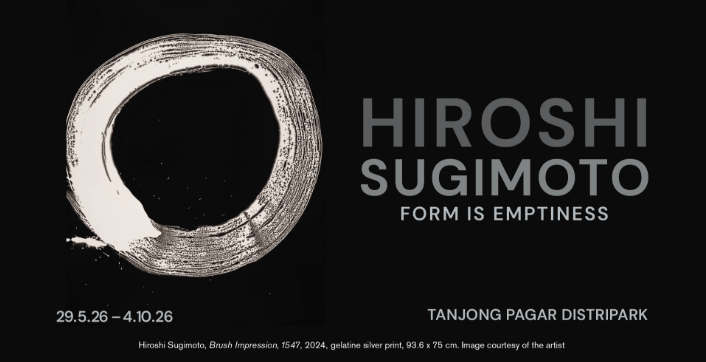
One of the first impressions inside Hiroshi Sugimoto: Form Is Emptiness is not visual in any straightforward sense, but atmospheric. The galleries seem to slow the body before the mind has time to interpret what is happening. Sound falls away into a low, diffuse hush, not quite absolute silence, but instead the softened acoustics of carpeted distance, of people unconsciously lowering their voices as they move between rooms that do not fully resolve themselves into linear sequence.
In his first major Southeast Asian survey exhibition, Hiroshi Sugimoto transforms Singapore Art Museum into a meditative landscape of fossils, horizons, cinema screens, Buddhist statuary and spectral light. Across five decades of work, the Japanese artist asks a deceptively simple question: what does it truly mean to see?

Hiroshi Sugimoto. Image courtesy of the artist.
Light behaves differently here. It is not uniform or declarative, it is broken into conditions: the matte glow of silver gelatin prints, the dim absorption of black-and-white imagery, the occasional reflective interruption of glass vitrines holding fossils or optical sculptures. Even footsteps feel slightly delayed, as if the architecture is withholding its own tempo.
The exhibition at Singapore Art Museum’s Tanjong Pagar Distripark unfolds according to a logic closer to spatial thought than narrative progression. Designed with Hiroshi Sugimoto, it takes the form of a mandala, using it as a metaphorical structuring principle that distributes attention across multiple possible paths. Rooms do not conclude; they open into adjacent ones through angled sightlines and partial visibility. Wooden slats fracture the field of vision so that works appear, disappear, and reappear across distance, as if perception itself were being gently interrupted and reassembled.

Hiroshi Sugimoto. Image courtesy of Singapore Art Museum.
Movement through the space becomes less about progression than accumulation. One carries earlier images forward into later rooms as lingering visual afterimage: horizons, candles, faces, white screens, stone, darkness. Sugimoto’s practice, spanning more than five decades, is often described through its conceptual clarity, but what becomes apparent in this exhibition is something more sustained and bodily: a consistent attempt to hold time in suspension long enough for it to be felt rather than understood. Across photography, sculpture, installation, and architectural thinking, the works return repeatedly to a small set of conditions; sea and sky, light and shadow, presence and absence, as if testing how perception behaves when reduced to its most elemental relations.
The exhibition takes its title from the Heart Sutra, a text in which the phrase “form is emptiness, emptiness is form” appears not as paradox but as proposition. Within the galleries, this does not read as philosophical abstraction so much as environmental condition. Forms appear continuously, only to loosen under prolonged attention. Images that initially feel fixed begin to behave more like thresholds.

Hiroshi Sugimoto, U.A. Walker, New York, 1978, gelatine silver print, 119.4 x 149.2 cm. Image courtesy of the artist.
This becomes particularly clear in the Dioramas series, one of the earliest bodies of work on view. At first glance, the photographs present scenes of wildlife suspended in an uncanny stillness: wolves positioned along rocky ridges, prehistoric animals standing in what appear to be expansive natural habitats. The images carry the familiar authority of documentary photography, tonal depth, compositional stability, a sense of observed reality.
Only gradually does the recognition settle that these are not animals in nature but museum dioramas photographed within the American Museum of Natural History in New York. The landscapes are constructed; the animals are taxidermy; the sky is painted backdrop. Yet the camera flattens these distinctions. Under black-and-white exposure, texture becomes persuasive enough that artificiality begins to read as presence.

Installation view of Hiroshi Sugimoto’s Dioramas (1975 – 2025), as part of ‘Hiroshi Sugimoto: Form Is Emptiness’. Image courtesy of Singapore Art Museum.
There is a subtle disorientation in this recognition, not dramatic but actually cumulative. It arrives through looking rather than thinking, through the way the eye adjusts to shadow and detail until the boundary between staged and lived environment becomes less stable than expected. The effect lingers even after moving away from the images, a slight uncertainty about what constitutes visual evidence.
Nearby, fossils placed within vitrines extend this uncertainty into geological time. Trilobites, ammonites, and fragmented skeletal impressions sit like images that predate photography yet behave strangely like it. Their surfaces are compressions of time rather than representations of it. What appears here is not life preserved as memory, but life transformed into material trace.
The comparison between fossil and photograph does not resolve into analogy so much as shared logic. Both are forms of inscription produced under pressure, one through sediment and heat, the other through light and chemical reaction. In both, something disappears in order for something else to remain.

Installation view of Hiroshi Sugimoto, Opticks (2018 – ongoing), as part of ‘Hiroshi Sugimoto: Form Is Emptiness’. Image courtesy of Singapore Art Museum.
This sense of shared structure becomes more explicit in Opticks, where light itself becomes the subject of inquiry. Named after Isaac Newton’s 1704 treatise, the series emerges from prism experiments conducted in Sugimoto’s studio. Rather than treating colour as a fixed spectrum, the works attend to the subtle gradations between tonal states, the almost imperceptible transitions where blue becomes green, where violet thins into near-white.
Elongated mirrors and refractive surfaces produce conditions in which light is no longer simply recorded but studied as material behaviour. What appears in the final images are not discrete colours but continuous intervals of perception, expanded and slowed. In these works, light feels less like illumination than substance under transformation.

Installation view of Hiroshi Sugimoto, Theaters (1976 – 2014), as part of ‘Hiroshi Sugimoto: Form Is Emptiness’. Image courtesy of Singapore Art Museum
That sense of disappearance becomes more explicit in Theaters, one of Sugimoto’s most recognisable series. The images depict cinema interiors during film screenings, yet what is visible is not narrative content but the luminous rectangle of the screen itself. Each photograph is exposed for the full duration of a film, collapsing hours of movement into a single field of white light.
Standing before these works, there is a peculiar sensation of temporal compression that is almost physical. The longer one looks, the more the brightness seems to settle into the eyes, as if the images were less about depiction than endurance. Around them, viewers tend to remain still for extended periods, not quite leaving, as if waiting for something to re-emerge from within the blankness.
The white screen does not feel empty in a simple sense. It feels full, but without articulation, a fullness that resists resolution into images or narrative. In this sense, the series holds something quietly disquieting about contemporary visual culture, where so much is constantly in motion yet rarely sustained long enough to become perceptible as duration.

Installation view of Hiroshi Sugimoto, In Praise of Shadows 980806, 1998, gelatine silver print, 149.2 x 119.4 cm, as part of ‘Hiroshi Sugimoto: Form Is Emptiness’. Image courtesy of Singapore Art Museum.
A different kind of temporal density emerges in In Praise of Shadows, where candlelight becomes the primary subject of long-exposure photography. The works register not a single moment but the entire lifespan of a flame. Some images contain steady, almost architectural lines of light; others blur into instability, suggesting drafts of air, subtle movement, or shifts in burning intensity.
The surfaces of these photographs carry a faint material glow under gallery lighting. Silver gelatine prints do not behave like digital images; they absorb light unevenly, producing a sense of depth that feels almost sedimentary. Standing close, one becomes aware of the photograph not as image alone but as object with its own atmospheric presence.
In the surrounding space, viewers often remain unusually quiet, not out of instruction but because the images seem to require a different kind of attention. one that accommodates slowness without filling it with interpretation.

Exhibition view of Hiroshi Sugimoto, Accelerated Buddha (1997–2017), 3-channel video projection, 5:45 min, as part of ‘Hiroshi Sugimoto: Form Is Emptiness’. Image courtesy of Singapore Art Museum
This slow temporality continues in Sea of Buddha, where repetition becomes architectural. Rows of gilded statues fill the frame in rhythmic accumulation, each figure identical yet slightly differentiated by angle and light. Photographed within the Sanjūsangen-dō temple in Kyoto, the works register not individuality but continuity, a field of presence extending beyond visual focus.
Light enters the temple in a limited daily interval, and within that brief period the gold surfaces shift from subdued matte to reflective intensity. The photographs preserve this condition of illumination, but what they primarily communicate is duration: the waiting required to encounter such light, and the repetition involved in its documentation.
The rhythm of viewing here becomes almost bodily, as if the repetition of figures begins to influence the viewer’s own sense of time. Some visitors move slowly along the wall without stopping, while others stand still long enough for their attention to lose track of sequence altogether.

Exhibition view of Hiroshi Sugimoto, Five Elements (2011-2012), as part of ‘Hiroshi Sugimoto: Form Is Emptiness’. Image courtesy of Singapore Art Museum.
Within this gallery, the logic of the Five Elements becomes materially legible. Pagoda forms and spherical enclosures reference a cosmological system in which earth, water, fire, wind, and void are not symbolic abstractions but structural principles. Glass spheres containing seascape images appear as contained atmospheres, water enclosing water, image enclosing environment. Earth is implied in the architectural grounding of the forms; fire in reflective gold surfaces; wind in spatial circulation; void in the intervals between objects.
What appears as installation design becomes, under prolonged attention, a diagram of elemental relations. The exhibition space begins to behave less like a sequence of rooms than a constructed cosmology. That structure is most explicit in the pagoda sculptures, where photographic seascapes are embedded within spherical enclosures positioned along vertical axes. Each tier corresponds to one of the Five Elements, producing a spatial logic in which sculpture, image, and philosophy are inseparable. The sea, already central to Sugimoto’s practice, is here enclosed within water itself, an image folded back into its own material condition.
Seen in relation to the surrounding works, this ordering begins to extend outward. The candlelight of In Praise of Shadows, the horizon of Seascapes, and even the void-like brightness of Theaters begin to feel less like separate investigations than variations of elemental states, condensation, combustion, suspension, dissolution.

Installation view of Hiroshi Sugimoto, Mathematical Model 002: Dini’s Surface (2005), aluminium and steel, 2782 mm in height, 250 mm in diameter, as part of ‘Hiroshi Sugimoto: Form Is Emptiness’. Image courtesy of Singapore Art Museum
This sense of structural thinking extends into Mathematical Models, where form is generated through computational processes rather than observation. Based on geometric equations, the sculptures appear as continuous surfaces that twist and extend without clear beginning or end.
Placed within the exhibition, they function as a counterpoint to photographic stillness. Where photographs hold time, these forms articulate continuity. Yet both share an underlying interest in how invisible systems become visible, whether through light, equation, or spatial repetition.

Installation view of Hiroshi Sugimoto, Brush Impression, Heart Sutra, 2023, 288 unique gelatine silver prints, 49.5 x 59.7 cm each, as part of ‘Hiroshi Sugimoto: Form Is Emptiness’. Image courtesy of Singapore Art Museum.
The exhibition’s central installation, Brush Impression, Heart Sutra, intensifies this relationship between repetition and perception. Composed of hundreds of photographic prints arranged along a curved architectural surface, the work unfolds as a continuous field of calligraphic marks. Each character was produced in darkness using photographic fixer, applied by hand onto light-sensitive paper, so that writing becomes inseparable from chemical reaction and bodily memory.
The surface of the work does not resolve into linear reading. Instead, it behaves like a continuous visual field in which meaning accumulates without settling. The curvature of the installation encourages peripheral vision, so that no single section can be held in isolation. The viewer moves along it rather than in front of it, adjusting pace unconsciously to the density of marks.
There is a quiet sense of fatigue that can accompany prolonged viewing here. But it is not exhaustion, and instead, the gradual loosening of interpretive urgency. The work does not demand comprehension so much as sustained proximity.

Installation view of Hiroshi Sugimoto, Tyrrhenian Sea, Scilla (1993), gelatine silver print, 119.4 x 149.2 cm, as part of ‘Hiroshi Sugimoto: Form Is Emptiness’. Image courtesy of Singapore Art Museum
Elsewhere, Seascapes returns the exhibition to its most stripped condition. Each image contains only two elements: sea and sky, divided by a horizon line that is sometimes sharply defined and sometimes almost imperceptible. The simplicity of the composition becomes disarming only after extended looking, when the repetition across decades begins to register.
Despite their apparent sameness, no two seascapes are identical. Atmospheric conditions alter the density of the horizon; water and cloud exchange tonal dominance; light disperses differently across each frame. The effect is cumulative rather than singular, building a sense of continuity that resists narrative closure. Standing before them, one becomes aware of how long viewers tend to remain. There is often a kind of quiet stillness in front of these works that absorbs you, a suspension of conversational impulse.

Hiroshi Sugimoto. Image courtesy of the artist.
If earlier works in the exhibition explore illusion and mediation, the seascapes approach something closer to irreducibility. They do not reveal meaning so much as remove excess, leaving only conditions of perception themselves.
This reduction feels unexpectedly contemporary in a time saturated with images that rarely linger. In an environment shaped by algorithmic circulation, rapid visual consumption, and increasingly synthetic image production, Sugimoto’s long-duration works propose a different visual ethics, one in which seeing requires time before it yields anything at all.

Installation view of Hiroshi Sugimoto, Spacescape (2024), pigment print on washi paper, mounted to a folding screen, 180 x 872 cm fully extended, as part of ‘Hiroshi Sugimoto: Form Is Emptiness’. Image courtesy of Singapore Art Museum
Within this context, the exhibition’s closing movement toward Spacescape, an image series produced from orbital photography, carries a subtle shift. The viewpoint is no longer human in any immediate sense. Earth appears from above, partially lit, partially withdrawn into darkness. The familiar horizon is displaced into planetary curvature.
The image does not conclude the exhibition so much as reframe it. After so many works concerned with memory, imitation, and duration, the view from space introduces a perspective in which human perception is no longer central, yet still implied.

Installation view of Hiroshi Sugimoto, Brush Impression, 1547 (2024), unique gelatine silver calligraphy print, 93.6 x 75 cm, as part of ‘Hiroshi Sugimoto: Form Is Emptiness’. Image courtesy of Singapore Art Museum.
Says Dr Eugene Tan, Chief Executive Officer and Director of SAM, said, “Hiroshi Sugimoto is one of the most influential artists of our time, whose work has continually redefined the boundaries of image-making and perception. We are delighted to present his works in Southeast Asia at this scale for the first time. Form Is Emptiness brings together key bodies of work across five decades, from early photographic series to more recent explorations that extend beyond the camera. His practice continues to shape how we understand the art of our time, moving between image, object, and space, and inviting close and sustained engagement.”
It is difficult to leave the exhibition without some residue of its pacing. Outside, the ambient speed of the museum feels slightly accelerated, as if the body has not fully recalibrated to the conditions it just passed through. The sea, the cinema screen, the candle flame, the fossil, the blank sky, these images persist, as lingering temporalities that refuse immediate departure. They remain, for a while, like afterimages that do not fade at the same rate as attention.
Hiroshi Sugimoto: Form Is Emptiness runs from 29th May to 4th October 2026 at SAM @ Tanjong Pagar Distripark. More information available here

