

Lee Hyeyoung delivers a masterclass performance in Park Jung-hee’s hypnotic, sexually charged reimagining of Ibsen’s classic, now transformed into a suffocating psychological thriller of a K-drama.
Before we see anything in the National Theater Company of Korea’s Hedda Gabler, we hear a gunshot. It tears through the darkness with such violence that the audience visibly jolts. And from that very first moment, director Park Jung-hee makes clear that this is not a polite revival of an Ibsen classic, but something volatile, erotic and terrifyingly alive. By the time the lights rise on Hedda’s immaculate prison of a home, fate already hangs in the air like smoke, like an alarm waking Hedda up to realise that something is terribly wrong.

Presented as part of the 2026 Singapore International Festival of Arts, this remarkable production demonstrates exactly why international theatre exchange matters. Rather than treating Hedda Gabler as untouchable literary heritage, Park strips away the historical distance surrounding the text and rediscovers its emotional violence through a distinctly contemporary Korean sensibility. The result feels startlingly immediate. What emerges is not a museum-piece European drama but a sleek psychological thriller simmering with repression, voyeurism and unresolved desire, very much resembling a high-end K-drama distilled into pure theatre.

Written in 1891, Henrik Ibsen’s Hedda Gabler follows the newly married Hedda Tesman as she returns from her honeymoon already consumed by dissatisfaction. Trapped in a suffocating bourgeois marriage to the earnest but deeply unexciting academic George Tesman, Hedda finds herself lashing out at everyone around her as old lovers, rivals and temptations begin circling her carefully maintained world. Yet Park’s production never frames Hedda simply as monstrous or tragic. Instead, as she writes in her director’s note, she approaches the play as “a portrait of a human being standing before the question: How should one live?” In this interpretation, Hedda’s desperation feels less like the pathology of one woman than the symptom of a society that offers freedom while quietly denying agency.

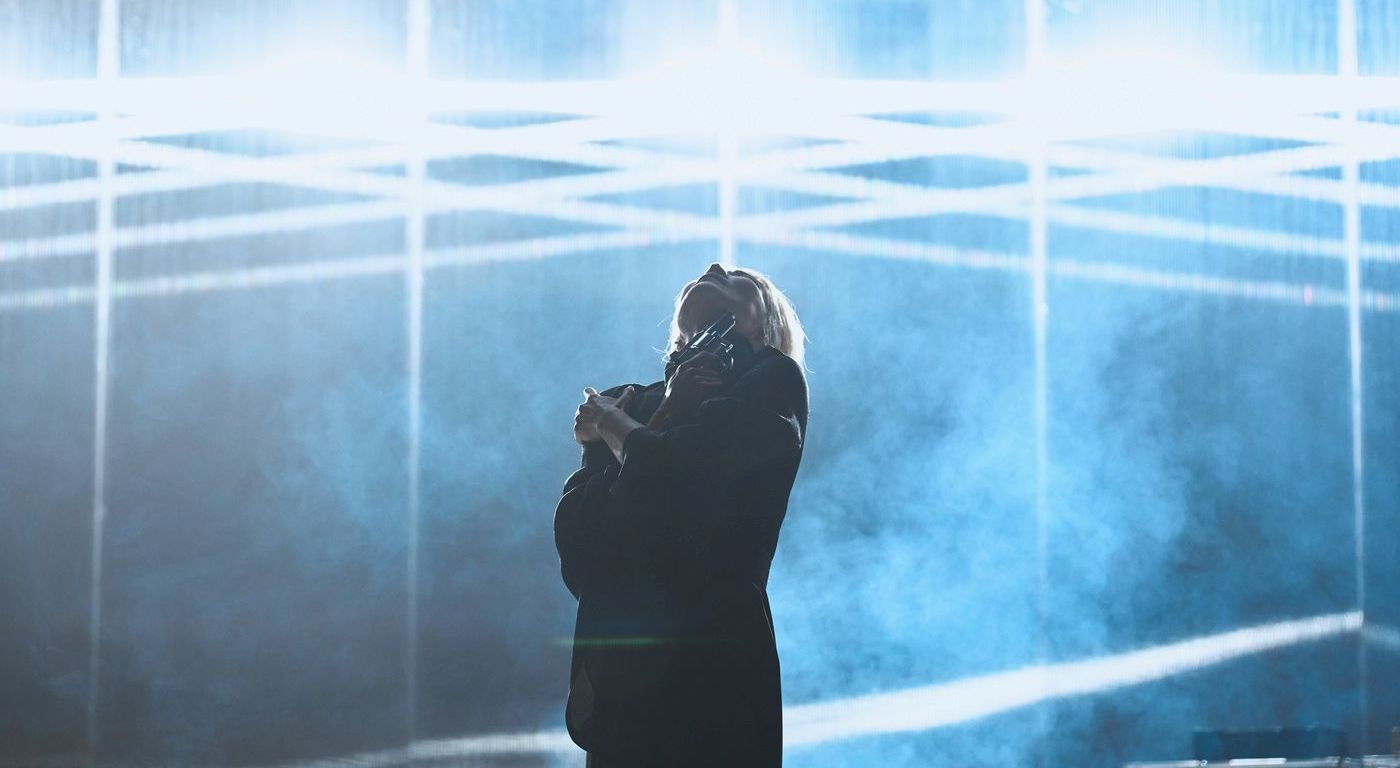
That suffocation is embedded immediately into the production’s visual language. The scenography, realised by Scenic Construction Director Lee Seung Soo and Scenic Construction Supervisor Lee Yunjoong under the production’s restrained aesthetic vision, creates one of the more oppressive interiors seen onstage in recent memory. Hedda’s home is luxurious yet deeply hostile and impersonal: metallic walls, sparse furnishings, polished surfaces and an enormous frosted-glass upstage wall through which silhouettes frequently emerge and disappear. Figures drift behind the translucent panels like voyeurs or ghosts, giving the unnerving impression that Hedda is never truly alone, never unwatched.

Everything about the apartment radiates discomfort. There is no warmth, no softness, no sense of intimacy. A sharply phallic, abstract sculpture lurks ominously in the background, while the gleaming drinks cabinet and designer furniture make the house feel less like a home than a showroom built for social performance. It is a living room meant to entertain guests, not shelter human beings. The effect is chilling. Hedda has not married into domesticity so much as entombed herself inside it.

Yeo Shindong’s exquisite lighting design heightens this claustrophobia with astonishing precision. Rather than relying on dramatic visual flourishes, the production subtly adjusts brightness and shadow throughout, tightening emotional pressure scene by scene. Social gatherings glow with brittle artificial warmth, while Hedda’s moments alone narrow into concentrated pools of darkness that make the villa feel almost dungeon-like. During the manuscript-burning scene, one of the production’s most hypnotic sequences, Hedda feeds pages into the fire one by one as smoke slowly rises through the room, her face illuminated by flickering light and something perilously close to ecstasy. It is destruction staged as seduction. Yoon Kyung Min’s sound design quietly sustains the production’s atmosphere of dread, from the explosive opening gunshot to the low ambient textures simmering beneath scenes like nervous tension trapped inside the walls themselves.

Park Jung-hee’s direction is masterful precisely because of its restraint, wanting to foreground the gap between what is spoken and unspoken, and nowhere is this clearer than in the rhythms of the performances themselves. The Korean translation gives Ibsen’s dialogue startling sharpness. Even through surtitles, conversations feel tighter, faster, more combative than in many English-language productions. Exchanges do not unfold leisurely but strike like attacks. Every pause carries social calculation. There are also curiously fascinating moments where characters briefly slip into foreign language: “Monsieur”, “Mademoiselle”, even “Shalom”, small gestures of cosmopolitan sophistication that reveal people constantly performing class and refinement for one another. Beneath those affectations, however, lies something raw and ugly. Koh Soohee’s Juliana Tesman speaks with an almost phlegmatic warmth that immediately explains Hedda’s visceral disdain toward her. The production becomes deeply attentive to social texture: class anxiety, performative gentility, emotional repression, and the violence hidden beneath manners.

At the centre of all this stands Lee Hyeyoung in a performance so commanding it feels destined to become legendary. The role of Hedda Gabler has long been considered one of theatre’s greatest roles for actresses: psychologically contradictory, emotionally exhausting, monstrously charismatic. It demands an actor capable of embodying cruelty, vulnerability, intelligence and despair simultaneously. Lee rises to the challenge and attacks it, to the extent it feels she doesn’t just chew the scenery; she completely consumes the production from within.

While Ibsen’s Hedda is canonically twenty-nine, Lee wisely refuses to chase the illusion of youth. Instead, she transforms Hedda into a woman acutely aware of ageing, social visibility and diminishing power. The blonde-dyed hair, immaculate makeup and controlled elegance suggest someone desperately curating herself against irrelevance. There is something quietly heartbreaking in the effort. Hedda’s manipulations begin to feel not merely cruel, but existential: attempts to preserve agency in a society that increasingly renders women decorative once youth begins slipping away.

Sim Narae and Shin Eunhye’s costume design becomes an extension of Hedda’s psychological armour throughout the evening. She first appears in a silky blue nightgown projecting softness and domestic femininity, only for the illusion to quickly fracture once she emerges in an immaculate white suit whose pants hint at the authority she truly desires. Even then, the costume remains carefully seductive: exposed cut-outs at the sleeves reveal flashes of skin, reminding us that Hedda understands exactly how desire can be weaponized and how power can be exercised through appearance. By the final act, dressed in severe black mourning attire with flowing draped sleeves, black heels and unmistakable luxury detailing, Hedda resembles both widow and empress. Even at the edge of annihilation, she refuses vulnerability. Every costume change becomes another act of self-construction, another attempt to maintain control over how the world consumes her image.

Hedda is never weak. She dominates the stage with frightening precision. Even in silence, she exerts a gravitational pull so intense that the eye cannot drift elsewhere. Lee weaponises stillness itself: the slight narrowing of her gaze, the way she lounges on the couch as though testing ownership over the room, the calculated delay before speaking. You constantly feel Hedda thinking several moves ahead, studying everyone around her for weakness, leverage, or escape.

The production brilliantly frames Hedda’s relationships as exercises in predation. With Song Inhsung’s trembling, anxious Thea Elvsted, Hedda eyes like a cat tormenting prey, fascinated by the younger woman’s emotional openness. At one point, she even bites Thea’s shoulder in a moment so intimate and unsettling that the audience collectively stiffens. It feels less flirtatious and more vampiric, as though Hedda wishes to consume the vitality she herself has lost.

Kim Myeongki’s George Tesman provides perfect comic and emotional contrast. Endlessly bumbling and consumed by academia, he drains erotic energy from every room he enters through sheer obliviousness. Kim never turns him into a villain; rather, he becomes tragic precisely because he genuinely cannot comprehend the woman he has married. To him, Hedda is a beautiful achievement, a trophy signifying success. He remains blind to the abyss opening directly beside him.

Kim Eunwoo’s Eilert Lövborg introduces another layer of dangerous chemistry. Younger and emotionally volatile, his history with Hedda gives their scenes together a feverish erotic tension. Lee’s Hedda possesses an unmistakable mature sexual authority over him; he gazes at her with the awe of someone falling helplessly back under a spell he never truly escaped. As the play progresses, Kim charts Lövborg’s collapse with painful physical detail, his once-confident presence deteriorating into something bloodied, dishevelled and broken.

Yet perhaps the production’s most electrifying dynamic emerges between Hedda and Hong Seonwoo’s Judge Brack. Rather than presenting Brack as physically repulsive or obviously sinister, Hong makes him devastatingly handsome and socially immaculate. The effect is genius. His charm only sharpens the menace beneath it. Brack understands power instinctively, and recognises in Hedda someone frighteningly similar to himself. Their scenes together crackle with flirtation, intellectual play-fighting and unresolved sexual tension. These are not merely adversaries circling one another; they are two predators engaged in extended foreplay.

Park stages many of their private interactions with an almost unbearable intimacy. They lean into one another’s space, tease, bait and provoke each other constantly, both understanding exactly what lies beneath the conversation while refusing to state it openly. The chemistry between Lee and Hong becomes almost suffocatingly charged. Crucially, however, Brack ultimately possesses what Hedda never can: structural power. As a man, society allows him to manipulate from the shadows while maintaining respectability. By the end, he traps Hedda using the very games she once believed she controlled.

The production repeatedly returns to acts of watching. Characters spy from behind the translucent wall, hovering silently outside rooms, overhear conversations from the shadows. Park transforms the audience itself into voyeurs trapped inside the house alongside Hedda. The atmosphere grows increasingly claustrophobic, as though privacy itself has collapsed.

What makes this Hedda Gabler so extraordinary is precisely this accumulation of tension. Every scene vibrates with emotional danger. Park understands that Hedda’s cruelty emerges not from simple malice, but from suffocation. This is ultimately a locked-room drama about a woman who already feels her life ending in real time. The six-month honeymoon with Tesman has not liberated her but devastated her. Marriage has transformed General Gabler’s daughter into merely somebody’s wife. Every manipulation, every flirtation, every casual act of cruelty becomes a desperate attempt to feel alive again before bourgeois domesticity consumes her entirely.

The few moments where Hedda handles her father’s pistols reveal the terrified child still buried within her. Lee’s face briefly lights up with excitement whenever she touches them. It is one of the production’s sharpest observations: violence becomes the only thing that makes Hedda feel powerful, playful, free.

And so by the time the ending arrives, the audience is no longer waiting to see whether Hedda will die, but whether she will ever experience freedom again. Her final attempt to create “something beautiful” from Lövborg’s death has failed. Brack has trapped her. Society has trapped her. The future itself has trapped her. The only remaining thing she can still control is herself.

Lee stages Hedda’s suicide with terrifying serenity. As Hedda puts on a relaxing, casual record, she dances through the room with the almost childish exhilaration of someone rediscovering agency for the first time in the entire play. She points the gun half-teasingly at the audience, at the walls, at the life imprisoning her. Then comes the final image: the pistol beneath her chin, a flicker of a smile, a flash of light. And the gunshot we’ve all been waiting the entire time for. It is devastating, troubling, and perversely beautiful.

And in that final moment, Park Jung-hee’s production reveals the true horror of Hedda Gabler: not simply that Hedda chooses death, but that death becomes the only space in which she can finally imagine freedom. Thrilling and dangerous, this Hedda Gabler does not ask us to forgive its heroine, nor simplify her into victimhood. Instead, it forces us to sit inside her contradictions of vanity, cruelty, loneliness, intelligence, sensuality and despair, until they begin reflecting our own.
Photos Courtesy of The Arts House Group
Hedda Gabler plays from 28th to 30th May 2026 at the Drama Centre Theatre. Tickets available here
SIFA 2026 runs from 15th to 30th May 2026. More information and tickets available here
Production Credits
| Production National Theater Company of Korea Director/Artistic Director Park Jung-hee Cast: Lee Hyeyoung, Koh Soohee, Song Inhsung, Kim Myeongki, Kim Eunwoo, Hong Seonwoo, Park Eunho Artistic Director Park Junghee Assistant Director Kim Kangmin Line Producer Lee Seulyae Company manager (Production Interpreter) Sohn Soo Kang Touring Producer (International Exchange) Jang Hyewon Coordinator (International Exchange) Wang Gang Technical Director Eum Chang In Stage Manager Kim Seungcheal Scenic Construction Director Lee Seung Soo Scenic Construction Supervisor Lee Yunjoong Sound Designer Yoon Kyung Min RF Engineer Kim Yelyn Lighting Designer Yeo Shindong Lighting Director Lee Sangmin Costume Director 1 Sim Naraw Costume Director 2 Shin Eunhye Stage Crew Choi Soyoung Hair & Make-up Jo Eunhye Hair & Make-up Lim Yiyoon |


One thought on “★★★★★ Theatre Review: Hedda Gabler by National Theater Company of Korea (SIFA 2026)”