
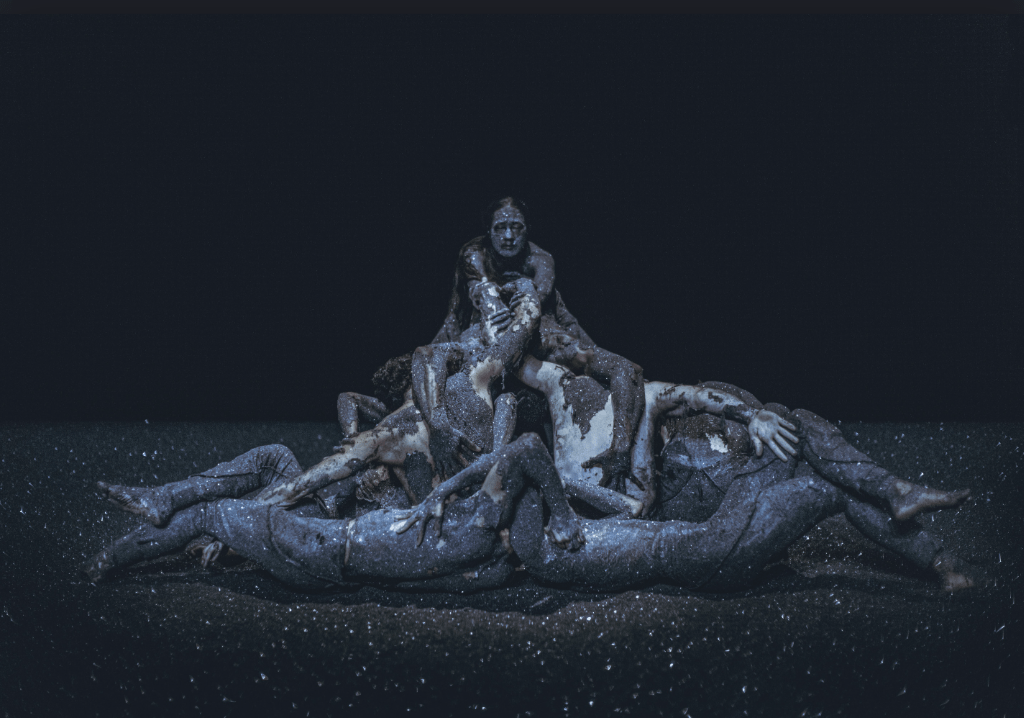

Awe-inspiring, hypnotic dance-installation, that takes audiences on an existential odyssey through a world that’s hostile, hauntingly beautiful, and beyond our control.
Some performances tell stories, but Planet [wanderer] creates a world. Surreal, unnerving, and at times profoundly unsettling, Damien Jalet and Kohei Nawa’s latest collaboration unfolds less like a dance performance than a waking dream. Playing as part of the 2026 Singapore International Festival of Arts, it is a work that asks for patience, and perhaps even submission.
For much of its hour-long runtime, very little appears to happen. Bodies sway, hesitate, repeat. Time stretches, and meaning remains elusive. Yet by the end, it feels as though one has witnessed an entire cycle of existence: awakening, exploration, struggle, adaptation, and eventual surrender.

The work begins in near-total darkness. Before anything can be seen, an ominous booming reverberates through the Esplanade Theatre, so loud that it is felt physically in the body. The sound repeats again and again, evoking distant detonations, the footsteps of giants, or the warning tremors before a volcanic eruption. When the curtain finally rises, visibility remains limited. Light emerges almost imperceptibly, forcing the audience to adjust slowly to the darkness.
It is a remarkable opening gesture that controls how we experience the work. Rather than immediately revealing its world, Planet [wanderer] requires us to acclimatise to it. Like explorers arriving on an unfamiliar planet, we must learn how to see. As our eyes adjust, Kohei Nawa’s extraordinary stage design gradually reveals itself. The stage is covered in what appears to be black sand, though under light it glitters with metallic brilliance, transforming the floor into a shimmering landscape of meteor dust, volcanic ash, and distant starlight. It feels simultaneously prehistoric and futuristic, beautiful and hostile — a world after catastrophe, or perhaps before civilisation altogether.

From this landscape, life begins to emerge. A lone figure, covered in sand and glitter, crawls across the stage. We see movement before we recognise a body. She burrows beneath the surface like a worm or serpent, disturbing the terrain as she moves through it. Elsewhere, what initially appears to be a rock formation gradually reveals itself to be the remaining dancers locked together in stillness. The encounter is difficult to classify. Is it predation, camouflage, or communion? The ambiguity is central to the work’s power. Throughout the evening, bodies continually shift between human and non-human states, becoming creatures, geological formations, and sculptural objects in equal measure.
This fascination with transformation defines Damien Jalet’s choreography. The dancers often appear less like performers executing movement than organisms adapting to shifting environmental conditions. Emerging from pools of white liquid sunk into the stage, they begin one of the evening’s most mesmerising sequences. The pools themselves begin to feel almost alive; bubbling, responsive, at once relaxing and threatening, as though they are entrapped in the zone of comfort. Standing ankle-deep, all facing the same direction, the dancers rock back and forth. At first the motion is gentle. Then it gradually intensifies. Their bodies tilt further and further off centre, testing impossible angles without falling.

The image is hypnotic: reeds bending in violent winds, rooted plants enduring a storm, or inflatable tube figures caught in a relentless draft. The repetition becomes so persistent that it begins to alter perception itself. For some, this may prove frustrating. We are accustomed to performances that escalate, that reward attention with novelty. Jalet does the opposite. He asks us to sit with repetition long enough for it to transform into something else. The dancers cannot escape their circumstances through force, and neither can we.
That frustration eventually gives way to empathy. We begin to recognise the performers’ predicament. They are trapped in a world governed by forces larger than themselves. A beam of light intensifies from one side of the stage like an approaching storm or celestial event. They sway against it, though whether they are resisting, enduring, or attempting to flee remains unclear. What matters is the vulnerability it exposes.

Throughout the evening, we find ourselves increasingly concerned for them. What begins as abstract movement gradually takes on the emotional shape of a survival narrative. Each small advance feels significant, each setback increasingly acute. When one performer finally discovers a way out of their pool and the others gradually follow, the moment arrives with genuine relief.
They move forward, then unexpectedly sink into a collective act of kneeling at the front of the stage. The gesture is loaded with meaning: exhaustion, surrender, and supplication, as though the bodies are asking silently for reprieve. A sharp beeping sound cuts through the space like an alarm, and the lighting resolves into a vast circular frame that seems to organise the stage into a controlled system. The dancers respond instinctively, forming lines and moving in slow motion, as if adapting to instructions we cannot hear, governed instead by something instinctive and inescapable.

A blackout follows almost immediately. Jalet captures something profoundly recognisable about human behaviour: our tendency to advance cautiously into the unknown, always looking to others for reassurance before taking the next step. By now, interpretation itself begins to fracture. What once felt like survival becomes system; what felt like chaos becomes design; what felt like meaning refuses to settle into any single form.
The work’s title offers an important clue. The Greek root of the word planet means “wanderer”, and wandering becomes the central condition of existence within the piece. These figures are explorers, though not triumphant ones. They traverse hostile terrain without maps or guarantees. Watching them, one thinks not only of migrants, travellers, and pioneers, but of humanity’s oldest impulse: the need to venture beyond the horizon despite the risks involved.

There is something deeply moving about that instinct. Whether crossing oceans, climbing mountains, or imagining worlds beyond our own, human beings have always been compelled to explore environments that do not necessarily welcome them. We know the risks and dangers. We proceed anyway.
That tension between curiosity and vulnerability reaches its most powerful expression in the latter half of the performance. The dancers spread across the black landscape, sweeping sand back and forth as waves echo through Tim Hecker’s haunting score. Invisible currents seem to push them backward, transforming the theatre into something fluid and unstable. As light returns, narrative certainty dissolves. Any earlier sense of survival or progression begins to unravel. Mist rises and consumes the stage. Movements expand and fracture as though the dancers have entered open water — at times swimming, at times drowning, always suspended between resistance and surrender.

Knowing that Nawa drew inspiration from the tsunami-ravaged landscapes of Ishinomaki following the 2011 Great East Japan Earthquake lends these images particular weight. One senses throughout the work an awareness of nature’s indifference to human ambition. The black sands evoke volcanic landscapes. The waves suggest tsunamis. The dancers struggle against environments that cannot be negotiated with or conquered. The result is not despair, but humility in the face of impossibility.
This builds towards one of the most extraordinary images seen onstage this year. Returning to the pools from which they first emerged, the dancers are subjected to a torrential rain of viscous white liquid descending from above. Those caught beneath it gradually petrify. Their movements slow as they resist, struggle, and then freeze entirely. The substance clings stubbornly to their bodies, transforming them into living sculptures suspended between motion and stillness. It is an image that lingers long after the performance ends — bodies frozen in time while the rain continues to fall, as though nature itself has outlasted narrative, control, and time.

Whether mortality, fate, environmental catastrophe or the inevitability of time, the work never insists on a single interpretation. Instead, Jalet and Nawa create a theatrical environment spacious enough to hold all of them at once.
Crucial to this achievement is the production’s extraordinary design team. Tim Hecker’s score envelops the theatre in drones, reverberations, and electronic textures that feel at once futuristic and primordial. Yukiko Yoshimoto’s lighting shapes perception with astonishing precision, alternately expanding and constraining the visible world. Light becomes weather, geography, and threat. Together with Nawa’s set, they create an environment that feels less designed than discovered.

By the end, we are taken on an odyssey of emotion. It begins in confusion, passes through frustration and fear, and settles into concern and awe. As audience members, we find ourselves willing these bodies onward, hoping they might survive whatever comes next. Yet Planet [wanderer] is too honest a work to offer easy catharsis. What remains instead is a profound awareness of both humanity’s fragility and its persistence.

When Jalet finally joins his dancers onstage for the curtain call, it feels like the appearance of a visionary who understands something fundamental about movement, restraint, and surrender. In an age obsessed with speed, certainty, and control, Planet [wanderer] asks us to confront their opposites. Simultaneously sobering and beautiful, it reminds us that we are wanderers moving through landscapes we do not fully understand, shaped by forces we cannot command, searching for meaning nonetheless.
Featured Photo Credit: Rahi Rezvani
Planet [wanderer] plays from 29th to 30th May 2026 at the Esplanade Theatre. Tickets and more information available here
SIFA 2026 runs from 15th to 30th May 2026. More information and tickets available here
Production Credits
| Choreography Damien Jalet Set Design Kohei Nawa Performers Shawn Ahern, Francesco FERRARI, Risa Makino, Aimilios Arapoglou, Vinson Fraley, Ema Yuasa, Karima El Amrani, Christina Guieb Music Tim Hecker Lighting Yukiko Yoshimoto Costumes Sruli Recht Sound design collaboration Xavier Jacquot Assistant to the choreography Alexandra Hoàng Gilbert Outside Eye Catalina Navarrete Hernández General management David Thebaut Stage management Youna Boutmin, Jasmine Bouvier and Laurent Lebarbe Lighting control Fabien Bossard and Damien Caris Sound control Orian Arrachart Dressing Mickaël Lecoq and Florence Messé |

