
For Joanna Dong, better known as a jazz vocalist and local musical star, the shift into experimental, interdisciplinary performance isn’t a reinvention so much as a return to something unfinished. Long before she became widely recognised through television and large-scale performances, she was already drawn to work that resisted neat categorisation, pieces that blurred sound, movement, and space into something less easily named. “Going into mainstream formats was actually the detour,” she says now. “This is what I’ve always wanted to do.”
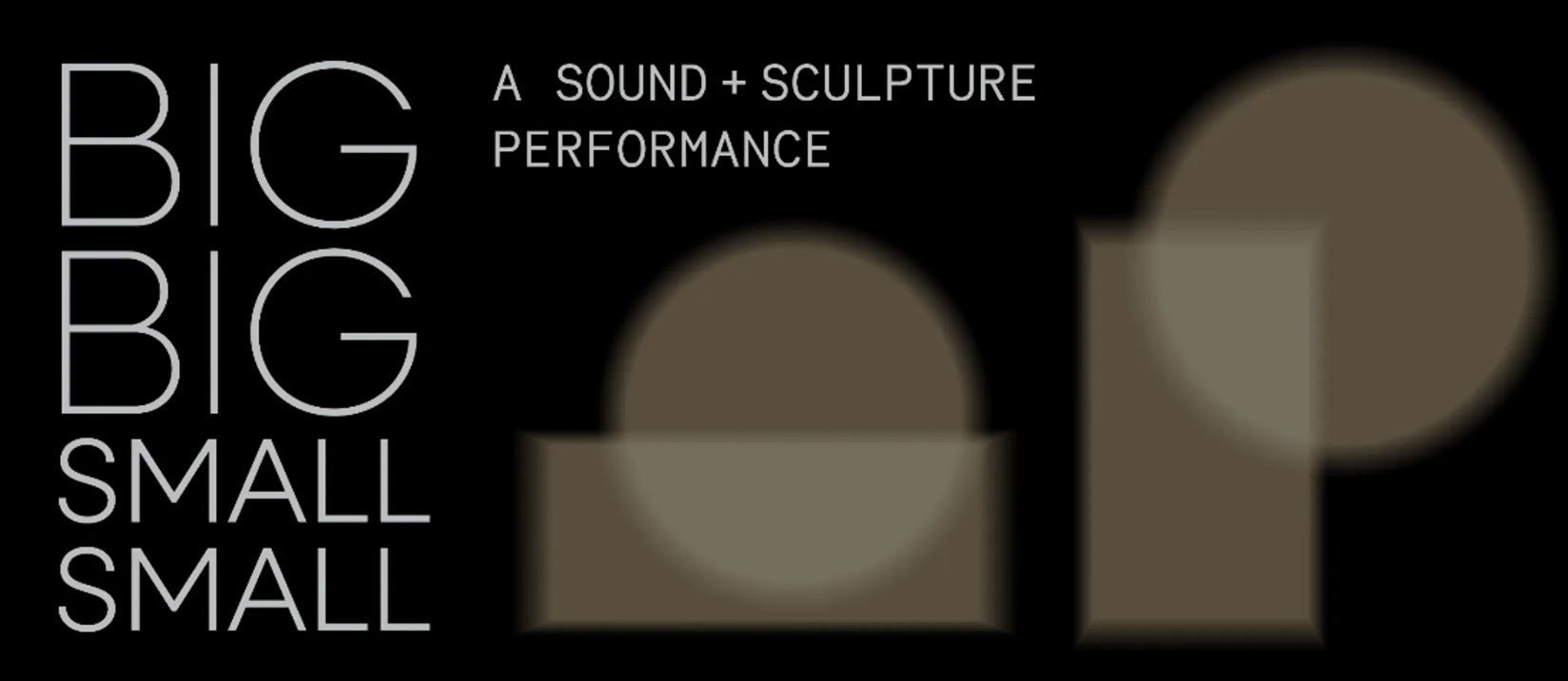
That instinct finds its fullest expression yet in BIG BIG small small, a 40-minute immersive performance that premieres this June at the SOTA Studio Theatre. Created with composer Chok Kerong and visual artist Dawn Ng, the work dissolves the boundaries between concert, installation, and ritual. There is no fixed stage, no seated audience, and no linear narrative. Instead, audiences move through a darkened environment where sound reverberates through sculptural forms, voices emerge and recede, and meaning accumulates through sensation rather than explanation. It is, by design, difficult to describe, and even harder to categorise.
Dong traces this sensibility back to her formative years studying theatre at Victoria Junior College, where she encountered experimental performance for the first time as a theatre studies student. The works she references include artists like Robert Wilson and Meredith Monk, or more recently Transverse Orientation, and what they share is a commitment to atmosphere, abstraction, and interdisciplinary thinking. “We were doing strange things in strange spaces,” she recalls. “Any corner, the more grungy, the better.”

But that early boldness didn’t survive intact into her professional life. As she entered the industry, she became increasingly aware of expectations of audiences, institutions, and the weight of her own growing visibility. “As I got older, I became more afraid of failure,” she says. “And as I became more well-known, I became even more afraid to fail.” A cancer scare two years ago disrupted that trajectory, forcing a reassessment. “It was a wake-up call,” she says simply.
If BIG BIG small small feels unbounded, that’s because it began that way. The project was initiated through a grant application with Kerong, but instead of proposing a defined concept, the trio committed to a process. “We didn’t know what the themes were, what the format would be,” Dong says. When asked by the panel what would anchor the work, her answer was disarmingly blunt: their individual artistic track records. “You just have to trust us,” she recalls telling them. “Our careers are the pillars.”
The grant was approved, somewhat to her surprise, and what followed was more than a year of iterative experimentation, with workshops, improvisations, and conversations that gradually revealed recurring patterns. The cosmic themes that now frame the piece were not imposed from the outset; they surfaced organically, through repetition and instinct. “Every time we worked, certain ideas kept coming back,” she explains. “So we followed them.”
That same openness shaped the formal language of the work. Early exercises were deliberately simple: blindfolded participants navigating space, collaborators generating sound from everyday objects. Over time, these experiments evolved into one of the production’s defining elements, what the team termed “sound sculptures.” Rather than treating visual art and music as separate layers, the team found ways to collapse them into a single system. Sculptural forms are embedded with transducers, allowing them to vibrate and emit sound directly. “The sculptures literally sing,” Dong says. “The material becomes the speaker.” It’s a solution that neither the composer nor the visual artist would have arrived at independently, and one that embodies the project’s core principle: that meaning emerges not from hierarchy, but from interaction.

For Dong, this mode of working also reflects a deeper shift in how she understands her own role. She is notably candid about what she is not. “I’m not a virtuoso,” she says. “I can’t even read music.” But where that might once have felt like a limitation, it has become a point of orientation. “I realised I’m a pluralist, not a specialist,” she explains. “I have a talent for bridging things.” In a process that requires constant translation between disciplines, where there is a need to find connection between sound, image, text, and movement, that ability becomes central. Her contribution is often invisible, existing in the fine calibration of timing, phrasing, and spatial awareness. “It’s like painting with time,” she says. “That’s where I feel my artistry lies.”
The collaborative dynamic itself is deliberately resistant to fixed structures. The three artists do not operate as a formal collective, and there is no single authorial voice guiding the work. Instead, the process is shaped by negotiation, friction, and gradual alignment. “To genuinely understand another practice takes time,” Dong says. “And to respond meaningfully takes time.” Differences in working styles, such as Kerong’s instinctive, rapid composition versus the more methodical approaches of Dong and Ng, become part of the rhythm of creation rather than obstacles to it. What emerges, she suggests, is less a synthesis than a shared intuition. “At a certain level, it’s no longer analytical,” she says. “It’s just feeling.”
That openness extends to the audience experience. BIG BIG small small does not offer a narrative to follow or a message to decode. Instead, it invites audiences into a sensory environment where perception itself becomes the focus. Movement is unrestricted, and proximity is unavoidable. “You don’t need to understand anything,” Dong says. “But it should evoke something.” The only explicit instruction given is a simple phrase: step out of the light and into the dark. It serves less as a directive than as a conceptual anchor, reflecting an underlying philosophy influenced by the Tao Te Ching, an attempt to remain uncontrived even within a constructed framework. “We’re trying not to over-prescribe meaning,” she says. “Even though there’s an irony in building something to achieve that.”
If the artistic ambitions are expansive, the practical realities are equally present. Unlike many of Dong’s previous projects, this production is largely artist-led, from fundraising to logistics. The decision to cap each performance at 50 audience members, an artistic necessity to preserve spatial and sensory clarity, comes at a financial cost. “With more people, it would feel claustrophobic,” she explains. “There wouldn’t be space to breathe.” The trade-off is deliberate, but not without anxiety. “Having full control also means taking full responsibility,” she says. “And that’s terrifying.”

Yet it is precisely this tension between risk and intention, control and uncertainty that defines the project. “The whole point is to do something I would never do with my commercial hat on,” she adds. “This is me putting on my artist’s hat.”
Beyond its immediate presentation, Dong sees the work as part of a broader ecosystem. She hopes it will provoke not only reflection, but also action, particularly among other artists. “I hope people watch this and think, ‘I could have done this differently,’” she says. “And then go and do it.” In a landscape where interdisciplinary work often remains the exception, she is interested in what happens when such approaches become more widespread, more accessible, and less dependent on institutional validation. “I want this to be more of a norm,” she says. “Not something unusual.”
Ultimately, the project circles back to a question that has followed Dong throughout her career: what it means to be seen. If performing for tens of thousands once defined that experience, BIG BIG small small reframes it in more intimate terms. “Fifty people up close is more confronting than fifty thousand,” she says. “You see every expression, feel every reaction.”
The scale may be smaller, but the stakes feel higher. And yet, the underlying challenge remains unchanged. “I’ve always struggled with rejection,” she admits. “That doesn’t go away.” What has shifted, perhaps, is her willingness to sit with that vulnerability rather than avoid it. “The reminder is that I’m worthy of being seen,” she says. “Whether it’s thousands of people, or fifty standing right in front of me.”
BIG BIG small small (work-in-progress) plays from 6th to 7th June 2026 at School of the Arts, Singapore – Studio Theatre. Tickets available here

