
Icon of Singapore’s music scene tells the story of her three ex-husbands through docudrama and song, in a theatrical concert that captures her verve for love, life and all it offers.
There is a word Jacintha Abisheganaden uses early in Lush Life that tells you everything about what kind of evening this will be. Recounting her years performing in Hawaii, where a manager suggested she adopt a stage name because audiences might struggle to pronounce her own, she pauses, and smiles. “Diva.” One word, delivered with the cool assurance of someone who has always known exactly who she is. The audience laughs. But the word hangs in the air long after the laughter fades, because it is not just a punchline. It is the founding myth of the entire show.
Written and directed by Ong Keng Sen for T:>Works and premiering over the final weekend of SIFA 2026, Lush Life is billed as a documentary concert-performance built around the story of Jacintha’s three marriages. Ignore that description. Or rather, hold it loosely. Because what Ong has actually created is something far harder to categorise: a work that behaves less like biography than like memory itself: fragmented, excessive, romantic, self-mythologising, and shot through with a grief it refuses to fully name.

The title comes from Billy Strayhorn’s 1936 jazz standard, and Ong wears his sources openly. Lush Life draws from pop art, surrealism, Dutch vanitas painting, the visual worlds of Magritte, Warhol, and Grace Jones’s legendary Island Life cover. But most of all, it draws from the album covers of Jacintha and Dick Lee themselves; those elaborate, fantastical images that were conceptual artworks in their own right. Jacintha’s 1987 Tropicana cover: a collage of crescent moons, hibiscus blossoms, and a graphic portrait embedded in blue. Her 1991 Dramamama back cover: a photoshopped Jacintha in tiara and feathers, surrounded by tropical flora, a parrot on her shoulder, designed by Dick Lee. Under production designer Elizabeth Mak’s visual imagination, these images become the grammar of the show: surreal, lush, extravagant, and emotionally serious.
Choosing to pare down the staging to let the visuals and performers shine, the stage at Victoria Theatre is almost entirely bare, save for a shimmering fringe curtain that would not look out of place in a jazz lounge, except that here, scaled to theatrical proportions, it becomes a projection screen, and upon it appears Jacintha herself, draped in black, wearing an enormous jewelled necklace, speaking about her own life entirely in the third person. She is not quite a narrator and not quite a character. She is, in the show’s central conceit, a myth observing herself from the outside, speaking in the third person.
Onstage, in the body, is actress Frances Lee as ‘Ja’: a younger incarnation, immediate and embodied where Jacintha onscreen is cool and elevated. The theatrical doubling is more than clever. It articulates something true about the experience of looking back across decades: you see yourself as both participant and observer, inhabiting your own story and hovering above it simultaneously. The older Jacintha mythologises; the younger one experiences. One watches; the other lives out the past.

What makes this division so effective is Thomas Wee’s costuming for Frances Lee with ensemble pieces of startling vivacity: a floral bustier and skirt layered with individually-sewn blooms, a yellow babydoll dress beneath a sheer coat, each outfit capturing a youthful spring that becomes all the more poignant when worn against the narrative. There is a moment when Jacintha recalls waiting an extra month for her wedding dress to be completed, that same freshness, that season of bloom, stretched to its breaking point. The costumes are not just decoration but a chronology of hope and life itself.
The first half moves with the energy of someone who has always followed her heart before her head. Honolulu. A hafu man met on a plane. A career building itself under warm light. A return to Singapore that surprises her by feeling, improbably, like home. The songs, Still Burns from the 1983 Silence LP, and the jaunty Single in Singapore from the Beauty World soundtrack, sketch someone propelled by optimism, by the belief that the next city, the next room, the next person might contain something extraordinary.
But the evening’s most disorienting and most powerful moment comes when the fringe curtain pulls back to reveal that Jacintha has been there all along: live, standing before a green screen, and performing to the camera to generate the projections in real time. The icon is embodied, singing And Then You Came, arriving right after Frances Lee has broken the ice with The Best of Singapore. Her voice arrives with a warmth that is almost physically felt. Not perfect in the way a recording is perfect, a little older, lived-in, but honeyed, carrying decades in every phrase. There is a brief hesitation at the start, a second where she finds her footing and her presence onstage again, and then she settles, and the theatre exhales with her. It goes beyond just a concert performance and feels more like a homecoming to the limelight.

Act Two is where Ong’s visual imagination risks everything and, largely, wins. This is the act that captures her relationship with Dick Lee, the relationship that would become the defining artistic partnership of her life, and Elizabeth Mak’s production design reaches its most audacious here. Flowers bloom alongside skulls. Tropical imagery bleeds into dreamlike collage. The 1987 Tropicana album aesthetic dissolves into vanitas symbolism: hourglasses, rotting fruits, flickering candles. Ong draws directly on the Dutch painters such as Pieter Claesz, Harmen Steenwijck, before playfully leaping centuries to Matisse cutouts, then landing squarely in Magritte. Images arrive faster than they can be processed, and that, it gradually becomes clear, is exactly the point. This is what memory looks like when it is also mythology. Certain moments balloon into enormity; others blur into impressionistic traces. We feel as if we are caught in some kind of surrealistic dream.
The wedding sequence crystallises this. What begins as romantic fantasy mutates, by degrees, into something absurd and faintly terrifying: guests stranded on sampan boats, performances at one’s own ceremony, a wedding night spent watching Rosemary’s Baby. Flowers coexist with mortality. Imagery of busts floating at sea and concealed faces gazing at each other nods to Magritte’s The Lovers. And when Jacintha sings Where’s My Baby, the projections show miniature Dick Lees raining gently from the sky: funny, melancholic, and stranger than anything you expect from a show with the word “documentary” attached to it. The sequence understands that the most formally surreal art can sometimes be the most emotionally accurate.

This act captures, with painful precision, what Ong has described as the central tension of their marriage: that they were perhaps always better suited as artistic partners than as spouses, a marriage of convenience that she mistook for romantic love. The music connected them, and the music, eventually, could no longer hold them as their career paths diverged and their desires grew in different directions.
You think you know all there is to about Jacintha. But when we return from the intermission, the show morphs once again. No projections. No Frances Lee. No excess. Just Dick Lee himself, alone on a bare stage in changing light, telling his side of the story. The decision to strip everything back at this point is among the boldest in the production. For nearly an hour, the audience has lived inside Jacintha’s imagination, seeing her colours, her surrealism, her scale through her eyes. To suddenly find yourself in Dick Lee’s quiet, conversational register carries a genuine disorientation. It is the show’s Rashomon move: neither version contradicts the other, yet each reveals what the other cannot see.

Lee intersperses his songs with conversation and memory. Songs like With Every Day, Love Me The Way I Am, and When I Think of You carry real wistfulness, real specificity. Life at Treetops at Cairnhill in separate apartment units. His mother’s insistence on a wedding at the worst possible time. The work on Nagraland that complicated everything. He does not offer bitterness or revision. He offers something more fragile and more interesting: a person wondering whether different timing might have changed the story. Without the theatrical scaffolding, the emotional stakes arrive with startling clarity. It feels, suddenly, like eavesdropping.
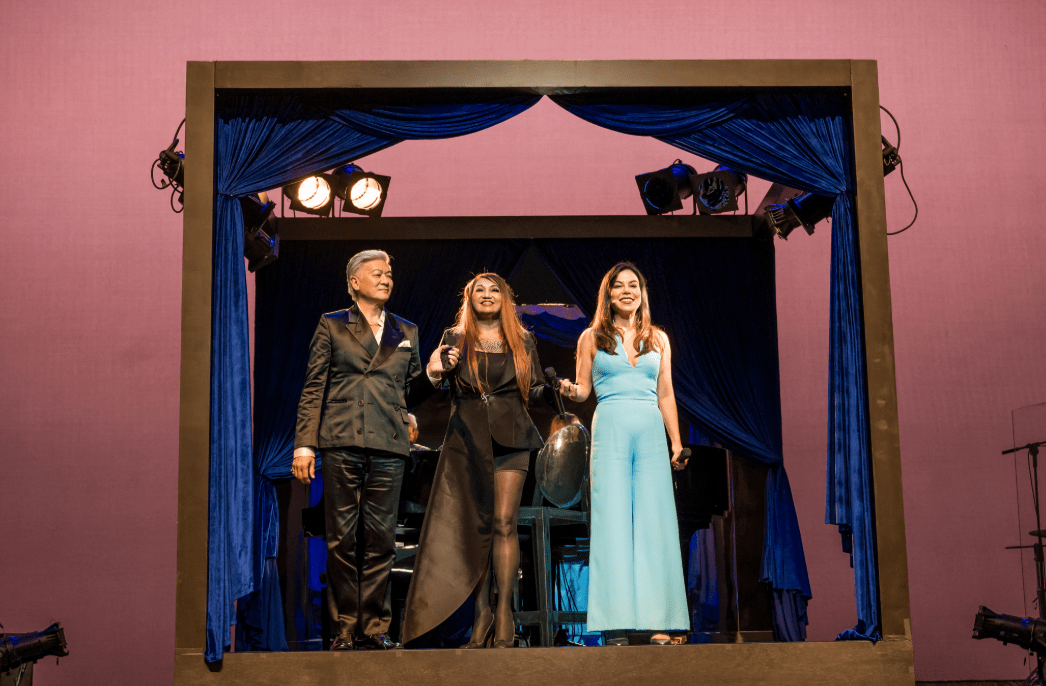
The reunion scene follows inevitably, and yet it still catches you off guard. Jacintha returns, wheeled to the front of the stage on a platform beside a Steinway piano, and the two of them perform It Takes Two. What you witness is not a performance so much as a reckoning. There is visible affection between them, and visible complexity: exes who did not leave on clean terms, who are still, in some way, working out what they are to each other. The love has changed shape. The scars are there. But so is something else: the recognition that this person, across all the difficulty, still matters. It is impossible not to be moved.

The final act, which touches briefly on Jacintha’s third marriage, an abusive relationship, the man not named, the details sparse, makes a pointed editorial choice. It does not dwell or linger for dramatic effect. It passes through, because the point has already been made: Jacintha is not defined by the men she married, and this painful memory is a thing of the past. Instead, what defines her is the work and her self. And so, in the end, that is what we are left with.
Significantly, there are no more Dick Lee songs in the repertoire from here. Every previous act has been shaped by his catalogue where his songs carry her story, his arrangements framing her voice, even his half of the show playing his own compositions. In this final section, that disappears entirely. Jacintha’s rendition of Moon River arrives like a quiet distillation of everything that has preceded it. A song about longing and movement becomes inseparable from a life spent following instinct across continents, relationships and reinventions. It no longer feels like repertoire. It feels like autobiography, shaped by time and experience.
By her final songs, Jacintha no longer sounds like she’s putting on an act, and the myth and the person converge into present reality. Her rendition of Something Cool carries a different weight altogether, showcasing something essential about her artistry. And the rousing final song: Here’s To Life, delivered not for the sake of conclusion but as continuity, a song capacious enough to hold love, loss, ambition, regret and joy simultaneously, without resolving any of it. To hear it after everything the evening has contained is to feel the accumulated weight of a person’s whole life pressing gently against a single melody.

A false curtain call, and then Dick Lee steps forward to announce that Jacintha will have an encore, whether we like it or not. The song of choice: It Wasn’t Meant For Me, another Dick Lee composition from Beauty World. The choice is almost unbearably precise. The song premiered with T:>Works all those years ago with Jacintha in the role; in later restagings, it was Frances Lee who stepped into that same part. Tonight, the two of them have shared this stage, one carrying the memory of the other’s youth, and now, at the very end, Jacintha returns to a song that has already lived multiple lives without her, asking the question she has been circling all evening: Why did I fall in love? Maybe it wasn’t meant for me. It is not a lament, and actually something more open than that, wondering and reckoning held lightly, the sound of someone who has loved and lost, and has ultimately decided that is all right.
Those seated near the front could clearly see Jacintha visibly crying by its final bars. The tears feel neither performed nor incidental. They feel like relief: the relief of a very private person who has spent her career controlling her own image: the diva, the songbird, the icon, finally speaking the fuller version out loud. The abusive marriage. The pain of loss. The things that cost her. The show, for all its surrealism and spectacle, has given her somewhere to put all of that. And she is crying because it is the first time she has been able to, in front of a warm and welcoming audience willing to hear her out.
This is, after all, a rare thing to witness these days: Jacintha Abisheganaden, still onstage, still luminous, still every inch a star enamoured with the spotlight and exactly where she belongs. What makes her so singular is the capacity to inhabit performance fully while still acknowledging the life behind it, the myth and the person, held in the same breath. That her voice still carries that warmth, that her presence still commands a room, is its own kind of affirmation. The controlled narrative, the careful iconography, the surrealist excess: all of it has been, in some sense, about protecting herself even while revealing herself. And in the final curtain call, as she stands beside Dick Lee, you sense two people still figuring out exactly what they are, ex-partners, best friends, collaborators, the complicated residue of a shared life, acknowledging each other with all the emotion that entails, and thinking: ‘maybe it wasn’t meant for me’. There is no tidy bow, only the uneasy, enduring bond of people who made something real together, and have never quite been able to let that go.

Ong Keng Sen has made a work that is at times messy, fearless, occasionally overwhelming, but is grounded in a genuine love for its subjects. Elizabeth Mak’s production design conjures entire emotional registers out of projected light and collaged imagery. Thomas Wee’s ensembles dress Frances Lee in the full splendour of a life lived in colour. And Frances Lee, who disappears before the final act, her younger Jacintha folding back into the past, is a big reason the theatrical conceit feel like a human one.
But Lush Life is, finally, Jacintha’s show. It captures her verve and her vivacity, her talent for opening herself to the world even after everything it has taken from her. Not because she is untouched by disappointment. Not because love always stayed. But because some people possess a stubborn, undying faith in life itself. The belief that another song is worth singing, another city worth loving, another beginning worth risking your heart for. You feel like you have just witnessed someone look back across a life filled with departures, mistakes, passions, losses and impossible choices, and still, somehow, chooses tenderness over bitterness. Still chooses wonder. Still chooses the lush life.
Photos Courtesy of The Arts House Group
Lush Life played from 29th to 30th May 2026 at the Victoria Theatre. More information available here
SIFA 2026 ran from 15th to 30th May 2026. More information available here
Production Credits
| Production T:>Works Writer and Director Ong Keng Sen Creative Producer Traslin Ong Technical Director Andy Lim Production Stage Manager Cindy Yeong Production Designer Elizabeth Mak Fashion Designer Thomas Wee Sound Engineer Shah Tahir Makeup Artist Cecilia Chng Hair Artist Edward Aw Cast Jacintha, Dick Lee, Frances Lee Jazz Pianist Weixiang Tan Music Director and Musician (Keyboards) Xavier Lim Musician (Bass) Russell Seow Musician (Drums) Govin Tan Musician (Guitar) Daryl Khoo Assistant Stage Manager Andrew Ong Assistant Stage Manager Cristabel Ng Sound Technician (Rehearsal) Joel Fernandez Wardrobe Assistant Jean Ho Multimedia Operator Sion Choi Production Design Assistant Yi Lin Ang Production Assistant Maahira Nagri Publicity Photoshoot Vik Lim, James Seow and Rui Liang Documentation Tiny Big Picture, Tan Ngiap Heng, DWKM |


One thought on “★★★★★ Theatre Review: Lush Life by Ong Keng Sen / T:>Works, Jacintha & Dick Lee (SIFA 2026)”