
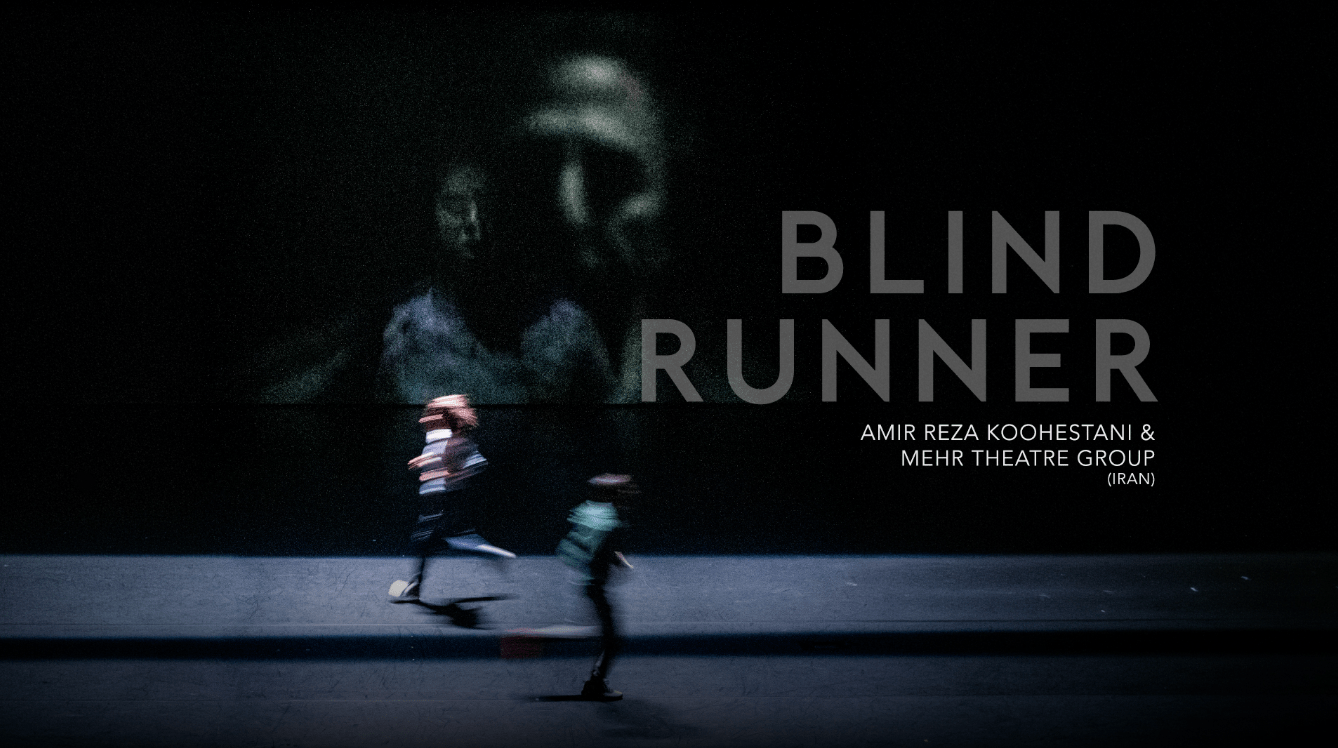

Surveillance cameras watch every interaction. A husband visits his imprisoned wife once a week, their conversations becoming increasingly strained under the weight of constant observation. Elsewhere, he agrees to guide a young blind marathon runner through the streets of Paris, discovering that trust, like freedom, is something built one careful step at a time. In Blind Runner, acclaimed Iranian playwright and director Amir Reza Koohestani weaves these seemingly separate lives into a quietly devastating meditation on oppression, connection and the fragile spaces where hope can still emerge.
Known for his restrained, deeply human approach to political theatre, Koohestani has spent more than two decades creating works that explore the intersection between personal lives and larger systems of power. Blending minimalist staging with live video that echoes the language of surveillance itself, Blind Runner asks how people continue to care for one another when every movement is monitored and every word carries risk. Ahead of the production’s Singapore premiere as part of The Studios: Precarious Bodies, Koohestani speaks about the image that sparked the work, finding politics in everyday moments, and why the smallest acts of solidarity can become the most radical.

Bakchormeeboy: Blind Runner centres on three people whose lives are shaped by surveillance, imprisonment and displacement. What first drew you to telling this particular story?
Amir Reza Koohestani: It started with an image, not an argument. Two runners, tied together by a short band. One sees, one doesn’t. The rules of guide running say they can’t be more than fifty centimetres apart, and the guide must never pull or push. I’d been circling that knot for years without knowing it — care that’s also constraint, closeness that’s also control. Around the image gathered lives I know. A woman measured out in visiting hours, a husband who arrives each week with a little less to say. A young woman who lost her sight in the protests and still wants to run. I didn’t want the interrogation room. I wanted the small talk before the guard says time’s up. The extreme cases are documented, rightly so; the quiet ones disappear, and theatre is good at keeping quiet things.
Bakchormeeboy: The play contrasts confinement with the act of running, something associated with movement and freedom. What interested you about placing these two opposing experiences alongside each other?
Amir: A prisoner counts time. A runner counts distance. Put them side by side, and they’re almost the same activity—surviving a stretch you can’t shorten, step by step. Prisoners run in circles in a courtyard, movement that goes nowhere. A marathon runner covers forty-two kilometres and stops where the officials decide. The opposition isn’t as clean as it looks, and that impurity is what interested me. There’s something personal in it too. After 2009 I started running myself — no trainer, no plan, just to outrun the memory of tear gas. Within a few sessions my leg gave out, and a doctor told me it was over. So I don’t believe running is simply freedom. It’s a negotiation between what you want and what the body, or the state, permits. The play lives inside that negotiation.

Bakchormeeboy: Throughout your work, you often explore political realities through intimate, everyday relationships rather than grand political statements. Why is that approach important to you as a storyteller?
Amir: Because the grand statement is the language of power, and I don’t want to borrow it. Slogans, verdicts, communiqués — they all speak with the same certainty. A couple who no longer know what to say, speaking through a glass partition, speak another language, and that one can’t be confiscated. I also don’t think an audience needs me to tell them what to think about a regime. They arrive knowing. What they may not have felt is how politics enters a kitchen, a phone call, the pause before someone says they’re fine. If I show that pause honestly, the politics is there without being declared. What looks like a private story is often just the political in disguise.
Bakchormeeboy: Blind Runner incorporates live video in a way that echoes surveillance while also bringing audiences closer to the characters. How did you arrive at this theatrical language, and what does video allow you to express that the stage alone cannot?
Amir: Cinema entered my rehearsal room long ago and never left. My theatre thinks in shots as much as in scenes. In Blind Runner the cameras are the kind used for surveillance — the image that watches you is the same image that lets you be seen. That doubleness is the play’s subject, so it had to be its form too. A security camera’s frame and a close-up’s frame are, technically, the same frame. What changes is who is looking, and why. And here’s what I keep coming back to: theatre is the only art form that’s live and virtual at the same time. The body is in front of you, breathing, while its image lives another life on the screen. No other medium lets you watch both at once and feel the gap between them. Video gives me two things the stage alone can’t. The face at the scale of memory — the close-up, the way we actually remember the people we love. And separation. Two performers stand a meter apart, yet on screen one is in a prison and the other in a tunnel. The stage says they’re together; the image says they’re not. I need both truths at once.

Bakchormeeboy: Your work is known for its restraint and minimalism, yet it carries enormous emotional weight. How do you decide what to leave unsaid, and how much do you trust audiences to fill in those gaps?
Amir: I learned elision before I learned dramaturgy. Writing under censorship teaches you that a sentence can be taken away, but a silence can’t. What began as survival became a conviction: the unsaid isn’t an absence; it’s a room I leave open, and the audience furnishes it with their own lives. In practice, I keep cutting until the scene stops breathing. Then I put back the last thing I took out. If a line explains what the situation already shows, it goes. And I trust the audience completely. Everyone out there has waited by a phone, visited someone they couldn’t help, said less than they felt. I don’t need to hand them the emotion — just the exact place where their own fits.
Bakchormeeboy: The play is ultimately about connection, whether between husband and wife, guide and runner, strangers helping one another. In times of oppression or uncertainty, what do you think these small acts of solidarity can reveal about our humanity?
Amir: The rules of guide running are, for me, a small ethics of solidarity. The guide can’t pull, push, or propel the runner; help that replaces the other’s effort gets you disqualified. And if the guide crosses the finish line first, both are out. So, you accompany. You don’t arrive instead of someone. You match your pace to a body that isn’t yours. That’s what solidarity looks like when times are dark—rarely heroic, mostly rhythmic. Someone runs beside you, adjusting their breath to yours, for kilometres, without applause. Freedom, I’ve come to think, isn’t experienced alone; it only means something through connection. These small acts don’t reveal our humanity so much as perform it, daily, at fifty centimetres’ distance.

Bakchormeeboy: You’ve been making work between Iran and exile, collaborating across different countries and contexts. Has living and creating between worlds changed the kinds of stories you feel compelled to tell today?
Amir: It has, though not the way I expected. I thought distance would make me write about Iran from memory. Instead I began writing about the distance itself. Part of my team works in Tehran, part in Europe. A piece has to survive bad connections, lost weeks, scenes built over video calls. I stopped treating that as a production problem and let it enter the plays: people who are close and still can’t reach each other. So the stories that compel me now are stories of the gap. The phone call, the checkpoint, the visiting room, the border that decides more than I do. Blind Runner features two bodies tied together and apart at once. That isn’t a metaphor I invented. It’s, quite literally, how we make our work.
Bakchormeeboy: In a Studios season and programme centred on Precarious Bodies, what do you hope audiences take away from your piece about how we relate to one another?
Amir: Everybody in this play is precarious. Eyes lost to a pellet, a leg that no longer obeys, a body kept behind glass, a body running through a tunnel built for trains. What holds each of them upright is another body, tied on by a short band. Precariousness here isn’t a condition to be cured. It’s the ground where two people find out what they owe each other. I don’t like prescribing what an audience should take away from a theatre. But if something stays, I hope it’s the band itself — the quiet question of who you’re tethered to, whose pace you’re matching, and who’s matching yours. We’re all running with partial sight. The piece is just sixty minutes of noticing the hand at the other end of the rope.
Photo Credit: Benjamin Krieg
Blind Runner plays from 31st July to 1st August 2026 at the Esplanade Theatre Studio. Tickets available here
The Studios 2026 – Precarious Bodies runs from July to September 2026 at the Esplanade. Full programme and tickets available here
 Bakchormeeboy