

A deceptively simple premise of a husband and wife’s relationship torn apart by imprisonment turns into something much more devastating in the face of political activism.
Performance watched on 1 August, 8pm
Duration: 60 minutes
In Iran, where dissent can turn an ordinary life into one shaped by surveillance, imprisonment and separation, freedom is never simply an abstract ideal. In Iranian theatremaker’s Amir Reza Koohestani’s Blind Runner, it is measured in visiting hours, monitored phone calls and the distance between two people who can no longer reach one another as they once did. Written and directed by Koohestani for the Mehr Theatre Group, this restrained and emotionally devastating work finds the political in the intimate, tracing how systems of control can slowly reshape a marriage while asking what it means to keep moving when freedom depends on another person.
Programmed as part of the Esplanade’s 2026 The Studios season, the play begins in darkness, as whispers drift through the theatre before two performers emerge and begin writing on separate black walls. One writes in Farsi, the other in English. Their words initially seem to align, only to shift and diverge through small edits: one version claims the story is based on fact, the other on fiction. It is an odd, understated opening, but one that immediately establishes the fractures at the heart of the work, between truth and narrative, memory and reality, and two people who are slowly drifting apart.

These two are then revealed to be an unnamed husband (Mohmammad Reza Hosseinzadeh) and wife (Ainaz Azarhoush), the latter of whom has been imprisoned after a social media post. They speak on the phone every day, but their only face-to-face contact comes during a tightly regulated 30-minute visit each week. For him, those meetings have become essential: precious fragments of normality that he clings to even as their conversations grow increasingly strained. For her, the visits seem to carry a different weight. She is guarded, dismissive and at times almost callous, responding to his attempts at connection with irritation or indifference. Yet beneath that apparent coldness lies anger, exhaustion and the emotional toll of being confined while the person she loves remains outside.
Their exchanges initially resemble the slow unravelling of a relationship. They bicker, trade dry jabs and circle around what they are unable to say. There is a times even a sharp humour to their deadpan exchanges, but it never fully relieves the sadness beneath them. As much as the wife continually reminds him of the four years eventually coming to an end, the husband’s promise he’ll help her leave earlier, every disagreement feels sharpened by the feeling that their time together is running out, while the surveillance surrounding them makes even ordinary conversation feel constrained. Koohestani does not turn their relationship into a grand metaphor or burden it with political speeches. Instead, he focuses on the small fractures: the pauses, the defensiveness and the growing sense that the couple are no longer moving at the same pace due to the physical and emotional distance.

Then Blind Runner opens out. At his wife’s request, and despite his misgivings, the husband travels to Paris for ten days to guide and compete with Parissa for an upcoming marathon, a young Iranian migrant and former marathon runner who lost her sight after being shot during a demonstration. Bound together by a short tether, guide and runner must learn to move in rhythm, matching their pace and trusting one another completely. Their growing closeness initially raises an uncomfortable question: will the husband, already emotionally distant from his wife, potentially form a romantic attachment to Parissa?
The answer takes the story somewhere far more unexpected. Eventually, after coming in third, Parissa asks him to stay on, but not because she wants a relationship. She needs him for another run: a dangerous attempt to travel through the Channel Tunnel towards England, covering 38 kilometres within the five hours and 35 minutes between the last and first trains. The journey is both an act of protest and an act of solidarity, undertaken in response to legislation threatening the rights of migrants and asylum seekers. What begins as a story about a marriage under strain becomes a much larger meditation on activism, displacement and the risks people take when ordinary avenues towards freedom have been closed.

Yet the political dimension never overwhelms the human one. Even audiences unfamiliar with the specific realities behind the play can recognise the pain of two people trying to sustain a relationship across distance. The husband wants to preserve what remains between them; the wife, imprisoned and increasingly frustrated, seems unwilling or unable to meet him halfway. Their positions gradually reverse as he becomes the one willing to risk everything for a cause, while she questions why he would place himself in danger. The shift is subtle but powerful: the husband who once challenged his wife’s actions now finds himself following a path she cannot understand.
Koohestani’s use of running is particularly striking. It is at once a physical act, a memory, a form of protest and a metaphor for connection. The husband and wife remember running together when they first met in Istanbul, completely together and bonded, and a faint memory in contrast to earlier present-day sequences that place them on separate paths, moving in opposite directions, no longer in sync. Running suggests freedom, but Blind Runner repeatedly complicates that idea. A prisoner runs back and forth. A blind runner can only move forward with someone beside her. A marathon has a fixed route and a finish determined by others. Freedom, the play suggests, is not simply the ability to move, but the ability to move alongside someone else.

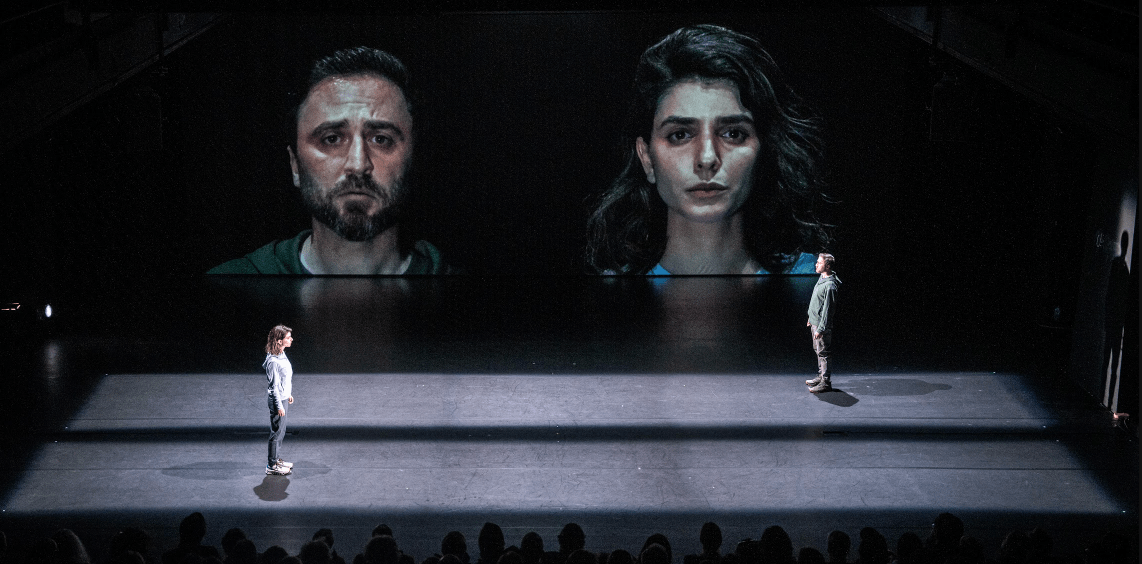
The staging is remarkably spare. A bare stage, cameras, chalk, light and live video create an entire world without unnecessary embellishment. Lighting then becomes a kind of architecture. During the prison visits, the couple occupy a tightly defined square of light. During the running sequences, they move along separate tracks, with the thin darkness between their tracks becoming an almost physical and emotional abyss. The design is minimal, but never empty. Every shift in space feels purposeful, revealing the emotional distance between bodies that remain close enough to see one another.
Live video is used with equal precision. The cameras evoke surveillance, but they also offer intimacy, bringing the performers’ faces close enough for every hesitation and flicker of emotion to register. Black-and-white footage (by Yasi Moradi and Benjamin Kreig) expands the world beyond the stage, while the projected close-ups make private moments feel immediate rather than observed from a distance. The technology never feels decorative; it deepens the play’s central tension between being watched and being seen.
Mohammad Reza Hosseinzadeh gives the husband a quiet, sympathetic presence. He is flawed and at times frustrating, but his determination to keep the relationship alive is deeply affecting. As both the imprisoned wife and Parissa, Ainaz Azarhoush shifts between the two roles with remarkable ease, altering her voice and physicality without making the distinction feel exaggerated. As the wife, she gradually allows the pride and defensiveness to give way to desperation. As Parissa, with eyes closed, she brings a younger energy and urgency to a character whose determination carries the story towards its final, terrifying act.

The play takes its time finding its rhythm, and Koohestani’s restraint and control proves deliberate. By the time the narrative strands are fully revealed, the emotional impact is overwhelming. The final sequence, with both the husband and Parissa entering the tunnel with a camera, as the sound and image of the approaching train emerge, is simple, frightening and deeply affecting. It transforms the abstract idea of risk into something immediate, placing the audience inside the uncertainty of a journey that may end in freedom or catastrophe.
Blind Runner does not shout its politics. It lets oppression reveal itself through a strained phone call, a guarded conversation and the painful distance between people who still love one another but no longer know how to communicate. Its ideas occasionally remain elusive, but its emotional logic is unmistakable. By the end, Koohestani has turned running into a powerful language for care: not carrying someone forward, not taking their place, but matching their pace and refusing to leave them behind, emphasising the risks we take when freedom can only be reached together.
Photo Credit: Benjamin Krieg, courtesy of Esplanade – Theatres on the Bay
Blind Runner played from 31st July to 2nd August 2026 at the Esplanade Theatre Studio. More information available here
The Studios 2026 – Precarious Bodies runs from July to September 2026 at the Esplanade. Full programme and tickets available here
Production Credits
| Text and Direction Amir Reza Koohestani Performers Mohmammad Reza Hosseinzadeh, Ainaz Azarhoush Dramaturgy Samaneh Ahmadian English Translation and Surtitle Adaptation Massoumeh Lahidji Director’s Assistant Dariush Faezi Surtitles Operator Negar Nobakht Foghani Lights and Scenography Éric Soyer Production, Administration, and Promotion Pierre Reis Video Yasi Moradi, Benjamin Kreig Music Philip Hohenwarter, Matthias Peyker Costume Design Negar Nobakht Foghani Blind Runner is supported by The Institut Français and The Ministry of Culture – DRAC Île-de-France. |
 Bakchormeeboy