

When Belgian theatre company Ontroerend Goed first conceived Handle with Care, they knew almost nothing about the performance itself. There were no actors, no technicians, no script, and not even a clear idea of what would eventually be inside the box that sits at the centre of the stage. What they did know was that they wanted to make something they had never made before.
“We sometimes have ideas for theatre shows and go, let’s not do it, because we think we’ve already done that or something similar,” recalls co-creator Samir Veen. “We’re always looking for something new—not necessarily completely new, but always finding a challenge for ourselves.” That impulse led to perhaps the company’s most radical work yet: a performance in which an audience creates the entire theatrical experience for itself. “The idea originated around 2020 or 2021,” he says. “We worked on this show for a very long time, but in snippets.”
The timing proved significant. As the world retreated indoors during the COVID-19 pandemic, Veen and his collaborators found themselves thinking less about theatre than about connection. “Covid was happening, and there was this feeling of isolation all around the world with lockdowns and this impending sense of doom. We were thinking about what ways there are to feel connection with someone who’s not in the same room with us. Yes, digitally—but it was always just mimicking.” Instead, they found themselves asking a deceptively simple question: “How do we connect as human beings with other human beings, even though we never meet them? There’s this societal concept of having to meet someone in order to feel a sort of care for them.”
Around the same time, another source of inspiration emerged from an unexpected place: board games. Not because Ontroerend Goed wanted to make one, but because they became fascinated by the invisible relationship between designer and player. “We love board games; not just games with rules, but games that feel like stories. Not so much I played this and won or lost, but we went to another galaxy yesterday.”
What intrigued them was the idea that someone could spend years crafting an experience that would eventually fit inside a single box. “Someone designs everything in the box and how the rules are supposed to guide you through a system. By following the rules, you experience something. If you don’t, you get lost. Someone designed an experience for you.”
To Veen, that process already felt deeply theatrical. “There’s something theatrical about that. Someone creates an experience years or even decades ago, someone you will never meet, who perhaps doesn’t even speak your language. They put everything into this box, and you take it out and live that experience. It wasn’t about creating a board game. It was about the concept of board games becoming theatre.”
Ironically, creating a performance that relinquishes so much control became the hardest production Ontroerend Goed has ever made. The company has built an international reputation on interactive works, but Veen explains that those performances are often far more tightly controlled than audiences realise. “In our previous shows like LIES, audiences feel they’re the engine of the show, but dramaturgically every performance is exactly the same. It’s about creating the illusion that the audience is in control.”
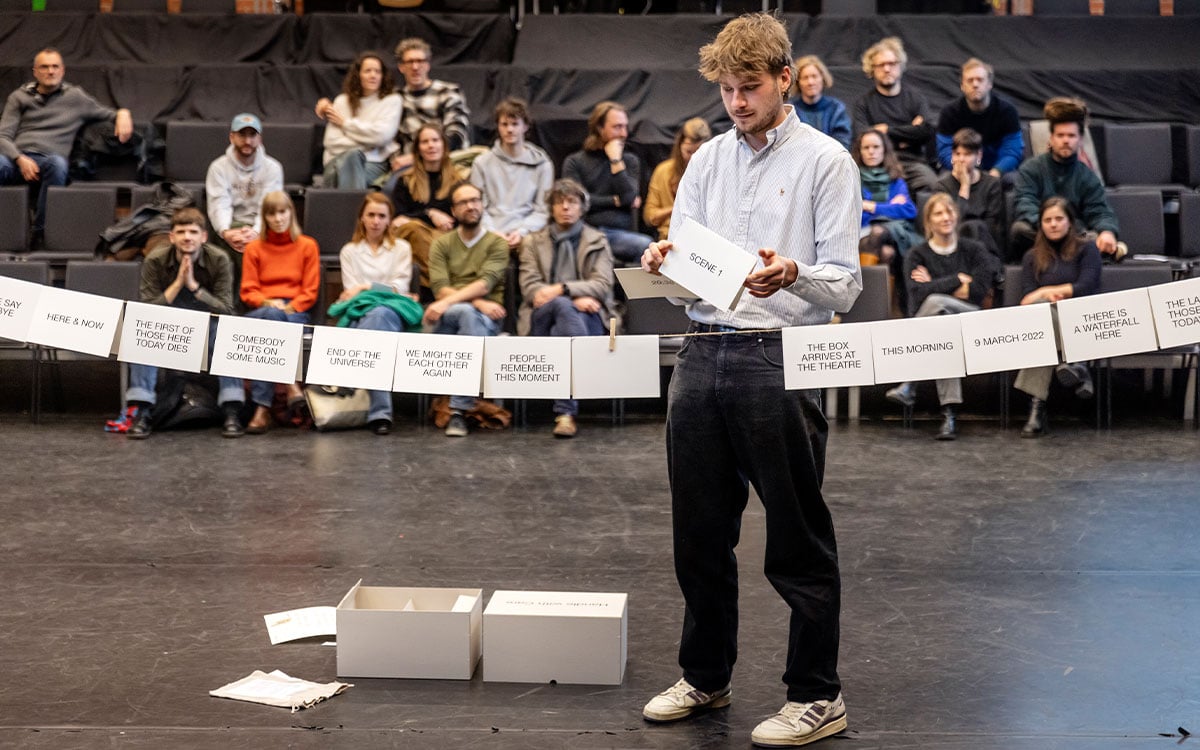
Handle with Care demanded something entirely different. “This is the hardest show we’ve ever done because we really want to control what the audience does. But this time we let it out of our hands much more than in other shows. We’re not there. People can do whatever they want.” He laughs before adding, “They could light the box on fire and leave the theatre. Nothing is preventing them from doing so.”
As it turns out, that wasn’t merely hypothetical. “We had one show where someone took the box outside, set it on fire, made a video, and sent it to us.” Other performances ended after just half an hour, while one stretched to three hours. The company soon discovered that trying to control every possibility only made things worse. “Initially we had very, very precise instructions. But then people just spent all their time reading and trying to execute everything perfectly, and that doesn’t make good theatre.” Instead, they shifted their thinking. “If you give people an end goal and let them figure it out themselves, it’s fun for the people solving it, but it’s also very fun to watch, especially when they come up with really weird solutions. That’s a form of theatre as well.”
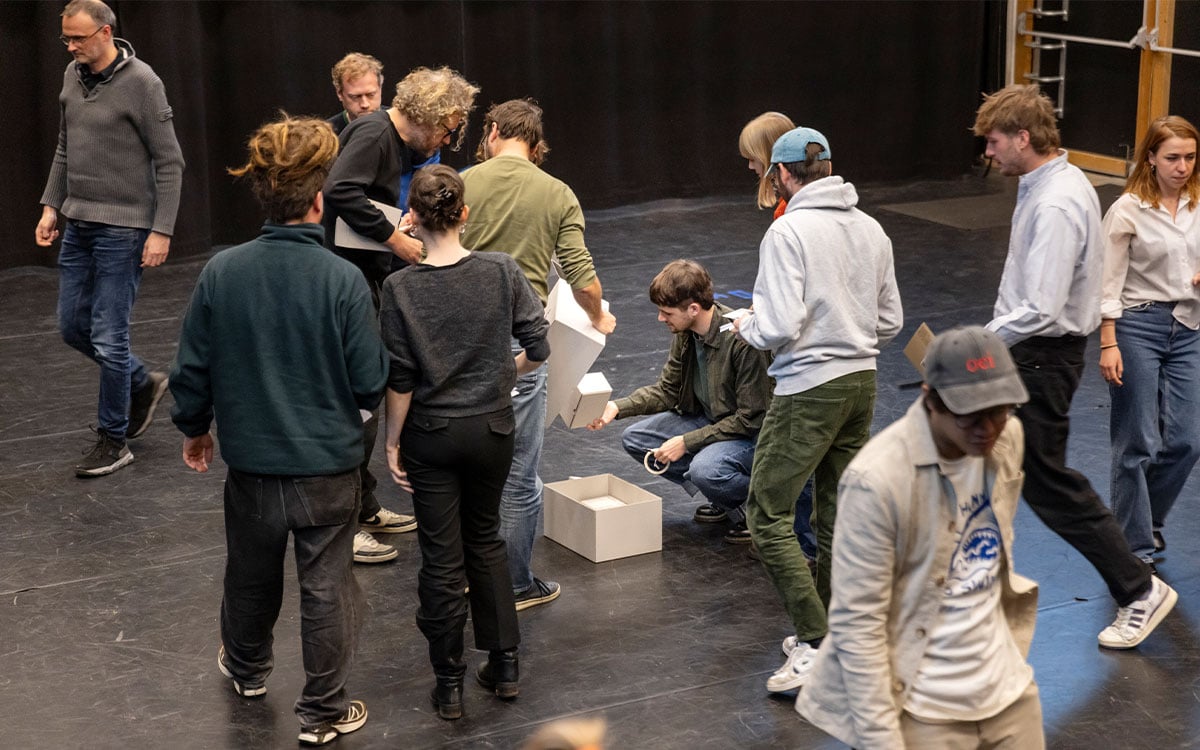
Developing the work became a process of constant experimentation. The creators gathered around tables covered with boxes, paper and prototypes, inviting colleagues and strangers alike to test unfinished versions. Scenes they thought would be brilliant often collapsed immediately. “You write beautiful theatrical text, but then you ask a random audience member to read it and they mumble, and the whole scene falls apart.” One early try-out has become almost mythical within the company. “The ticket was already on everyone’s chair, and from the very first moment a seven-year-old kid ran onto the stage, grabbed the box and threw everything onto the floor. The show lasted three hours.”
Yet rather than treating these moments as failures, they became valuable discoveries. “Thirty people were working together trying to figure out what was supposed to happen. It didn’t entirely make sense, but there was something beautiful about that.” Eventually the team built what Veen describes as “a failsafe” into the design—a hidden blueprint that could gently guide audiences back should they lose their way. Even then, the surprises never stopped. “Every try-out people did stuff we didn’t anticipate. There were moments where people spent forty minutes convinced the box had to be hidden behind a curtain. Nobody had suggested that. They just collectively decided it. People endlessly surprised us.”
Those surprises ultimately revealed something far more profound than ingenious problem-solving. They revealed kindness. “The idea of care came quite early because it’s such an obvious reference in the title,” Veen explains. “But during the try-outs we were touched again and again by how much attention and care people gave, not just to each other, but to the show itself. They genuinely wanted to do their best.” Again and again, strangers instinctively supported one another. He remembers one audience member who was unable to hold a pen because of a disability. “She received an instruction to write something, and she simply said she couldn’t. Immediately an older woman beside her helped her. She dictated while the other woman wrote. Everyone just nodded and adjusted. There was something bluntly loving about that.” It became one of many moments that reshaped the creators’ understanding of the piece. “If you put forty-five people in a room, they don’t immediately start fighting. They start helping each other. That was something incredibly hopeful about humanity.”
For Veen, that spirit of care extends well beyond the walls of the theatre. Living in Amsterdam, he wonders whether increasingly busy lives have made such moments rarer. “I think we gain a lot from being busy, but we also lose something. People aren’t bored together anymore.” He recalls watching teenagers outside his apartment simply spending time together. “They’re just hanging around, kicking cans, teasing each other and being bored together. There’s interaction. Friendship. I think the world would probably be a better place if it were a little less busy.”
Yet he is equally fascinated by the generosity that exists between people who never meet. Searching an online forum for parts for an old car, he found himself overwhelmed by strangers eager to help. “Within a few hours I had so many recommendations. I’ll never know what those people look like. They had absolutely nothing to gain from helping me. But people still go online and help complete strangers. That’s a very moving experience to me.” In many ways, he sees Handle with Care operating on precisely that principle. “There’s us, creating an experience for people we’ve never met. And then there are the people in the room, creating an experience together for one another. They’re two different levels of caring for strangers.”
That philosophy is reflected in the physical object that gives the performance its title. Early versions of the box were solid, sturdy and durable, but something about them felt wrong. “Alexander said, ‘It doesn’t feel right. If you pick up the paper, I want you to feel it’s fragile. It’s precarious. If it’s made of metal, you can throw it around and it feels indestructible.'” The creators deliberately chose materials that felt delicate in the hands. “We wanted people to enter the mindset of caring. We didn’t need them to take care of the material itself. We wanted them to be careful with the show. If people were careless with the material, we felt it would be easier for them to become careless with the experience.” In the end, the fragility of the box mirrors the fragility of the hour audiences spend together. “It’s something that’s easily made—but it can also be easily destroyed. We really wanted every performance to exist as just one box, one unique experience.”
For a company that has spent nearly two decades dismantling theatrical conventions, perhaps Handle with Care is Ontroerend Goed’s most quietly radical work. It doesn’t ask audiences to become actors so much as collaborators, nor does it dictate what they should feel. Instead, it simply creates the conditions for trust, vulnerability and care to emerge. Everything else belongs to the people in the room. As Veen discovered throughout the countless workshops and try-outs, that may be the most unpredictable and hopeful part of all.
Photo Credit: Ans Brys
Handle With Care plays from 7th August to 6th September 2026 at the Esplanade Theatre Studio or Esplanade Recital Studio. Tickets available here
The Studios 2026 – Precarious Bodies runs from July to September 2026 at the Esplanade. Full programme and tickets available here

