
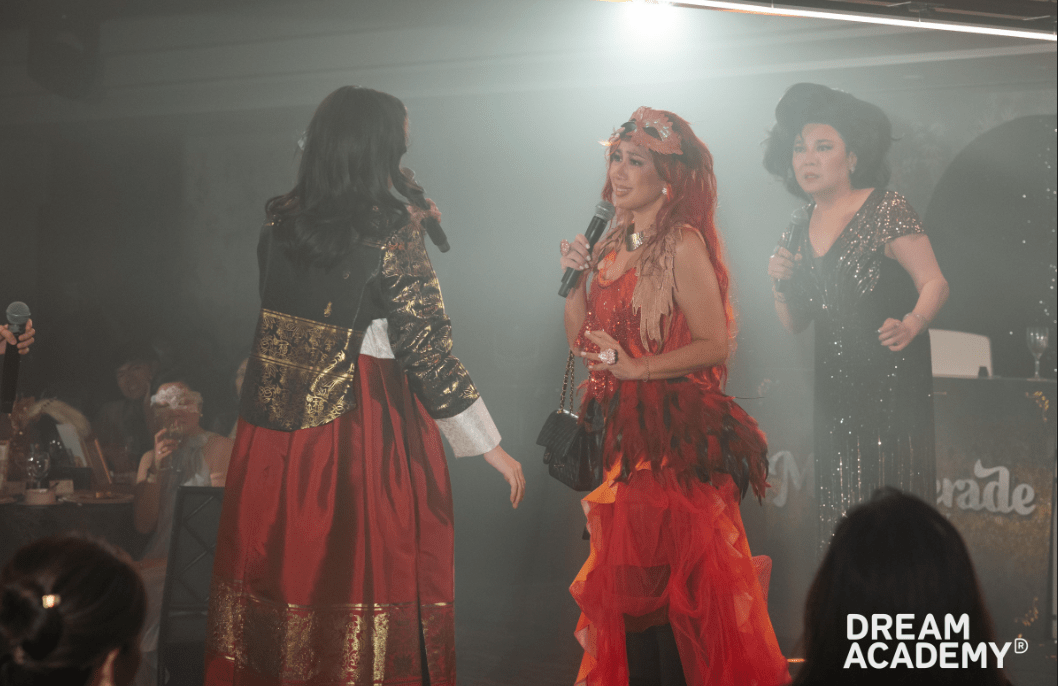
Dream Academy’s sequel to last year’s The Divorce Party satirises soap operas and turns the spotlight on sisterhood, family drama, and absurd corporate parties.
Duration: 2hr20min, inclusive of two food breaks
The dinner theatre format has become increasingly popular, and after the success of The Divorce Party last year, Dream Academy returns for a second round with a direct sequel. Once again written and directed by Selena Tan, with support from assistant writer Sharlene Lim, Choo’s Masquerade Party brings audiences back into the drama-filled Choo family, this time gathering them for a masquerade-themed corporate dinner to celebrate the company’s oddly chosen 78th anniversary.
Where the previous show focused primarily on the romantic woes of eldest daughter Phoebe Choo (Sharon Sum) and ex-husband Andy Sim (Andrew Marko), Choo’s Masquerade Party turns the spotlight to second daughter Phillippa Choo (Eugenia Lee), who has taken over as CEO of the family business, Choo’s Plastics. Best known for tupperware and plastic bags, the company is now being rebranded as Choo’s New Plastique, moving into sustainable, biodegradable plastics and even fashion in an attempt to breathe new life into the family business.

Naturally, no Choo family celebration would be complete without the watchful eye of family matriarch Penelope “Penny” Choo (Sebastian Tan), whose approval is about as difficult to obtain as you’d expect. Add fashion designer The Phoenix (Vernetta Lopez), a growing wedge between Phillippa and her best friend Lilly Hua (Charmain Ho), the return of Phoebe, and an entire ballroom of dinner guests caught in the middle, and there is more than enough combustible material for secrets to start flying.
Guests are invited to don their finest silver-and-gold attire and step into an extravagant masquerade party, once again held at The Capitol Kempinski Hotel Singapore’s Atelier Ballroom. Each guest is also given a lace mask on arrival, intended to set the mood of hidden identities and whispered agendas. Dream Academy has clearly taken lessons from the previous production and made some smart changes to the staging. The Divorce Party frequently sent scenes unfolding around the ballroom, which could be exciting and surprising but also meant that audiences sometimes had to choose between watching one scene and missing another. Here, the action is concentrated around a central runway-style stage, giving everyone a much clearer line of sight and making the overall production feel more cohesive.

The costumes also complement the characterisation nicely, with most of the cast dressed in relatively understated gold-and-silver looks appropriate for an extravagant corporate party. The restraint makes the more flamboyant moments stand out, particularly with Vernetta Lopez’s The Phoenix, a renowned fashion designer who naturally gets to indulge in more adventurous looks. From a tracksuit that Penny promptly dismisses as pyjamas to a more elaborate ensemble befitting her namesake, the costumes become another playful extension of the characters and their personalities.
It also suits the show’s fashion-forward masquerade concept, with the runway becoming a natural focal point for the evening’s parade of increasingly outrageous characters and costumes. There are topless models strutting down the catwalk to showcase Choo’s New Plastique, musical numbers, dance sequences and enough visual gags to ensure that something is almost always happening onstage.

That relentless momentum is one of the show’s greatest strengths. Even when the sprawling narrative occasionally feels as though it is trying to juggle too many characters and storylines at once, the production rarely becomes boring. There is always another reveal, another gag or another character barging into the spotlight, and the cast deserves credit for maintaining that energy throughout a two-hour-plus production while remaining firmly in character.
Sebastian Tan once again steals every scene as Penny, relishing every opportunity to play the ultimate stage mother in drag with impeccable comic timing and a deliciously domineering presence. Tan is particularly enjoyable whenever Penny turns her attention to her daughters, delivering withering reads with a flourish that makes even the most outrageous family confrontation land. Whether singing in English or Hokkien, there is a confidence and theatricality to the performance that makes Penny impossible to ignore.

The rest of the ensemble keeps pace admirably. Charmain Ho brings especially strong energy and characterisation as Lilly, while Vernetta Lopez is a welcome addition as The Phoenix, bringing a suitably cool presence without being afraid to lean into the comedy. Eugenia Lee gives Phillippa the requisite ambition and determination as she attempts to drag the family business into a new era, while Sharon Sum’s return as Phoebe adds another layer of melodrama to an already complicated family tree. Andrew Marko also gives it his all as Andy Sim, bringing his trademark jovial, slightly innocent energy to the role and providing a welcome counterpoint to the increasingly heightened Choo family drama. His chemistry with Sum remains an enjoyable part of their dynamic, with the two able to slip comfortably back into the familiar rhythms of their complicated relationship.
The plot itself is considerably more chaotic than The Divorce Party. Rather than following one central romantic storyline, Choo’s Masquerade Party spreads its attention across the Choo women and their various relationships, touching on sisterhood, inheritance, ambition and the difficulties of escaping an overbearing parent. The feminist slant remains one of the more appealing elements of the Choo saga: beneath all the jokes about plastics, corporate meetings and family squabbles is a story about women trying to define themselves outside the expectations placed upon them.

At times, however, the abundance of ideas can make the narrative feel somewhat disparate. Phillippa initially appears to be the clear protagonist, only for Phoebe’s surprise return, in a hanbok, no less, to divert attention once again. Lilly’s storyline is also given greater room to breathe, while the family business and its proposed transformation provide yet another strand. Essentially, there’s so much going on at any one point in time that it can be a bit of a whirlwind for audiences to keep up with the next big reveal.
Yet this increasingly tangled structure ultimately plays into the show’s soap opera sensibility. When one lets go of trying to make sense of every single family connection, you end up accepting its attempt to go fully absurd with its increasingly ridiculous and confounding “secrets”, and you end up just laughing because of how gloriously convoluted the family tree is, like the best long-running soap operas.

The audience participation, meanwhile, is more restrained than one might expect from an immersive dinner theatre production. Tables are assigned identities such as business associates, family friends or different departments, but these roles do not ultimately have a huge bearing on the story, and only a handful of audience members are called upon to read lines. There are also games, including a word-search-style activity, charades and an inventive lucky-draw variant involving matching cards with another guest.
These moments are fun enough, but they can feel somewhat detached from the main narrative rather than organically integrated into it. For a show that positions its audience as participants in the Choo family’s world, there are stretches where it feels more like traditional theatre with a dinner attached. That creates a little distance between the audience and the action. Still, the central staging largely compensates for this. By keeping the action visible and the energy high, the production maintains a sense of occasion, while the masquerade conceit provides plenty of opportunities for spectacle, surprise and visual comedy.
The two dining breaks are also integrated into the evening’s rhythm. Unlike The Divorce Party, which used a different dining arrangement, this production adopts a buffet format, with guests able to help themselves to live stations and desserts. Standouts include the laksa, mushroom soup and bandung choux pastry. There were some initial issues with quantity and the speed at which guests could move through the buffet, but these are the sort of logistical teething problems that should hopefully settle as the run progresses.

Ultimately, Choo’s Masquerade Party is less interested in being a tightly constructed piece of theatre than in giving its audience a lavish, silly and gloriously melodramatic night out. Its narrative may occasionally be overstuffed, and its immersive elements could be more deeply woven into the story, but the production makes up for this with a committed cast, strong visual staging, infectious energy and a willingness to embrace the sheer ridiculousness of its premise.
Most importantly, it understands that the Choo family’s greatest appeal has never really been about whether their problems make sense. It’s about watching these larger-than-life personalities tear into one another, dressing up family dysfunction as corporate drama and turning every revelation into another excuse for a song, a gag or a spectacular meltdown. With Choo’s Masquerade Party, Dream Academy has taken what worked about The Divorce Party and expanded the world rather than simply repeating it. It is messy, excessive and occasionally chaotic, but when the Choos are at their best, that is exactly the point. For audiences looking for an evening of food, camp, comedy and family melodrama, it’s one party you want to be invited to.
Photo Credit: Dream Academy
Choo’s Masquerade Party plays from 14th August to 4th October 2026 at the Capitol Kempinski Hotel. Tickets available from BookMyShow
Production Credits
| Executive Producer, Writer & Director Selena Tan Assistant Writer Sharlene Lim Choreographer Charmain Ho Art Director TRIPPLE Cast Andrew Marko, Charmain Ho, Eugenia Lee, Zaihar, Phiz Nasrudin, Sebastian Tan, Sharon Sum, Vernetta Lopez |

