
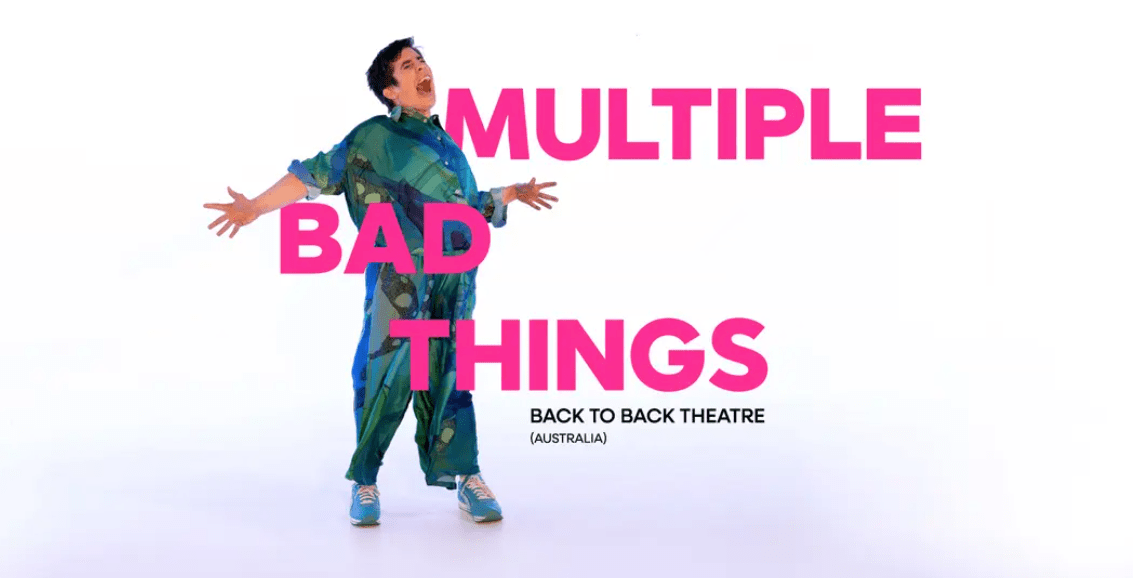
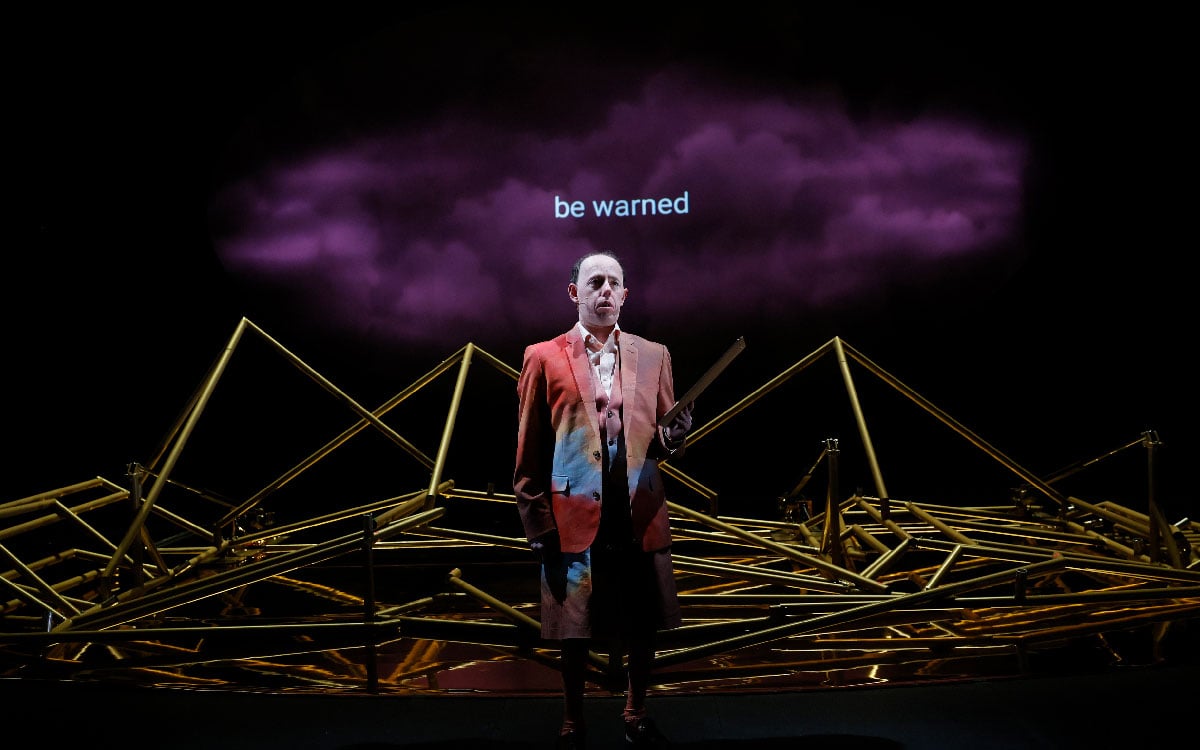
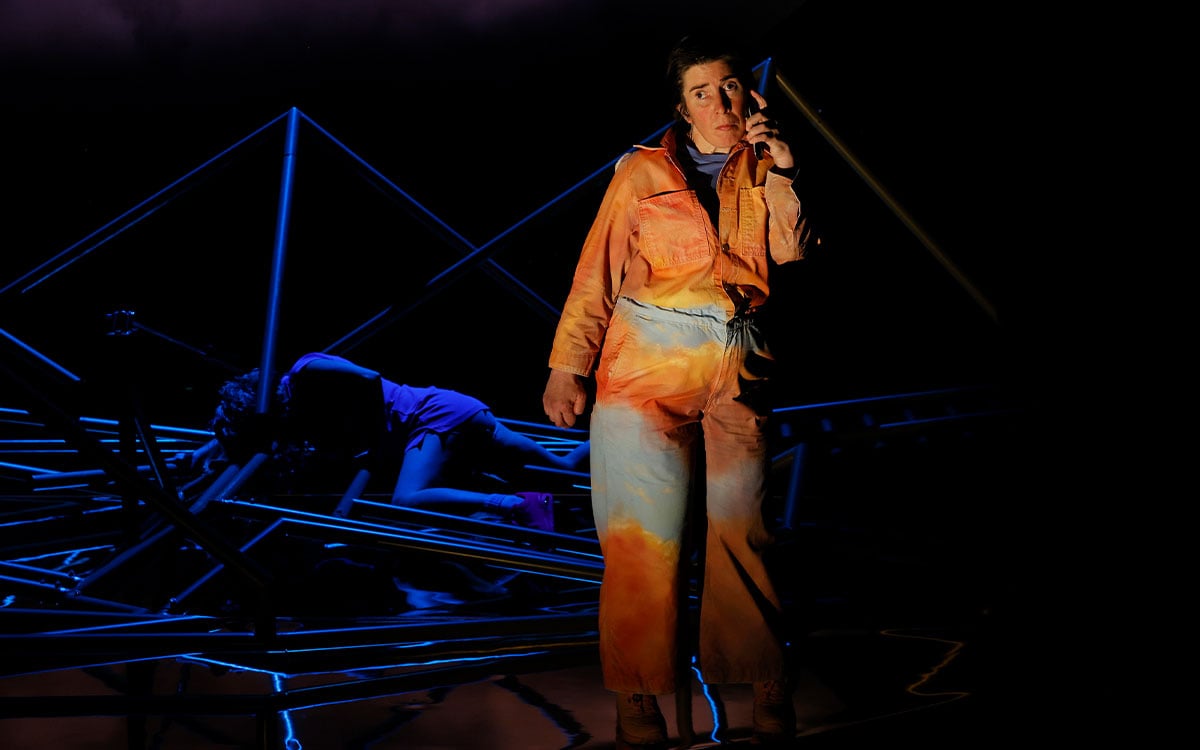
In a placeless warehouse at the end of the world, three employees are given a possibly pointless task. As they struggle to work together, the boundaries between cooperation and conflict begin to fray. What starts with politeness gradually descends into sly victimisation and bad behaviour, while language shifts from playful and absurd to threatening and deadly serious. In MULTIPLE BAD THINGS, award-winning Australian company Back to Back Theatre turns the workplace into a pressure cooker, exposing the familiar ways power operates through exclusion, identity, privilege and the search for someone to blame.
The work may be theatre, but its conflicts feel uncomfortably recognisable. As the employees test the limits of their bodies, their ability to cooperate and their capacity to care, MULTIPLE BAD THINGS asks a deceptively simple question: Are you complicit?
Created through Back to Back’s collaborative devising process with an ensemble of performers who identify as neurodivergent or intellectually disabled, the production interrogates not only the systems that marginalise vulnerable people, but the ways ordinary people can participate in them, often without realising it. Ahead of its presentation in Singapore, Associate Director Ingrid Voorendt speaks about the making of MULTIPLE BAD THINGS, finding humour in dark material, the weaponisation of language, and what happens when even an attempt to create an inclusive game becomes a system of exclusion. Read the interview in full below:
Bakchormeeboy: What was the origin of MULTIPLE BAD THINGS, and what questions did the company want to investigate through the piece?
Ingrid Voorendt: MULTIPLE BAD THINGS initially began with conversations with the ensemble about identity and borders, in response to observing the global refugee crisis. We were in and out of covid lockdowns throughout the early creative development, and the isolation we experienced informed our process. The origin of the work is talking about and creating islands – both metaphorically and literally. We made islands in our bedrooms and living rooms while working with each other on zoom.
Bakchormeeboy: The work places three employees in an increasingly hostile workplace. What drew you to the workplace as a setting for exploring power, inclusion, identity and complicity?
Ingrid: For much of our creative development the work was set in a dystopian, post-crisis environment – a small group of people attempting to create shelter and get along with each other. Tamara Searle (co-director) and I struggled with this setting, it felt too obvious. The shift to a workplace setting happened because we were having parallel conversations about power, inclusion, identity and complicity in our own workplace at Back to Back. We observed that workplaces are often environments where people interact with others who have different opinions, lived experiences, beliefs and political worldviews. This can lead to difficult interactions.

Bakchormeeboy: Back to Back Theatre’s work is developed through a collaborative devising process. How did the ensemble’s different perspectives and lived experiences shape the characters, conflicts and situations that emerged in MULTIPLE BAD THINGS?
Ingrid: The ensemble’s perspectives and lived experiences are inextricably intertwined into the fabric of the work because of who they are, and because of how long we take to make a show. Conversations, experiences, stories, interactions – all kinds of small details get embedded into the work. It’s a bit like making a soup without a recipe, you forget the exact details of what you’ve done, because you kept tasting it and adding a bit of this and a bit of that. The show is made out of people’s perspectives and lived experiences and imaginations, creating layers and layers of fiction and non-fiction.
Bakchormeeboy: The performance moves between humour, absurdity and moments that become genuinely unsettling. How did you work together to find the balance between comedy and menace, particularly when dealing with familiar forms of exclusion and victimisation?
Ingrid: When you’re working with difficult or dark material it’s vital to have a sense of humour. Humour is a coping mechanism for many of us. We made the show during a time when the world felt very uncertain, bleak and frightening, so we needed laughter. The ensemble are committed to theatre as entertainment, so even when the work is political, and is grappling with big questions, they still want to entertain their audience. Laughter is an important part of that. I also find it interesting to present audiences with moments where you want to laugh and at the same time feel that you shouldn’t. Back to Back enjoy being with and staging discomfort!
Bakchormeeboy: Language also seems to become increasingly unstable throughout the work, shifting from playful and funny to threatening and deadly serious. What interests you about the ways language can create, reinforce or disguise power?
Ingrid: We’re interested in the weaponisation of language, and in the ways that threats and abuse of power can be hidden beneath the language of civility and care. We’re also interested in how when people are in extreme states, their language can unravel and reveal hidden aspects of themselves. What lies beneath our civility? There’s an argument in the work between Scott’s character and Bron’s character. Scott’s character loses coherence and says insults that are absurd and also kind of poetic. Bron’s character has the power and the intellectual capacity to use language to trap Scott’s character and gaslight him.
Bakchormeeboy: The set and sound seem closely tied to the performers’ physical participation and the atmosphere of the work, and from the trailer, look phenomenal. How did Anna Cordingley’s design and Zoë Barry’s score influence the devising process and the way the story developed?
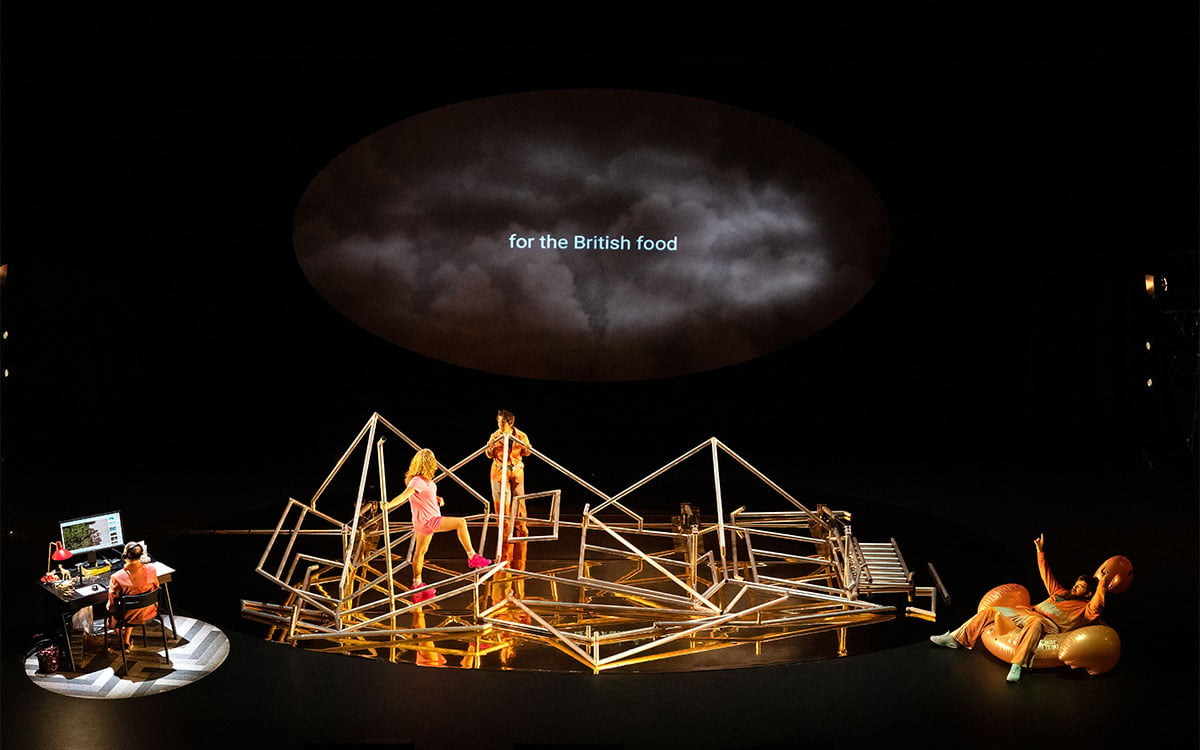
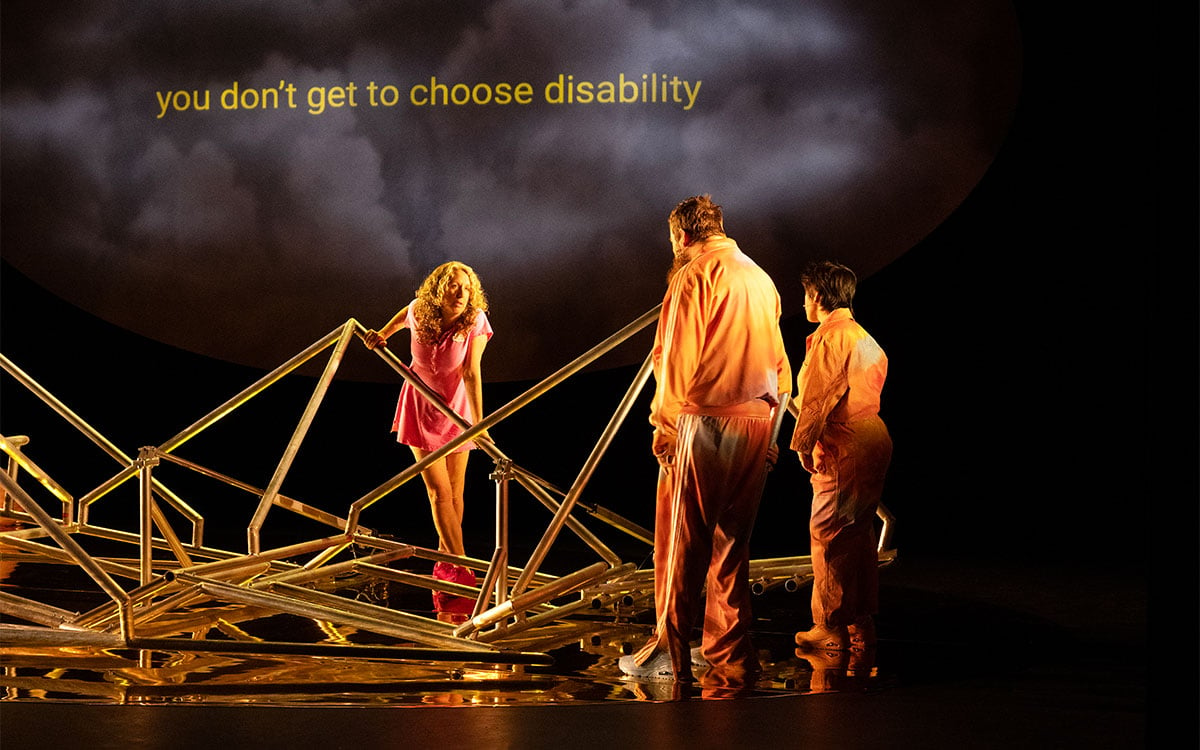
Ingrid: Anna and Zoë are such brilliant designers and it was a pleasure to work with them. Tamara and I knew from the outset that we wanted the actors to have a real, physical task during the show. We began with post-crisis dystopian environments with people were building shelter together on an island. We wanted some sort of structure to be assembled by the actors and Anna really took that on, with stunning results. The starting point for Zoë’s sound design was a prompt to collect the sounds of bad things. There’s a recurring sound in the design that’s actually a stretched out recording of a plastic bag maker! We wanted an unsettling, ominous atmosphere, which Zoë beautifully realised. The hold music Zoë created for Sarah’s character’s phone call also infiltrated the whole show, it is so catchy and absurd.
Bakchormeeboy: The work asks audiences to consider their own complicity in systems of exclusion and power. Was there a particular moment during the making or development of MULTIPLE BAD THINGS when the company surprised you with a different perspective on these questions?
Ingrid: Yes. One afternoon we played a game. We put a cupcake at one end of the room and everyone stood at the other end. If you could demonstrate ways in which you were oppressed by the world and its systems, you could take a step forward towards the cupcake. We were playing this with great enthusiasm until we observed that the people who perhaps needed the most support were not playing. One of them said “I don’t understand the game” which became a line in the show. We realised we had created a game that in itself was inaccessible and a system of oppression.
Bakchormeeboy: In a Studios season and programme centred on Precarious Bodies, what do you hope audiences take away from your piece about how we relate to one another?
Ingrid: I hope audiences take away an invitation to think about listening, about how we listen to other people. It’s easy to talk, it’s much harder to listen to another person. It’s also very hard to drop our defences and our judgements, and to be open to each other. There’s a moment of connection near the end of the show that I interpret as an invitation to be gentle. There’s a fragility to being human. Precarious bodies can be vulnerable. Let’s try to be kind to each other, especially when it’s hard and when we disagree.
MULTIPLE BAD THINGS plays from 21st to 22nd August 2026 at the Singtel Waterfront Theatre. Tickets and more information available here
The Studios 2026 – Precarious Bodies runs from July to September 2026 at the Esplanade. Full programme and tickets available here

